 TutorialKart.com
Data Warehouse Characteristics
A data warehouse is designed for business analysis, reporting, and decision support. Unlike an operational database, it is not mainly used for day-to-day transaction processing. It stores organised historical data from different systems so that users can compare performance across subjects, departments, and time periods.
The four important data warehouse characteristics are subject oriented, integrated, time variant, and non volatile. These characteristics explain how a data warehouse stores data and why it is useful for analytical queries.
- Subject Oriented.
- Integrated.
- Time Variant.
- Non Volatile.
Four Characteristics of a Data Warehouse at a Glance
| Data Warehouse Characteristic | Meaning | Simple Example |
|---|---|---|
| Subject oriented | Data is arranged around major business subjects. | Sales, customers, products, HR, accounts, and marketing. |
| Integrated | Data from different sources is cleaned and made consistent. | Customer codes and date formats are standardised across systems. |
| Time variant | Data is stored with a time element for historical analysis. | Revenue can be compared by year, quarter, month, week, or date. |
| Non volatile | Loaded data is usually stable and not updated like transactional data. | Past sales records are preserved for reporting and trend analysis. |
Subject Oriented Data Warehouse
Data warehouse is a subject oriented database, which supports the business need of individual department specific user.
A subject oriented data warehouse stores data by business area instead of storing it only by application or transaction. This means the warehouse is organised around subjects that business users analyse regularly.
Example : Sales, HR, Accounts, Marketing etc.
- A sales subject area may contain orders, products, customers, sales regions, and revenue.
- A finance subject area may contain accounts, budgets, payments, expenses, and profit measures.
- An HR subject area may contain employees, departments, attendance, salary bands, and performance data.
This subject-based organisation helps managers and analysts focus on business questions instead of searching through many unrelated operational tables.
Integrated Data Warehouse
A DWH is a integrated database, which allows you to collect the data and integrate the data with multiple database sources.
Integration is one of the most important data warehouse characteristics because business data often comes from many different systems. Each source system may use different names, codes, formats, and rules. Before data is loaded into the warehouse, it must be cleaned, transformed, and made consistent.
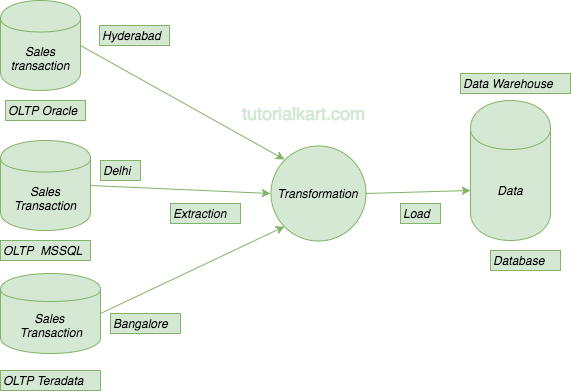
Examples of Data Integration in a Data Warehouse
- One system may store gender as M and F, while another stores Male and Female. The data warehouse should use a standard format.
- One application may store dates as DD-MM-YYYY, while another stores dates as YYYY-MM-DD. The warehouse should use a common date structure.
- Customer names, product codes, currency values, and location names may need standardisation before analysis.
- Duplicate records from different systems should be identified and handled using clear business rules.
Without integration, reports from different departments may show different answers for the same business metric. A properly integrated warehouse reduces this problem by applying common definitions and transformation rules.
Time Variant Data Warehouse
A Data Warehouse is a time variant data base, which supports the business management in analysing the business and comparing the business with different time periods like Year, Quarter, Month, Week and Date.
Time variance means that warehouse data is stored with a time reference. This makes it possible to analyse trends, compare current performance with past performance, and understand how business measures change over time.
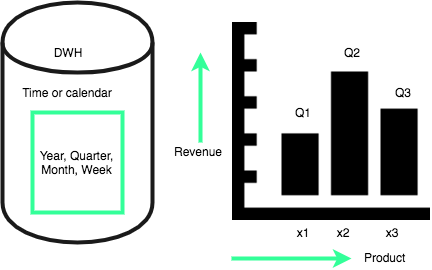
Attributes of Time in a Data Warehouse
- DAY_NAME
- DAY_NUMBER_IN_WEEK
- DAY_NUMBER_IN_MONTH
- DAY_NUMBER_IN_YEAR
- WEEK_NUMBER_IN_MONTH
- WEEK_NUMBER_IN_YEAR
- MONTH_NUMBER
- MONTH_YEAR
- QUARTER_YEAR
- QUARTER_NUMBER
- YEAR
- SESSION
- WEEKEND_INDICATOR_FLAG
- WEEKDAY_INDICATOR_FLAG
These time attributes are often stored in a date dimension table. A date dimension helps users group and filter data by day, week, month, quarter, year, financial period, weekday, weekend, or season.
Non Volatile Data Warehouse
It is non volatile Database, once the data entered into the database, it does not reflects to the change which takes place at operational database. Hence the data is statics in Data Warehouse.
Non volatile means that data in a warehouse is usually loaded, stored, and read for analysis. It is not continuously overwritten by every small operational transaction. Instead of changing historical records directly, a warehouse normally preserves history so that past reports remain meaningful.
- It generates artificially keys or surrogate keys to store the history.
- A surrogate key generated serious of numbers.
- It requires more disk space.
Surrogate keys are commonly used because they help track historical changes. For example, if a customer changes address, the warehouse can preserve the old address for earlier sales and store the new address for later sales, depending on the chosen history management method.
Operational Database vs Data Warehouse Characteristics
The characteristics of a data warehouse become clearer when compared with an operational database. An operational database supports daily transactions, while a data warehouse supports analysis over time.
| Feature | Operational Database | Data Warehouse |
|---|---|---|
| Main purpose | Transaction processing | Reporting and analysis |
| Data focus | Current operational data | Historical and analytical data |
| Data organisation | Application oriented | Subject oriented |
| Updates | Frequent inserts, updates, and deletes | Periodic loading and mostly read-based access |
| Users | Clerks, applications, operational users | Managers, analysts, executives, BI users |
| Queries | Short and transaction-specific | Large, summary-based, and trend-focused |
Core Components That Support Data Warehouse Characteristics
The four characteristics are supported by several data warehouse components. The exact architecture can vary, but most data warehouse systems include the following parts.
- Source systems: Operational databases, CRM systems, ERP systems, files, web applications, logs, and external data sources.
- Data extraction and transformation layer: ETL or ELT processes that extract, clean, standardise, and load data.
- Warehouse storage: Central storage where integrated, historical, and structured data is kept for analysis.
- Metadata and governance: Definitions, lineage, data rules, security settings, and ownership information.
- BI and reporting layer: Dashboards, reports, analytical tools, and query interfaces used by business users.
How the Four Data Warehouse Characteristics Work Together
The four characteristics are not separate ideas in practice. They work together to make warehouse data useful for analysis. Subject orientation gives the warehouse a business structure. Integration makes data consistent. Time variance preserves history. Non volatility keeps that history stable for reporting.
For example, a sales report by year needs subject-oriented sales data, integrated customer and product definitions, time-based sales history, and stable records that are not overwritten by operational changes. If any one of these characteristics is weak, the reliability of reporting can be affected.
Data Warehouse Characteristics FAQ
What are the four characteristics of a data warehouse?
The four characteristics of a data warehouse are subject oriented, integrated, time variant, and non volatile. These characteristics help a warehouse store business data in a consistent and historical form for analysis.
What does subject oriented mean in a data warehouse?
Subject oriented means the data warehouse is organised around important business subjects such as sales, customers, products, finance, HR, or marketing. It is not organised only around individual applications.
Why is a data warehouse called time variant?
A data warehouse is called time variant because it stores data with time references. Users can analyse data by year, quarter, month, week, date, or other time periods to understand historical trends.
What does non volatile mean in data warehousing?
Non volatile means that once data is loaded into the warehouse, it is generally preserved for analysis instead of being frequently changed like data in an operational database. This helps maintain reliable historical reports.
What are common components of a data warehouse?
Common data warehouse components include source systems, ETL or ELT processes, warehouse storage, metadata, governance rules, and BI or reporting tools. These components help collect, organise, store, and present analytical data.
Data Warehouse Characteristics QA Checklist
- The tutorial clearly lists the four data warehouse characteristics: subject oriented, integrated, time variant, and non volatile.
- The explanation distinguishes a data warehouse from an operational database.
- The time variant section explains historical comparison using year, quarter, month, week, and date.
- The integrated database section includes examples of standardising data from multiple source systems.
- The non volatile section explains that warehouse data is mainly preserved for analysis and reporting.
- The subject oriented section gives business-area examples such as sales, HR, accounts, and marketing.
- The FAQ answers match common student questions about data warehouse characteristics and components.