 TutorialKart.com
Julia Tutorial for Beginners
This Julia tutorial introduces the language through installation steps, basic syntax, variables, control flow, functions, collections, packages, plotting, and a complete first program. It is intended for beginners who want a practical path from installing Julia to writing and running useful scripts.
You can follow the topics in order or use the tutorial index to open a specific Julia lesson.
What Is the Julia Programming Language?
Julia is a high-level, dynamic programming language designed for technical computing, numerical work, data analysis, scientific applications, and general-purpose programming. Its syntax is designed to remain readable while allowing programs to compile specialized machine code for the types used at runtime.
Julia supports several programming styles, including procedural, functional, and object-oriented patterns through its type system and multiple dispatch. It also provides built-in support for complex numbers, rational numbers, matrices, Unicode identifiers, parallel computing, and package management.
Where Julia Is Commonly Used
- Numerical and scientific computing
- Data analysis and visualization
- Optimization and simulation
- Machine learning and statistical modelling
- Engineering and mathematical research
- Parallel and distributed computing
- General-purpose scripts and command-line tools
Julia Compared with Python and C
Julia is often considered alongside Python and C because it combines an interactive, high-level programming style with a compiler that can generate efficient native code. The languages are not direct replacements for one another, and the appropriate choice depends on the project.
| Language | Typical strength | Common consideration |
|---|---|---|
| Julia | Numerical computing with high-level syntax and multiple dispatch | Its package ecosystem is smaller than Python’s in some application areas |
| Python | Broad library ecosystem, automation, web development, and data science | Performance-sensitive sections may depend on compiled libraries or extensions |
| C | Low-level control and predictable native performance | Development generally requires more explicit memory and type management |
Julia can also call C and Python libraries when a project needs functionality from another ecosystem.
Install Julia on Windows, macOS, and Linux
Julia can run on Windows, macOS, and Linux. Visit https://julialang.org/downloads/ to find the currently available Julia releases and installation options.
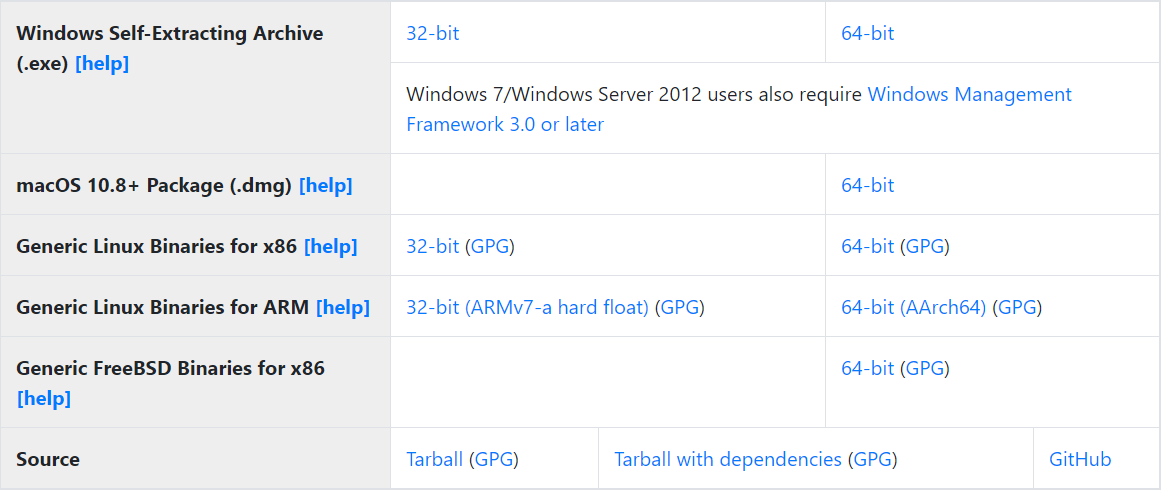
After installation, open a terminal or command prompt and run the following command to verify that Julia is available.
julia --versionThe command prints the installed Julia version when the executable is available on the system path.
Install Julia on Windows
Download the Windows installer suitable for your system from the official downloads page. Run the installer and follow the displayed setup steps. Where the installer provides an option to add Julia to the system path, enabling it allows you to start Julia by entering julia in a terminal.
Depending on the Julia release and installation method, the installation directory and available shortcuts may differ from the older screenshots below.
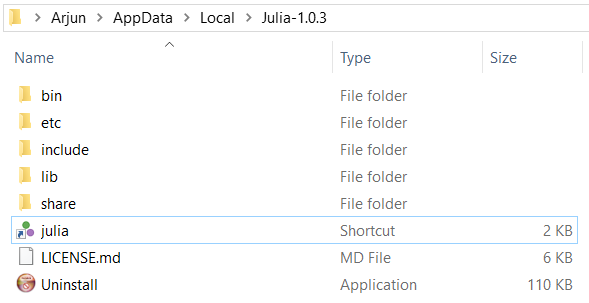
You can open the Julia shortcut when one is created, or start Julia from Windows Terminal, PowerShell, or Command Prompt.
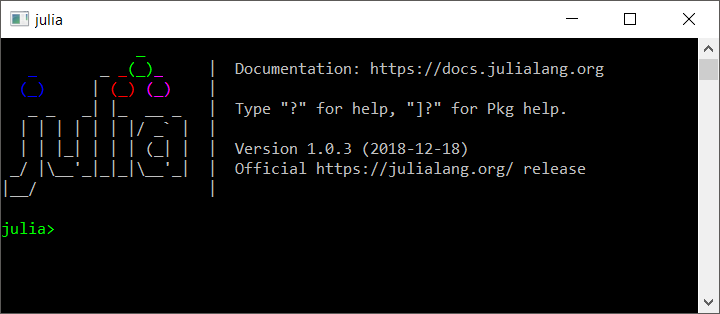
At the Julia prompt, enter a simple expression such as 1 + 2. Julia evaluates the expression and displays the result.
Install Julia on macOS
Download the macOS build that matches the processor architecture of the Mac. Open the downloaded disk image and place the Julia application in the Applications folder. Julia can then be opened as an application or started from a terminal after its executable has been made available on the path.
Install Julia on Linux
On Linux, download the appropriate archive, extract it, and run the Julia executable from its bin directory. To start Julia from any terminal location, add that directory to the system path or create an appropriate symbolic link.
Exact commands depend on the archive name and the directory in which Julia is installed. Follow the instructions supplied for the selected release rather than assuming a fixed version number.
Run Julia in the REPL
Running the julia command without a script opens the Julia REPL, which stands for read-evaluate-print loop. It reads an expression, evaluates it, prints the result, and waits for the next expression.
juliaAt the julia> prompt, try the following expressions one at a time.
2 + 3
sqrt(81)
println("Hello, Julia!")
Press Ctrl+D on many Unix-like terminals or use exit() to leave the REPL.
Write and Run Your First Julia Program
Create a text file named hello.jl. Julia source files normally use the .jl filename extension.
name = "Julia"
println("Hello, $name!")

number = 7
println("The square of $number is $(number^2).")
Open a terminal in the directory containing the file and run it with the Julia executable.
julia hello.jlOutput
Hello, Julia!
The square of 7 is 49.
The example declares two variables, inserts values into strings using interpolation, performs exponentiation with ^, and prints results with println().
Julia Variables and Basic Data Types
A Julia variable is created when a value is assigned to a name. Type annotations are optional for local variables because Julia can determine the type of the assigned value.
count = 12
price = 19.95
language = "Julia"
is_available = true
letter = 'J'

println(typeof(count))
println(typeof(price))
println(typeof(language))
Common Julia data types include integers, floating-point numbers, Boolean values, characters, strings, tuples, arrays, dictionaries, and user-defined composite types.
| Value | Typical Julia type |
|---|---|
42 | Int |
3.14 | Float64 |
true | Bool |
'A' | Char |
"Julia" | String |
[1, 2, 3] | Vector{Int} on a typical system |
Julia Conditional Statements and Loops
Julia uses if, elseif, and else for conditional execution. Blocks are closed with the end keyword.
temperature = 24

if temperature > 30
    println("Hot")
elseif temperature >= 20
    println("Mild")
else
    println("Cool")
end
A for loop iterates over a collection or range, while a while loop repeats as long as its condition remains true.
for number in 1:3
    println(number)
end

remaining = 3
while remaining > 0
    println("Remaining: $remaining")
    remaining -= 1
end
Define and Call Functions in Julia
Functions group reusable operations. A function may be written as a block or as a compact single expression.
function rectangle_area(length, width)
    return length * width
end

square(number) = number^2

println(rectangle_area(8, 5))
println(square(6))
Julia’s multiple-dispatch system selects a method according to the types of all positional arguments. You can therefore define several methods with the same function name for different argument types.
describe(value::Int) = "Integer: $value"
describe(value::String) = "Text: $value"

println(describe(10))
println(describe("ten"))
Work with Julia Arrays, Tuples, and Dictionaries
Arrays store ordered collections and are indexed from 1 by default. This differs from languages such as Python, Java, and C, which commonly begin indexing at zero.
scores = [82, 91, 76]
push!(scores, 88)

println(scores[1])
println(sum(scores))
println(length(scores))
Tuples are fixed-size ordered collections. Dictionaries associate keys with values.
coordinates = (10, 20)
student = Dict("name" => "Mira", "score" => 91)

println(coordinates[2])
println(student["name"])
Install and Use Julia Packages
Julia includes the Pkg standard library for adding, removing, updating, and managing packages. Package operations can be performed from Julia code or through package mode in the REPL.
The following example adds a package from Julia code. Replace Example with the package required by your project.
using Pkg
Pkg.add("Example")
After a package is installed in the active environment, load it with using or import.
using PackageNameFor reproducible projects, activate a project-specific environment before adding dependencies.
using Pkg
Pkg.activate(".")
Pkg.add("Example")
This creates or updates environment files in the current project directory so that its dependencies can be recorded separately from other Julia projects.
Read Data and Calculate a Summary in Julia
The following small program demonstrates a typical data-processing flow without requiring an external package. It stores observations in an array, calculates summary values, and filters the data.
measurements = [12.4, 11.8, 13.1, 12.9, 11.6]

average = sum(measurements) / length(measurements)
minimum_value = minimum(measurements)
maximum_value = maximum(measurements)
above_average = filter(value -> value > average, measurements)

println("Average: $average")
println("Minimum: $minimum_value")
println("Maximum: $maximum_value")
println("Above average: $above_average")
Output
Average: 12.36
Minimum: 11.6
Maximum: 13.1
Above average: [12.4, 13.1, 12.9]
Larger data-analysis projects commonly use packages for tabular data, statistics, file formats, and visualization, but the underlying Julia language features remain the same.
Julia Plots and Data Visualization
Plotting in Julia is normally provided through packages. After installing a suitable plotting package, a program can create line charts, scatter plots, bar charts, and other visualizations. Package APIs and supported backends vary, so consult the documentation for the package selected by the project.
The tutorial index below includes lessons on basic Julia plots and saving a plot as a PNG or JPEG image.
Julia Tutorial Index
- Julia Variables
- Julia Comments
- Julia Conditional Statements
- Julia if-else
- Julia Loops
- Julia Operators
- Julia Arithmetic Operators
- Julia Bitwise Operators
- Julia Relational Operators
- Julia Increment and Decrement
- Julia Mathematical Operators
- Julia Square Root
- Julia Cube Root
- Julia Hypotenuse
- Julia Exponential
- Julia Logarithm
- Julia Trigonometric Functions
- Julia Plots
Recommended Order for Learning Julia
- Install Julia and become familiar with the REPL.
- Learn variables, primitive values, strings, and operators.
- Practise conditions,
forloops, andwhileloops. - Write reusable functions and understand multiple dispatch.
- Work with arrays, tuples, dictionaries, and comprehensions.
- Learn modules, package environments, and dependency management.
- Build small scripts for files, numerical calculations, or data analysis.
- Study performance techniques only after the program is correct and measured.
Common Julia Beginner Mistakes
- Starting array indexes at zero: Julia arrays normally begin at index
1. - Forgetting
end: Functions, loops, conditionals, modules, and several other blocks end with theendkeyword. - Using
*for every array operation: Matrix multiplication, element-wise multiplication, and scalar multiplication are different operations. Element-wise forms commonly use a dot, such as.*. - Modifying a value without noticing the exclamation mark convention: Function names ending in
!conventionally indicate that an argument may be changed in place. - Installing every package in one global environment: Project-specific environments help keep dependencies reproducible and isolated.
- Optimizing before measuring: First write correct code, then profile the relevant workload before changing code for performance.
Julia Tutorial Frequently Asked Questions
Is Julia easy for a beginner to learn?
Julia’s basic syntax is approachable for learners who already know Python, MATLAB, R, or another programming language. New programmers can also learn it as a first language, although concepts such as multiple dispatch, parametric types, broadcasting, and package environments require additional study.
How should I start learning Julia programming?
Install Julia, practise expressions in the REPL, and then write small .jl scripts covering variables, conditions, loops, functions, and arrays. After learning the core language, create a project environment and build a small application related to numerical computing, data processing, or another area you already understand.
Is Julia better than Python?
Neither language is universally better. Julia is designed around technical computing, multiple dispatch, and native-code compilation. Python has a larger general-purpose ecosystem and is widely used for web applications, automation, machine learning, and data work. The better choice depends on required libraries, team experience, deployment constraints, and performance needs.
Can Julia call Python or C code?
Yes. Julia provides direct mechanisms for calling C-compatible functions, and packages are available for working with Python. Interoperability allows a Julia project to reuse established libraries instead of rewriting every component.
Which editor can be used for Julia programming?
Julia source files can be written in any text editor. An editor with Julia language support can additionally provide syntax highlighting, code completion, integrated execution, formatting, and debugging. The Julia REPL is also useful for testing short expressions while developing a program.
Julia Tutorial Editorial QA Checklist
- Confirm that installation guidance does not depend on an obsolete Julia version number or installer layout.
- Verify that every Julia block uses valid syntax and closes each structured block with
end. - Check that examples use one-based indexing when accessing Julia arrays.
- Distinguish scalar, matrix, and element-wise operators correctly in numerical examples.
- Use project environments in package-management examples where reproducibility matters.
- Mark terminal commands, Julia source code, and program output with their correct PrismJS classes.
- Avoid claiming that Julia is always faster than another language; performance depends on code, types, libraries, compilation, and workload.
- Retest package examples when package APIs or recommended installation practices change.