 TutorialKart.com
What is a Data Mart?
A data mart is a smaller, subject-oriented data store created for a specific department, business function, or user group. It usually contains selected data from an enterprise data warehouse or directly from operational systems so that users can analyse one business area such as sales, finance, marketing, inventory, or customer service.
In simple terms, a data mart gives a focused set of users the data they need without making them search through the entire enterprise data warehouse. For example, a sales data mart may contain sales orders, products, customers, territories, and revenue measures required by the sales team.
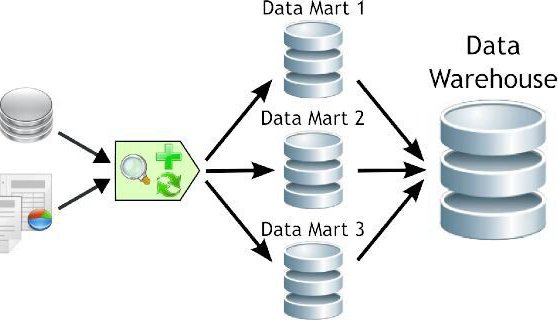
Data Mart Definition in Data Warehousing
In data warehousing, a data mart is designed around one subject area instead of the complete organisation. It stores cleaned, organised, and often summarised data so that business users can run reports, dashboards, and analytical queries more easily.
A data mart may be created from an enterprise data warehouse, from source systems, or by combining both approaches. The design depends on the organisation’s reporting needs, existing data architecture, data governance rules, and performance requirements.
Data Mart Example for a Sales Department
Consider a company that has separate systems for orders, customers, products, and payments. The enterprise data warehouse may store data from all departments. A sales data mart can extract only the sales-related data and organise it for questions such as:
- Which region generated the highest revenue this quarter?
- Which products are selling well in each territory?
- Which customers have repeated purchases?
- How does actual sales performance compare with targets?
This focused structure helps sales managers and analysts work with relevant data instead of navigating the full enterprise data warehouse.
Difference between Data Mart and Data Warehouse
| Data Mart | Data Warehouse |
|---|---|
| Represents a single subject area such as sales, finance, or marketing. | Integrates data from multiple subject areas across the enterprise. |
| Usually serves a department, team, or specific user group. | Usually supports organisation-wide reporting and strategic analysis. |
| Stores a smaller and more focused set of data. | Stores a larger and more comprehensive set of enterprise data. |
| Can be faster to design and easier for business users to navigate. | Takes more planning because it must support many business functions. |
| May depend on a data warehouse or may be built independently. | Acts as the central integrated repository in a data warehousing architecture. |
The main difference is scope. A data warehouse provides an integrated enterprise view, while a data mart provides a focused view for a specific business need.
How a Data Mart Works in a Reporting System
A data mart usually receives data through an extract, transform, and load process. Data is selected from source systems or a data warehouse, cleaned and transformed, and then loaded into the data mart in a structure suitable for analysis.
- Identify the business subject: Choose the area the data mart will support, such as sales, finance, or HR.
- Select required data sources: Pick the source tables, files, applications, or warehouse tables needed for analysis.
- Transform the data: Clean records, standardise values, calculate measures, and prepare dimensions.
- Load the data mart: Store the prepared data in fact and dimension tables or another analytical model.
- Connect reporting tools: Allow dashboards, BI tools, or analysts to query the data mart.
Top-Down Data Mart Approach by Inmon
According to the top-down approach associated with W. H. Inmon, an enterprise data warehouse is designed first. Department-specific data marts are then created from the enterprise data warehouse.
In this approach, the data mart depends on the central warehouse. This helps keep definitions, dimensions, business rules, and historical data consistent across departments.
Bottom-Up Data Mart Approach by Kimball
According to the bottom-up approach associated with Ralph Kimball, department-specific data marts are designed first and then integrated through conformed dimensions to support an enterprise data warehouse architecture.
In this approach, business value can be delivered one subject area at a time. The important requirement is that shared dimensions, such as customer, product, and date, are designed consistently so that data marts can work together.
Types of Data Mart
The three common types of data mart are dependent data mart, independent data mart, and hybrid data mart.
- Dependent Data Mart: A dependent data mart is created from an enterprise data warehouse. It uses the warehouse as its main source and follows central data definitions and governance rules.
- Independent Data Mart: An independent data mart is built directly from operational systems or external sources without depending on an enterprise data warehouse. It can be faster to create, but it may create inconsistent definitions if not governed carefully.
- Hybrid Data Mart: A hybrid data mart combines data from an enterprise data warehouse and other source systems. It is used when a department needs both centrally governed data and additional local data.
Dependent Data Mart vs Independent Data Mart vs Hybrid Data Mart
| Type of Data Mart | Main Source | Best Used When | Main Risk |
|---|---|---|---|
| Dependent data mart | Enterprise data warehouse | The organisation already has a reliable central warehouse. | Changes may depend on the warehouse team and central architecture. |
| Independent data mart | Operational systems, files, or external sources | A department needs a focused reporting solution quickly. | Different departments may create different definitions for the same metric. |
| Hybrid data mart | Warehouse data plus other data sources | A department needs both governed enterprise data and additional local data. | Data integration and ownership rules must be clearly managed. |
Data Mart Features in Business Intelligence
- It is focused on one business subject or department.
- It contains less information than a full enterprise data warehouse.
- It is easier for business users to understand and navigate.
- It can be designed for specific dashboards, reports, and analytical queries.
- It can fit within departmental budgets when the scope is controlled.
- It may store historical data needed for trend analysis.
Data Mart Advantages for Department-Level Reporting
- Focused analysis: Users work with data related to their department or subject area.
- Faster access: Queries can be faster because the data set is smaller than a complete warehouse.
- Simpler navigation: Business users do not need to understand the complete enterprise data model.
- Quicker implementation: A limited subject area can usually be designed and delivered faster than an enterprise-wide solution.
- Relevant security: Access can be restricted to the department or user group that needs the data.
Data Mart Disadvantages and Common Risks
- No complete enterprise view: A data mart may not show the full picture of the business.
- Duplicate data: Multiple data marts can store similar data in different places.
- Inconsistent definitions: Independent data marts may define revenue, customer, profit, or region differently.
- Maintenance effort: A large number of data marts can become difficult to manage.
- Scalability issues: Data volume, user growth, and complex queries may require redesign if the mart was built for a small scope only.
Data Mart, Data Lake, and Data Warehouse Comparison
A data mart should not be confused with a data lake or a data warehouse. These systems can work together, but they serve different purposes in a data architecture.
| System | Purpose | Typical Data | Typical Users |
|---|---|---|---|
| Data mart | Focused reporting for one subject area. | Cleaned, selected, and structured data. | Department managers, analysts, and BI users. |
| Data warehouse | Enterprise-level integrated reporting and analysis. | Cleaned and structured historical data from many departments. | Executives, analysts, data teams, and business leaders. |
| Data lake | Large-scale storage for raw or semi-processed data. | Structured, semi-structured, and unstructured data. | Data engineers, data scientists, and advanced analytics teams. |
When to Use a Data Mart
A data mart is useful when a department needs reliable reporting for a clearly defined subject area. It is especially suitable when users need repeated analysis on a known set of metrics, dimensions, and filters.
- Use a sales data mart for revenue, targets, products, customers, and territories.
- Use a finance data mart for budgets, expenses, accounts, and profitability.
- Use a marketing data mart for campaigns, leads, conversions, and channel performance.
- Use an inventory data mart for stock levels, suppliers, warehouses, and reorder analysis.
A data mart may not be the right choice when the organisation needs a single enterprise-wide source of truth first. In that case, the data warehouse design and governance model should be planned carefully before creating several department-specific marts.
Data Mart Design Checklist
- Define the exact department, subject area, and reporting users.
- List the metrics and dimensions required by the users.
- Confirm whether the data mart will be dependent, independent, or hybrid.
- Use consistent definitions for shared business terms such as customer, order, revenue, and date.
- Plan data refresh frequency based on reporting needs.
- Apply access control so that users see only the data they are allowed to use.
- Document source systems, transformation rules, and ownership of the data mart.
Data Mart FAQ
What is a data mart in simple words?
A data mart is a smaller data store created for one department or business subject. It gives users a focused set of data for reporting and analysis instead of giving them the entire enterprise data warehouse.
What is a data mart vs data warehouse?
A data mart covers one subject area, while a data warehouse covers many subject areas across the organisation. A data mart is usually smaller and easier to use, while a data warehouse provides a broader integrated view.
What are the three types of data mart?
The three common types of data mart are dependent data mart, independent data mart, and hybrid data mart. A dependent data mart is created from a data warehouse, an independent data mart is created directly from source systems, and a hybrid data mart uses both warehouse and non-warehouse sources.
How does a data mart work?
A data mart works by collecting selected data from source systems or a data warehouse, transforming it into a useful analytical format, and making it available to business users through reports, dashboards, or BI tools.
Is a data mart always created from a data warehouse?
No. A dependent data mart is created from a data warehouse, but an independent data mart can be created directly from operational systems or external data sources. A hybrid data mart can use both types of sources.
Data Mart Tutorial QA Checklist
- The definition clearly explains that a data mart is subject-oriented and department-focused.
- The comparison with data warehouse explains scope, users, data volume, and purpose.
- The tutorial covers dependent, independent, and hybrid data mart types.
- The Inmon top-down and Kimball bottom-up approaches are explained without mixing their sequence.
- The examples connect data mart design to real reporting needs such as sales, finance, and marketing analysis.
- The disadvantages mention governance, duplicate data, and inconsistent definitions.