 TutorialKart.com
How to Check Exchange Ratios for Currency Translation in SAP
Exchange ratios define how SAP interprets the relationship between two currencies when exchange rates are maintained or used for currency translation. This tutorial explains how to check existing ratios and create a new exchange ratio in SAP Treasury and Risk Management through the SAP Reference IMG.
- Transaction code: SPRO
- SAP IMG path: Financial Supply Chain Management > Treasury and Risk Management > Basic Functions > Market Data Management > Master Data > Currencies > Check Exchange Ratios for Currency Translation
What an Exchange Ratio Means in SAP Currency Translation
An exchange ratio specifies the number of units used on the source-currency and target-currency sides of an exchange-rate quotation. In many currency pairs, SAP uses a ratio of 1:1. A different ratio may be required when one unit of a currency would otherwise produce an inconveniently small or large exchange-rate value.
For example, a ratio can indicate that the maintained exchange rate applies to 100 units of the source currency rather than one unit. The ratio does not replace the exchange rate. It controls the currency units to which that rate applies.
Prerequisites Before Maintaining SAP Exchange Ratios
- Confirm the required exchange rate type, such as the rate type used by your company for standard currency translation.
- Verify the source and target currency keys before creating an entry.
- Check whether a valid ratio already exists for the same exchange rate type, currency pair, and validity date.
- Obtain the required configuration authorization and use the appropriate development or customizing system.
- Coordinate the change with the team responsible for exchange-rate maintenance because an incorrect ratio can affect currency conversion results.
Configure Exchange Ratios for Currency Translation in SAP FSCM
Step 1: Enter transaction code SPRO in the SAP command field and press Enter.

Step 2: On the Customizing screen, choose SAP Reference IMG.
Step 3: In the Display IMG screen, follow this navigation path:
Financial Supply Chain Management > Treasury and Risk Management > Basic Functions > Market Data Management > Master Data > Currencies > Check Exchange Ratios for Currency Translation
Select the IMG activity Check Exchange Ratios for Currency Translation.
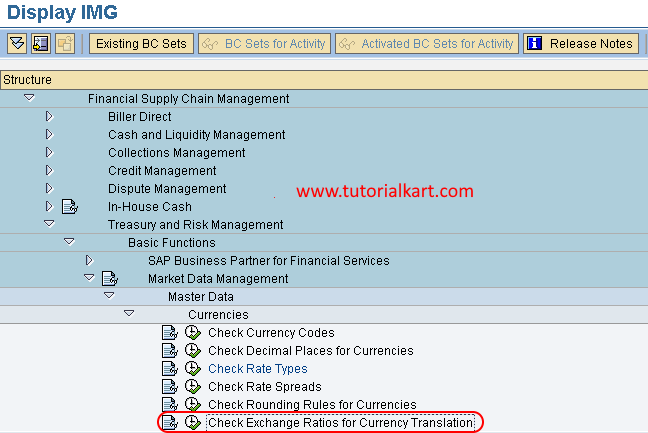
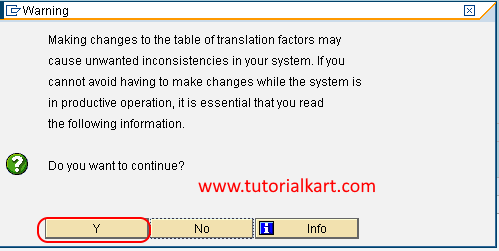
Step 4: If SAP displays a warning or confirmation message, review it and choose Yes to continue when appropriate.
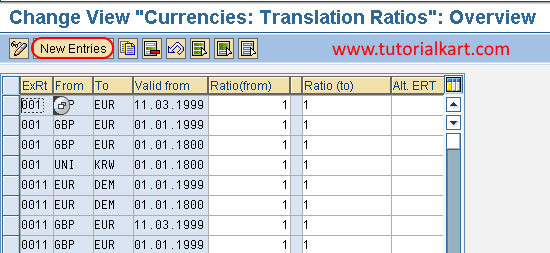
Step 5: On the Change View: Currencies Translation Ratios overview screen, review the existing entries. To add a ratio, choose New Entries.
Step 6: Enter the required translation-ratio details.
- ExRt: Enter the exchange rate type for which the ratio applies.
- From: Enter the source currency key.
- To: Enter the target currency key.
- Valid From: Enter the date from which the ratio becomes effective.
- From Ratio: Enter the number of source-currency units represented by the exchange rate.
- To Ratio: Enter the number of target-currency units represented by the exchange rate.
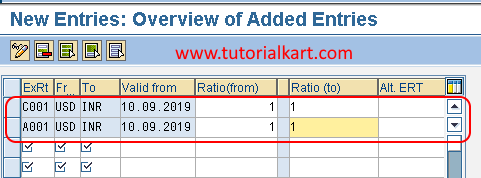
Step 7: Check the currency keys, validity date, and ratio values. Choose Save and assign the change to a customizing request when SAP prompts you.
How to Read the From and To Ratio Fields
The two ratio fields define the units used by the exchange-rate entry. A From Ratio of 1 and a To Ratio of 1 means that the exchange rate is quoted for one unit of the source currency against one unit of the target currency.
If the From Ratio is 100 and the To Ratio is 1, the maintained rate applies to 100 units of the source currency against one unit of the target currency. The correct values depend on the quotation convention and currency pair used by your organization.
Valid-From Dates and Existing Currency Ratio Entries
SAP can store time-dependent exchange ratios. Before adding a row, check whether another entry already exists for the same exchange rate type and currency pair. The valid-from date determines when the new ratio begins to apply.
A new validity period should be created only when the ratio genuinely changes. Avoid overwriting historical configuration without reviewing its impact on existing exchange-rate records and currency-translation processes.
Checks After Saving the SAP Currency Translation Ratio
- Return to the overview and confirm that the entry appears with the intended exchange rate type and currency direction.
- Verify that the valid-from date does not create an unintended overlap or gap.
- Confirm that the From Ratio and To Ratio were not entered in reverse order.
- Check the related exchange-rate maintenance for the same rate type and currency pair.
- Test the currency conversion in a non-production environment before transporting the configuration.
Common Problems with Exchange Ratios in SAP
Currency conversion result is larger or smaller than expected
This usually indicates that the exchange rate and exchange ratio do not use the same quotation basis. Check whether the rate represents one unit, 100 units, or another quantity of the source currency.
Duplicate or overlapping ratio entries
Review all entries for the exchange rate type and currency pair. Correct the validity dates so that SAP applies the intended ratio for each period.
Source and target currencies were reversed
The ratio is maintained for a specific direction. Confirm that the From and To currency fields match the direction used by the related exchange-rate entry.
Unable to save the configuration
Check your authorization, client settings, and customizing-request assignment. Configuration changes may be restricted in production or non-modifiable clients.
Exchange Ratio Configuration Review Checklist
- The exchange rate type matches the intended business process.
- The From and To currencies are entered in the correct direction.
- The valid-from date is accurate and does not unintentionally replace another period.
- The ratio values match the quotation basis used for exchange-rate maintenance.
- The entry has been saved to the correct customizing request.
- A test conversion produces the expected result before transport to production.
Frequently Asked Questions About SAP Exchange Ratios
What is the difference between an exchange rate and an exchange ratio in SAP?
The exchange rate provides the conversion value between currencies. The exchange ratio defines how many units of each currency that value represents.
Can the same currency pair have different exchange ratios?
Yes. Ratios can differ by exchange rate type and validity period. Each entry should match the quotation method used for the corresponding exchange-rate records.
Why does SAP use a ratio other than 1:1?
A ratio other than 1:1 can make exchange-rate values easier to maintain when one unit of a currency would result in a very small or very large quoted rate.
Does changing an exchange ratio automatically change the exchange rate?
No. The ratio and exchange rate are separate but related settings. They must use a consistent quotation basis to produce the correct translation result.