 TutorialKart.com
Define Relationship Categories in SAP FSCM
A relationship category defines the technical structure and permitted behavior of a relationship between two SAP Business Partners. It controls details such as the allowed Business Partner categories, relationship direction, time dependency, additional relationship data, and validation rules.
This SAP FSCM tutorial explains how to define relationship categories using transaction code BUBA. You can create a category manually or copy an existing SAP relationship category and adjust the copied settings for your business requirement.
SAP Relationship Category Transaction and IMG Access
- Transaction code: BUBA
- Configuration area: SAP Business Partner relationship settings
Before creating a new relationship category, review the standard categories already available in the system. Copying a suitable standard category is often safer than creating one from an empty entry because dependent settings can be copied together.
Open Relationship Categories with Transaction BUBA
Step 1: Enter transaction code BUBA in the SAP command field and press Enter.

The system opens the relationship category maintenance view, where existing SAP Business Partner relationship categories are displayed.
Create or Copy an SAP Business Partner Relationship Category
Step 2: On the Change View: Relationship Categories overview screen, choose the method that matches your requirement:
- New Entries: Creates a relationship category that must be configured manually.
- Copy As: Copies an existing relationship category together with its maintained settings and dependent entries.
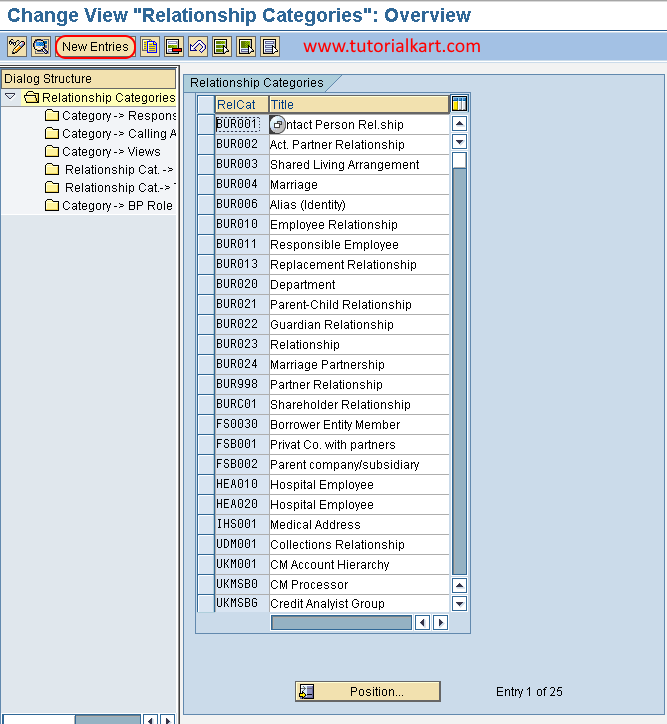
SAP systems normally include predefined relationship categories. Create a new custom category only when the standard configuration does not represent the required Business Partner relationship.
To base the new category on an existing configuration, select the source relationship category and choose Copy As. This approach copies the source settings so that only the required differences need to be maintained.
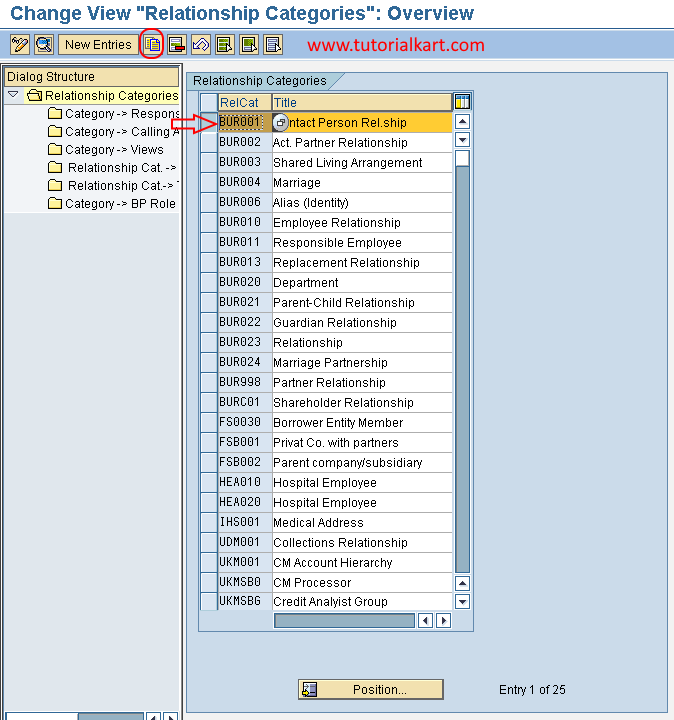
Maintain SAP Relationship Category Details
Step 3: On the relationship category detail screen, enter the new category key and review every copied or newly created setting before saving.
- Relationship category key: Enter a unique identifier according to the naming convention used in your SAP system.
- General data: Maintain the basic characteristics and direction of the Business Partner relationship.
- Additional data: Specify whether supplementary information can be stored for the relationship.
- Semantic checks: Configure validation behavior that SAP applies when users maintain the relationship.
- Business Partner categories: Define the permitted category for Partner 1 and Partner 2, such as person, organization, or group, according to the business scenario.
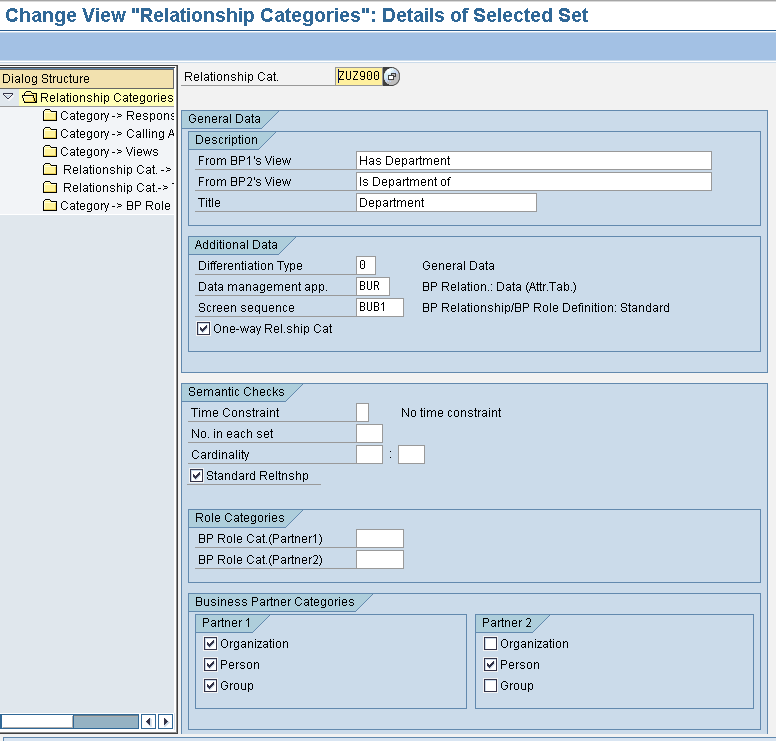
Check the source and target category values carefully when using the copy function. The copied settings should support the intended relationship and the permitted Business Partner category combination.
Copy Dependent Relationship Category Entries
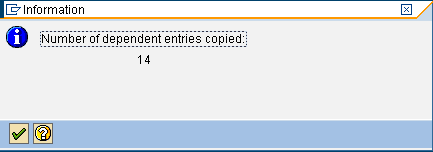
Step 4: After updating the copied details, press Enter to validate the values. Choose Copy All when SAP asks whether the dependent entries of the source category should also be copied.
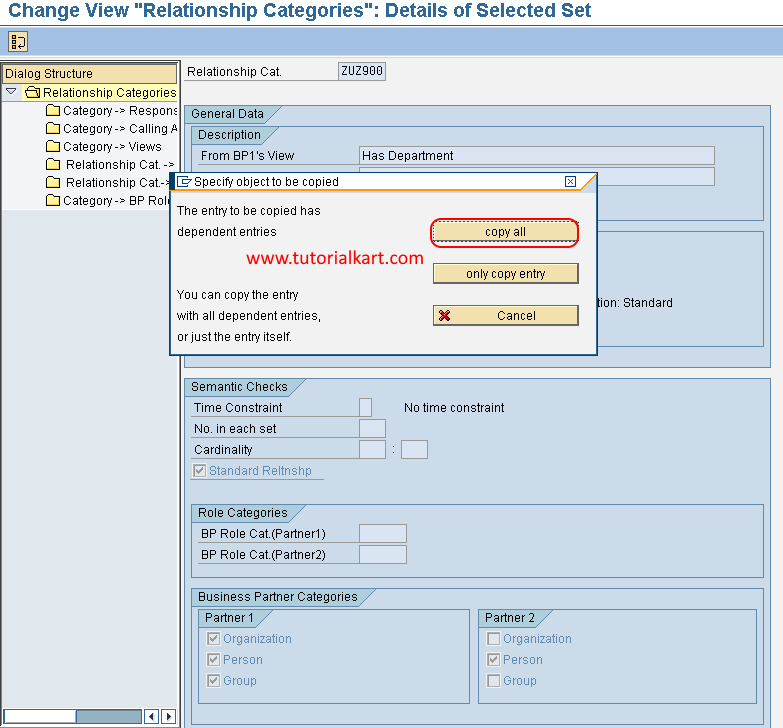
SAP displays a confirmation message indicating that the dependent entries were copied to the new relationship category.
Save and Transport the SAP FSCM Relationship Category
Step 5: Choose the Save icon to store the relationship category configuration. If the SAP system prompts for a Customizing request, assign the change to the correct transport request according to your project procedure.
Return to the overview screen and verify that the new relationship category appears with the expected key and settings. The category can then be assigned to a Business Partner relationship type.
Relationship Category and Relationship Type in SAP FSCM
A relationship category and a relationship type are connected but are not the same configuration object.
- Relationship category: Defines the technical rules, partner combinations, direction, and behavior of the relationship.
- Relationship type: Provides the business-facing key and description used to represent a particular relationship based on that category.
Configure the relationship category first. Afterward, create the required relationship type and assign the category to it.
Checks for SAP Relationship Category Configuration
- Confirm that the relationship category key is unique and follows the project’s naming convention.
- Verify that the Partner 1 and Partner 2 categories match the intended Business Partner scenario.
- Review the relationship direction and semantic checks after copying a standard category.
- Confirm that all required dependent entries were copied.
- Save the configuration in the correct Customizing transport request.
- Test the category through an assigned relationship type in Business Partner maintenance.
SAP Relationship Category FAQs
What does a relationship category control in SAP Business Partner?
It controls the technical behavior of a Business Partner relationship, including permitted partner categories, relationship direction, additional data, and validation settings.
Should a new SAP relationship category be created or copied?
Copying an existing category is suitable when a standard category already has similar behavior. Creating a new entry is appropriate when the configuration must be maintained independently from the beginning.
What does Copy All do in transaction BUBA?
Copy All transfers the dependent configuration entries of the selected source relationship category to the new target category.
Why are Partner 1 and Partner 2 categories important?
They determine which Business Partner categories can participate on each side of the relationship. An incorrect combination can prevent the relationship from being used as intended.