 TutorialKart.com
Use the TypeScript String.split() method to divide a string into an array of substrings. You can split by a character, a word, a multi-character delimiter, or a regular expression. An optional limit controls the maximum number of array elements returned.
TypeScript String split() Syntax
mystring.split([separator][, limit]);The method returns a new string[]. It does not modify the original string.
separator: An optional string or regular expression that identifies where the string should be divided.limit: An optional non-negative integer specifying the maximum number of elements to include in the returned array.
If the separator is not found, the returned array contains the complete original string as its only element. If no separator is supplied, the method also returns an array containing the original string.
Basic TypeScript String Split Example
In this example, the string is split wherever the delimiter -- occurs.
example.ts
var str = new String("Apple--Basket--Share--Options")
var splits = str.split("--")
console.log(splits)
Convert this to JavaScript
tsc example.tsexample.js
var str = new String("Apple--Basket--Share--Options");
var splits = str.split("--");
console.log(splits);
Run it on a browser.
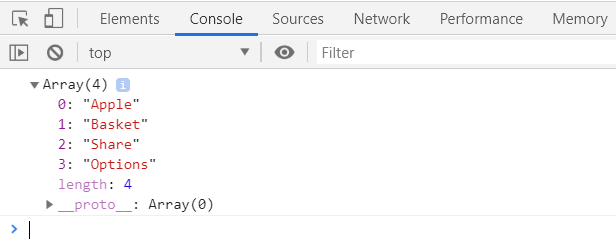
The resulting array contains four strings:
[ 'Apple', 'Basket', 'Share', 'Options' ]Split a TypeScript String with a Result Limit
The second argument limits the number of elements placed in the returned array. It does not preserve the unsplit remainder after the limit is reached.
example.ts
var str = new String("Apple--Basket--Share--Options")
var splits = str.split("--", 3)
console.log(splits)
Convert this to JavaScript
tsc example.tsexample.js
var str = new String("Apple--Basket--Share--Options");
var splits = str.split("--", 3);
console.log(splits);
Run it on a browser.
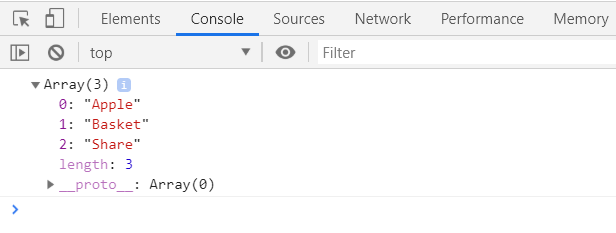
Because the limit is 3, only the first three substrings are returned:
[ 'Apple', 'Basket', 'Share' ]Split a TypeScript String by a Character
Pass a single character as the separator to split a value such as a comma-separated list.
const fruits: string = "Apple,Banana,Orange";
const fruitList: string[] = fruits.split(",");

console.log(fruitList);
[ 'Apple', 'Banana', 'Orange' ]The separator itself is not included in the resulting strings.
Split a String into Individual Characters
Use an empty string as the separator to divide a basic string into individual UTF-16 code units.
const word: string = "Type";
const characters: string[] = word.split("");

console.log(characters);
[ 'T', 'y', 'p', 'e' ]For text containing emoji or some combined Unicode characters, split("") may divide a visible character into multiple values. Use Array.from() when you need code-point-aware iteration.
const text: string = "A😊B";
const characters: string[] = Array.from(text);

console.log(characters);
[ 'A', '😊', 'B' ]Split a TypeScript String by Whitespace
A regular expression can split text containing one or more spaces, tabs, or line breaks. Calling trim() first prevents leading or trailing whitespace from producing empty array elements.
const sentence: string = "  TypeScript   string\tsplit  ";
const words: string[] = sentence.trim().split(/\s+/);

console.log(words);
[ 'TypeScript', 'string', 'split' ]Split a TypeScript String with Multiple Delimiters
Use a regular expression when more than one delimiter should be accepted. The following example splits on a comma, semicolon, or vertical bar and also removes surrounding whitespace.
const values: string = "red, green;blue | yellow";
const colors: string[] = values.split(/\s*[,;|]\s*/);

console.log(colors);
[ 'red', 'green', 'blue', 'yellow' ]Remove Empty Strings after split()
Repeated delimiters can produce empty strings. Apply filter() when empty elements are not useful.
const data: string = "Apple,,Banana,,Orange";
const items: string[] = data.split(",").filter((item) => item !== "");

console.log(items);
[ 'Apple', 'Banana', 'Orange' ]Split a String Only at the First Separator
Using split(separator, 2) returns only two elements, but it discards any later parts. To preserve everything after the first separator, find its index and slice the string.
const entry: string = "name=Arjun=Admin";
const separator: string = "=";
const separatorIndex: number = entry.indexOf(separator);

const key: string = separatorIndex === -1
    ? entry
    : entry.slice(0, separatorIndex);

const value: string = separatorIndex === -1
    ? ""
    : entry.slice(separatorIndex + separator.length);

console.log(key);
console.log(value);
name
Arjun=AdminTypeScript split() Return Type and Safe Index Access
split() returns a string[]. Accessing an element by index can still produce undefined when that position does not exist. This is especially relevant when the TypeScript compiler option noUncheckedIndexedAccess is enabled.
const record: string = "101:Pending";
const parts: string[] = record.split(":");

const id: string = parts[0] ?? "";
const status: string = parts[1] ?? "Unknown";

console.log(id, status);
Use a fallback value, a length check, or array destructuring when the input format may be incomplete.
String Primitives and the String Object
The earlier examples use new String() to retain the original tutorial code. In current TypeScript code, a primitive string is normally preferred over the boxed String object.
const preferred: string = "Apple--Basket--Share";
const parts: string[] = preferred.split("--");
Common TypeScript String Split Mistakes
- Expecting the original string to change:
split()returns a new array and leaves the source string unchanged. - Assuming the limit preserves the remainder:
split("-", 2)keeps only the first two resulting elements and drops later ones. - Forgetting whitespace around delimiters: splitting
"red, green"by a comma produces" green". Usemap(item => item.trim())or a suitable regular expression. - Ignoring empty elements: adjacent, leading, or trailing separators can create empty strings in the result.
- Using an unescaped dynamic regular expression: characters such as
.,*,+,?, and|have special meanings in regular expressions.
TypeScript String split() FAQs
How do I split a TypeScript string by a comma?
Call value.split(","). To remove spaces around each item, use value.split(",").map(item => item.trim()).
How do I split a TypeScript string by spaces?
Use value.trim().split(/\s+/) to handle one or more spaces, tabs, and line breaks without creating leading or trailing empty elements.
What happens when the separator is not found?
The method returns an array containing the entire original string as one element.
Does TypeScript split() change the original string?
No. JavaScript and TypeScript strings are immutable. The method creates and returns a new array.
Can split() use a regular expression in TypeScript?
Yes. The separator can be a RegExp, which is useful for whitespace, multiple delimiters, and pattern-based splitting.
Editorial QA Checklist for TypeScript split() Examples
- Confirm that every example returns a
string[]and does not imply thatsplit()modifies the source string. - Verify that explanations of the
limitargument state that later substrings are discarded rather than combined into a remainder. - Check comma, whitespace, character, multi-delimiter, and regular-expression examples against their displayed output.
- Ensure indexed array access accounts for missing elements where strict TypeScript settings are discussed.
- Retain primitive
stringas the recommended type while keeping legacyStringexamples technically explained.