 TutorialKart.com
Important Considerations While Working with a Machine Learning Algorithm
Choosing and using a machine learning algorithm is not only about getting a high accuracy percentage. A good algorithm choice depends on the problem type, data quality, feature behavior, assumptions, training cost, prediction speed, interpretability, evaluation method, and the way the model will be used after training.
There are many factors which influence your accuracy percentages when you are trying to build a solution using machine learning. One of the most important of such factors is the machine learning algorithm you choose. In this machine learning tutorial, we shall look into important considerations while working with a Machine Learning Algorithm and how to compare algorithms before selecting one for a project.
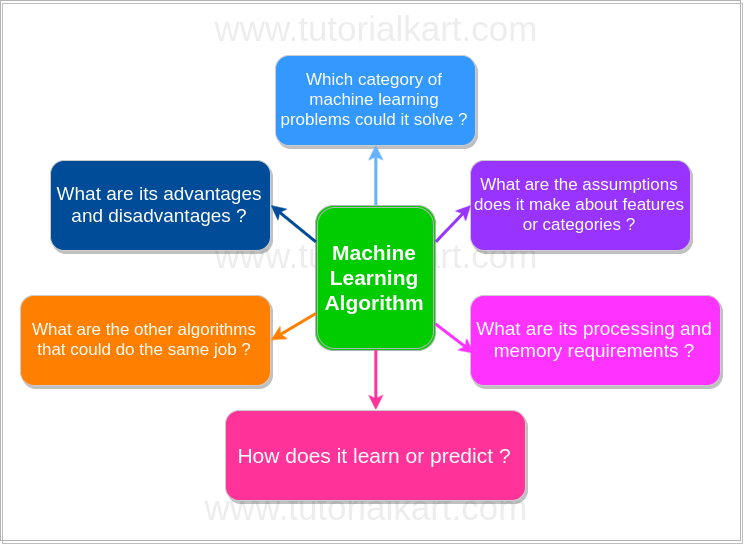
Following are the important aspects of a machine learning algorithm to be considered keeping in mind the features you have chosen, categories that you have, correlation between the features, the size of data, and the business problem being solved:
- What does this machine learning algorithm do?
- Which machine learning problem type are you solving?
- What kind of learning does this algorithm do?
- Is the training data suitable for this algorithm?
- What are the assumptions made about features or training data by this algorithm?
- What is the computational complexity of the algorithm?
- What are the memory requirements of this algorithm?
- What mathematics does this algorithm use?
- What is the cost function?
- What is the cost reduction technique used by the algorithm?
- How will you evaluate the machine learning algorithm?
- What are the advantages of this algorithm over related algorithms?
- What disadvantages are imposed by the assumptions made by this algorithm?
- What use cases fit this algorithm?
- What other algorithms can be used as alternatives?
What does this machine learning algorithm do?
There are many real world problems like spam detection, document classification, entity classification, weather prediction, traffic prediction, fraud detection, online purchase recommendations based on searching history, personalized user’s online retail profile, suggesting diagnostics based on symptoms, natural language processing, financial trading and many more.
An algorithm in machine learning could solve one or more problems stated above or could help another machine learning algorithm in solving the problem. Before using any algorithm, define the exact task in plain language. For example, “predict whether an email is spam” is different from “group similar emails without labels” and also different from “recommend related products to a customer”. These tasks need different learning approaches and evaluation methods.
Understand your problem and identify the area under which it comes. For example if the problem is regarding classification, or predicting a future course of process based on previous observations, which is regression. For each kind of machine learning problem, there are many machine learning algorithms from which one can be chosen. Analysis of features and categories help in choosing a few from the lot.
Which machine learning problem type are you solving?
An important consideration when choosing a machine learning algorithm is the type of output you need. If the expected output is a category, the problem is usually classification. If the output is a number, it is usually regression. If there are no labels and the goal is to find natural groups, it may be clustering. If the system must suggest items, ranking or recommendation algorithms may be more suitable.
| Problem type | Example output | Common algorithm families to compare |
|---|---|---|
| Classification | Spam or not spam, approved or rejected | Logistic regression, decision tree, random forest, support vector machine, naive Bayes, neural networks |
| Regression | Price, demand, time, quantity | Linear regression, ridge regression, decision tree regression, random forest regression, gradient boosting |
| Clustering | Customer segments or document groups | K-means, hierarchical clustering, DBSCAN, Gaussian mixture models |
| Dimensionality reduction | Reduced feature representation | PCA, t-SNE, UMAP, autoencoders |
| Recommendation | Ranked products, videos, or articles | Collaborative filtering, content-based recommendation, matrix factorization, learning-to-rank models |
What kind of learning does this algorithm do or how can it predict?
A machine learning algorithm learns the trends or rules or condition from training data available. Or it can always make use of all the training data available, each time when it tries to predict some useful information for experiment or event or problem instance.
The learning style matters because it decides what kind of data you need. Supervised learning requires labelled examples, such as past transactions marked as fraudulent or genuine. Unsupervised learning works with unlabelled data and tries to detect structure. Semi-supervised learning uses a small amount of labelled data with more unlabelled data. Reinforcement learning learns through actions and rewards in an environment.
In practical projects, start by asking whether correct labels are available, reliable, and recent enough. If labels are missing or weak, a complex supervised algorithm may not perform well even when it looks powerful on paper.
Is the training data suitable for this machine learning algorithm?
Data quality often affects model performance more than the algorithm name. Missing values, duplicate records, incorrect labels, outliers, leakage from future data, imbalanced classes, and inconsistent feature formats can make a model look accurate during testing but unreliable in real use.
Before comparing algorithms, check whether the data represents the problem you want to solve. For example, a fraud detection model trained only on old transaction patterns may not detect new fraud patterns well. A demand prediction model trained on normal sales periods may fail during unusual events if those events are not represented in training data.
- Feature completeness: Important variables should be available at prediction time, not only after the outcome is known.
- Label reliability: Wrong or inconsistent target labels can train the model in the wrong direction.
- Class balance: If one class is rare, accuracy alone may hide poor performance on the important class.
- Data leakage: Features must not contain information from the future or from the target value itself.
- Data drift: The relationship between input features and output may change over time.
What are the assumptions made by this algorithm?
The mechanism or technique in an algorithm always makes some assumptions. These assumptions could be on the number of training experiments or observations available, the relation between the features considered, or limit on number of categories from which it has to choose, the type of noise in feature values, features being linear or non-linear, features’ values being continuous or discrete, and many more.
For example, linear regression assumes a roughly linear relationship between the features and the target. Naive Bayes uses a strong independence assumption between features. K-means clustering works better when clusters are reasonably compact and separated. Tree-based models can capture non-linear patterns, but they may overfit if not controlled using depth, minimum samples, pruning, or ensemble methods.
When an algorithm’s assumptions match the data, the model is usually easier to train and explain. When the assumptions do not match, more data or more computation may not fix the underlying mismatch.
What is the complexity in regard to computations performed by the algorithm?
Complexity is the measure which is proportional to the number of processing steps required or computational power required by an algorithm to make a prediction, or generate a model during training. This could help you in deciding the processing power you might require.
Computational complexity should be checked in two places: training time and prediction time. Some algorithms are expensive to train but fast to predict after training. Some instance-based methods may be simple during training but slower during prediction because they compare a new example with many stored examples. For real-time systems, prediction latency can be as important as training accuracy.
What are the memory requirements of this algorithm?
Based on the way in which a machine learning algorithm learns from the data, or how it predicts some useful information for an experiment or observation, or how it models the training data decides the physical memory required for the algorithm to run successfully before it could go out of memory. If you are using established tools like TensorFlow, scikit-learn, PyTorch, or Deeplearning4j, the processes may include optimizations, but memory planning is still required for large datasets and large models.
Memory usage depends on feature count, number of records, model size, batch size, number of parameters, and whether the algorithm stores the full training set. A small model may be preferred for mobile, browser, embedded, or low-latency systems even if a larger model gives slightly better offline test results.
What are the mathematics that this algorithm is going to use?
A machine learning algorithm could use probabilistic or statistical or curve fitting or regression or gradients or some other mathematical technique to solve the problem it has chosen. It is very important to understand or get an idea of how it takes help of these mathematical techniques. In course, these mathematical techniques an algorithm chooses, dictate the complexity of the algorithm, some of the assumptions an algorithm considers, memory requirements of the algorithm and such.
You do not need to derive every formula before using a library, but you should understand the basic mathematical behavior. For example, distance-based algorithms are sensitive to feature scaling. Gradient-based algorithms can be affected by learning rate, local minima, and feature normalization. Probabilistic models need careful interpretation of probabilities and class priors. This understanding helps while debugging poor results.
What is the cost function?
A machine learning algorithm tries to fit the training data to a model with reduced cost in prediction. The cost function defines the method to calculate amount of deviation of model’s prediction from the actual facts.
The cost function should match the real goal of the problem. In regression, mean squared error penalizes larger errors more heavily than smaller errors. In classification, cross-entropy is commonly used when predicted probabilities matter. In imbalanced classification, a cost function or class weighting strategy may be needed so that the model does not ignore the minority class.
What is the cost reduction technique used by the algorithm?
During a machine learning algorithm fits training data to a model, it tries to reduce the cost paid in accuracy. A machine learning algorithm comprises of a technique, like gradient descent, which helps in achieving this goal of reduced cost.
Cost reduction or optimization technique influences training stability. Gradient descent, stochastic gradient descent, mini-batch optimization, coordinate descent, pruning, and boosting are examples of techniques used in different algorithms. Poor optimization settings can lead to underfitting, overfitting, slow training, or unstable results.
How will you evaluate the machine learning algorithm?
Evaluation should be planned before finalizing an algorithm. A model with high training accuracy may still fail on new data. Split the data into training and testing sets, or use cross-validation when suitable. The commonly mentioned 80/20 rule means using about 80 percent of data for training and 20 percent for testing, but this is only a practical rule of thumb, not a fixed law.
Choose the metric according to the problem. Accuracy may be enough for balanced classification, but precision, recall, F1-score, ROC-AUC, PR-AUC, or confusion matrix analysis may be better for imbalanced problems. For regression, compare MAE, MSE, RMSE, and R-squared based on how errors should be interpreted. For ranking and recommendation problems, use ranking-specific metrics such as precision at K, recall at K, or NDCG where appropriate.
| Project concern | What to check | Why it affects algorithm choice |
|---|---|---|
| Small dataset | Overfitting risk and validation method | Complex models may memorize instead of generalize |
| Many features | Feature selection, regularization, dimensionality reduction | Some algorithms slow down or become unstable with high dimensional data |
| Imbalanced classes | Recall, precision, class weights, sampling | Accuracy may hide poor minority class performance |
| Real-time prediction | Latency, model size, memory usage | A slightly less accurate but faster model may be more practical |
| Need for explanation | Interpretability and feature importance | Some use cases require clear reasons for predictions |
What are the advantages of this algorithm over related algorithms?
There is huge list of machine learning algorithms out there and possibly many solutions for a given problem. Usually more than one algorithm could solve a given problem. But the challenge is picking the algorithm that has better accuracy than others, and has the assumptions that are in alignment with the training data and problem information.
Justifying the choice made in terms of machine learning algorithm should consist of the advantages of this algorithm over other related algorithms. Trying out at least three or four algorithms for a problem and choosing the one with better validation performance is a good approach. Along with accuracy, compare training time, prediction time, explainability, stability across data splits, and ease of maintenance.
What are the disadvantages imposed by the assumptions made by this algorithm?
There is always a trade-off to be made in choosing a machine learning algorithm. Usually the assumptions, computational cost and such factors pose limitations. If the assumptions deviate even slightly from the actual training data or features or such, the accuracy may reduce which is a disadvantage. These factors which affect the accuracy should be taken care and the machine learning programmer should always be aware of the consequences when deviation from assumptions happen.
Disadvantages should be written down before deployment. A model may be hard to explain, sensitive to noisy data, slow on large datasets, biased toward majority classes, or difficult to update when data changes. Knowing these limitations helps you set monitoring rules and decide when retraining is required.
What are the use cases that it can have in its implementation scope?
Based on all the factors considered above, there could be only section of problems that this machine learning algorithm could solve or be preferred.
For example, linear models are often useful when the relationship is fairly simple and interpretability is important. Tree-based models are often useful for tabular business data with non-linear relationships. Naive Bayes can work well for text classification baselines. Neural networks are useful for large-scale image, speech, text, and representation learning tasks, but they usually need more data, tuning, and computation than simpler models.
What are the list of other algorithms available that can used in alternative to the algorithm?
As we already know, there is a huge list of machine learning algorithms. For a given problem that belong to a class of problems, the problem could be solved by any of a group of algorithms. And it is always good that one knows about most of the possible algorithms suitable for solving a particular class of problems, so that the computational power available or resources could be exploited for better accuracy numbers.
A practical way to choose alternatives is to keep one simple baseline and then compare more advanced algorithms against it. For classification, a logistic regression or naive Bayes baseline can be compared with tree-based ensembles or neural networks. For regression, a linear regression baseline can be compared with regularized regression, random forest regression, or gradient boosting. If the advanced model does not clearly improve validation results or business usefulness, the simpler model may be the better choice.
Machine Learning Algorithm Selection Checklist
- Define whether the task is classification, regression, clustering, recommendation, ranking, generation, or another ML problem type.
- Confirm that the training labels and input features are available at the time of prediction.
- Check missing values, outliers, duplicates, data leakage, and class imbalance before blaming the algorithm.
- Compare at least one simple baseline with more complex models.
- Use evaluation metrics that match the business risk, not only overall accuracy.
- Consider training time, prediction latency, memory usage, and deployment environment.
- Write down algorithm assumptions and known disadvantages before deployment.
- Monitor performance after deployment because data patterns can change over time.
FAQs on Choosing and Working with a Machine Learning Algorithm
What is an important consideration when choosing a machine learning algorithm?
The most important consideration is whether the algorithm matches the problem type and the available data. A classification algorithm is suitable for category prediction, a regression algorithm is suitable for numeric prediction, and a clustering algorithm is suitable for finding groups without labels. After that, compare data quality, assumptions, evaluation metrics, speed, memory, and interpretability.
What are the five basic things an algorithm should have?
In general computer science, an algorithm should have clearly defined inputs, clearly defined outputs, definite steps, finite completion, and effective operations that can actually be performed. In machine learning, you should also check the learning objective, training data, cost function, evaluation metric, and deployment requirement.
What is the 80/20 rule in machine learning?
The 80/20 rule usually refers to using about 80 percent of available data for training and about 20 percent for testing. It is a practical rule of thumb, not a compulsory split. Depending on dataset size and project risk, you may use train-validation-test splits, cross-validation, time-based validation, or other evaluation methods.
Should I choose the most accurate machine learning algorithm?
Not always. Accuracy is important, but the best algorithm for a project must also be reliable on unseen data, fast enough for prediction, possible to deploy, maintainable, and understandable enough for the use case. In sensitive or regulated decisions, interpretability and error analysis may be as important as raw accuracy.
Why should I test multiple machine learning algorithms?
Different algorithms make different assumptions about data. Testing multiple algorithms helps you find whether a simple baseline is already sufficient or whether a complex model gives a meaningful improvement. The comparison should be done using the same data split, same preprocessing rules, and suitable evaluation metrics.
Editorial QA Checklist for This Machine Learning Algorithm Tutorial
- Does the tutorial explain how problem type affects machine learning algorithm choice?
- Does it separate data quality issues from algorithm limitations?
- Does it explain assumptions, cost function, optimization, complexity, and memory in practical terms?
- Does it warn that accuracy alone may be misleading for imbalanced or high-risk problems?
- Does it include topic-specific FAQs on algorithm selection, 80/20 split, and testing alternatives?
Final Notes on Machine Learning Algorithm Selection
This concludes our topic on important considerations while working with a Machine Learning Algorithm. A dependable model usually comes from clear problem definition, clean data, suitable assumptions, careful evaluation, and practical deployment planning. The algorithm matters, but it works well only when the surrounding machine learning process is handled correctly.