 TutorialKart.com
SAP stands for Systems, Applications and Products in Data Processing. The name comes from SAP’s earlier German name, commonly written as Systeme, Anwendungen und Produkte in der Datenverarbeitung. In business and IT, SAP usually refers to enterprise software used to manage company processes such as finance, sales, procurement, manufacturing, inventory, human resources, and reporting.
What Does SAP Stand For?
According to English language, the full form of SAP is Systems, Applications and Products in Data Processing. The original name was connected to German, where SAP is associated with Systeme, Anwendungen und Produkte in der Datenverarbeitung, meaning systems, applications, and products in data processing.
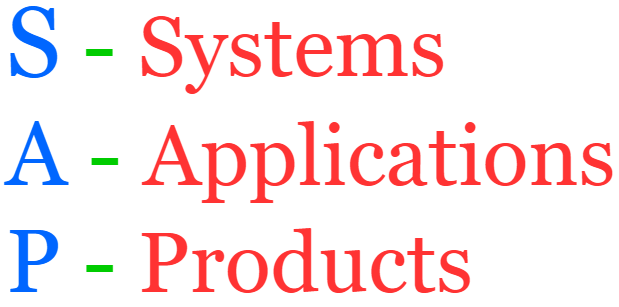
SAP full form in English and German
| Context | SAP full form | Meaning |
|---|---|---|
| English usage | Systems, Applications and Products in Data Processing | A name used to describe SAP’s enterprise software products and business data processing systems. |
| German usage | Systeme, Anwendungen und Produkte in der Datenverarbeitung | The German form that corresponds to systems, applications, and products in data processing. |
| Original company name | Systemanalyse Programmentwicklung | The earlier German company name, usually translated as system analysis and program development. |
What SAP means in business software
SAP AG is the German MNC software organization, that produces Enterprise Resource Planning (ERP) software to manage day to day business operations, long term relationship with customers and providing the better business solutions. SAP was officially formed in the year 1972 as Systemanalyse und Programmentwicklung (“System Analysis and Program Development), later the name was changed to “Systeme, Anwendungen Produkte in der datenverabeitung (Systems, Applications and Products in Data Processing).
In practical usage, SAP is not only a full form. It is also the name of a software company and the name people use for its ERP and enterprise application systems. When someone says that a company uses SAP, they usually mean that the company uses SAP software to record, process, and connect business transactions across departments.
What exactly is SAP used for?
SAP software is used to centralize business data and support daily operations. Instead of keeping finance, sales, inventory, production, and HR data in separate systems, an SAP system can connect these processes so that business teams work with consistent information.
- Finance and accounting: posting transactions, managing ledgers, tracking payables and receivables, and preparing reports.
- Sales and distribution: handling customer orders, pricing, billing, shipping, and sales documents.
- Materials management: managing purchasing, vendor records, stock movement, and inventory valuation.
- Production and manufacturing: planning production, tracking materials, and monitoring shop-floor requirements.
- Human resources: maintaining employee records, payroll-related data, time records, and organization structures.
- Customer and service processes: managing customer information, service requests, and long-term customer relationships.
For example, when a sales order is created in SAP, the system can connect that order with stock availability, delivery, billing, accounting entries, and reporting. This is why SAP is commonly discussed together with ERP.
SAP, ERP, and SAP modules
ERP stands for Enterprise Resource Planning. SAP is one of the best-known ERP software providers. An SAP implementation is usually divided into functional areas called modules. Each module supports a specific business function, and modules work together by sharing business data.
| SAP area | Common business use |
|---|---|
| SAP FI | Financial accounting and statutory reporting. |
| SAP CO | Controlling, cost centers, profit centers, and internal management reporting. |
| SAP MM | Purchasing, material master data, inventory, and vendor-related processes. |
| SAP SD | Sales orders, delivery, billing, pricing, and customer-related sales processes. |
| SAP PP | Production planning, manufacturing orders, and material requirements planning. |
| SAP HCM | Human capital management and employee-related business processes. |
Also read: What does ERP stands for ?
SAP R/1, SAP R/2, SAP R/3, and modern SAP systems
SAP was initially developed and released into several versions i.e. SAP R/1, SAP R/2 & SAP R/3. SAP R/3 is a three tier client server architecture and was officially formed in the year 1992.
The older names are still useful when learning SAP history. SAP R/1 was an early real-time system, SAP R/2 was used mainly on mainframe systems, and SAP R/3 became widely known for its client-server architecture. Modern SAP landscapes commonly discuss SAP ECC, SAP S/4HANA, cloud applications, analytics, integration tools, and industry-specific solutions.
SAP meaning in IT, accounting, business, and manufacturing
The SAP full form does not change by department, but the way people use SAP can differ by role. In IT, SAP may refer to system configuration, development, integration, and administration. In accounting, SAP often refers to financial postings, reports, ledgers, and period-end activities. In manufacturing, SAP may refer to production planning, material movement, inventory, and plant-level processes.
| Area | What SAP usually means in that area |
|---|---|
| Information Technology | SAP systems, technical architecture, configuration, ABAP development, integrations, security, and system support. |
| Accounting | Financial accounting, invoices, payments, ledgers, cost tracking, and reporting. |
| Business operations | Connected workflows across sales, purchase, inventory, finance, production, and services. |
| Manufacturing | Production planning, bill of materials, work centers, material requirements, and stock movement. |
Frequently asked questions on SAP full form
1. What does SAP stand for in Information Technology?
According to Information Technology, SAP stands for Systems, Applications and Products in Data Processing. In IT work, SAP can also refer to the installed SAP system, its modules, technical platform, integrations, and development environment.
2. What does SAP stand for in accounting?
According to accounting, SAP stands for Systems, Applications and Products in Data Processing. In accounting departments, SAP is commonly used for financial postings, vendor and customer transactions, tax records, ledgers, cost tracking, and financial reports.
3. What does SAP stand for in business?
According to business usage, SAP stands for Systems, Applications and Products in Data Processing. In a business setting, SAP usually means enterprise software that connects operations such as finance, sales, procurement, inventory, manufacturing, and reporting.
4. What does SAP stand for in manufacturing?
According to manufacturing usage, SAP stands for Systems, Applications and Products in Data Processing. Manufacturing teams may use SAP for production planning, material requirements, inventory movement, purchase orders, quality checks, and plant-level reporting.
5. What is the full form of SAP in German language?
In German, SAP is commonly expanded as Systeme, Anwendungen und Produkte in der Datenverarbeitung. The original company name was also connected with Systemanalyse Programmentwicklung, translated as system analysis and program development.
More resources for learning SAP software
- SAP software training tutorials
- Free SAP materials for practice
- SAP Interview questions and answers
- How to become an SAP consultant.
If you are new SAP and like to get trained in SAP system, please refer SAP tutorial with complete reference materials.
Editorial QA checklist for this SAP full form article
- Confirm that the SAP full form is written consistently as Systems, Applications and Products in Data Processing.
- Check that the German form is not misspelled, especially Datenverarbeitung.
- Make sure the article explains both meanings: SAP as a full form and SAP as enterprise software used in business.
- Verify that the existing image and internal links remain unchanged.
- Ensure that FAQ answers are specific to SAP in IT, accounting, business, manufacturing, and German usage.