 TutorialKart.com
ERP stands for Enterprise Resource Planning. In simple terms, ERP is business software that connects important departments such as finance, sales, inventory, manufacturing, purchasing, human resources, and customer service into one shared system.
When people search for ERP full form, they are usually trying to understand both the expansion of the acronym and what an ERP system actually does in a business. This guide explains the meaning of ERP, how ERP software works, common ERP modules, examples of ERP packages, and how ERP is different from CRM.
What does ERP stand for?
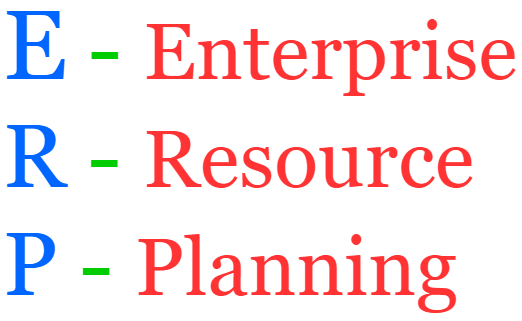
What does ERP stand for / ERP Full form? The acronym ERP stands for “Enterprise Resource Planning“. ERP software systems integrate the main systems of an organization into a single system with modules that support core business areas such as manufacturing, sales, finance, inventory, procurement, customer service, and human resources. ERP facilitates the free flow of data among different departments in an organization, so people in different departments can work with one consistent source of business data.
ERP meaning in simple terms for business users
ERP means a central business system where many departments enter, update, and use related information. For example, when a sales order is created, the ERP system can update inventory, create a delivery requirement, trigger billing, post accounting entries, and give managers a current view of business performance.
Without ERP, each department may use separate spreadsheets or disconnected applications. That often leads to duplicate records, delayed reporting, manual reconciliation, and inconsistent numbers. An ERP system reduces these issues by keeping related business processes and data in one connected environment.
How an ERP system connects departments and business data
By implementing an ERP system, an enterprise can integrate major business processes into a single system. This allows authorized users from different departments to access the same business records instead of maintaining separate copies of data.
A simple ERP flow can look like this:
- A customer places an order.
- The sales team records the order in the ERP system.
- The inventory module checks stock availability.
- The warehouse or production team receives the requirement.
- The finance module records billing, payment, tax, and accounting details.
- Managers review reports from the same source of data.
This is the main reason ERP is called enterprise resource planning: it helps an enterprise plan, use, track, and report its resources across multiple functions.
Major ERP modules used in companies
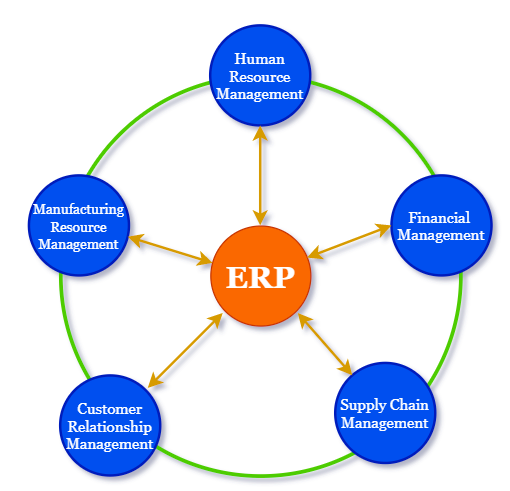
Major components of ERP usually depend on the industry and size of the organization. A manufacturing company may need production planning and shop-floor control, while a services company may focus more on projects, finance, billing, and human resources.
- Finance and accounting: general ledger, accounts payable, accounts receivable, asset accounting, budgeting, and financial reports.
- Supply chain management: purchasing, vendor management, inventory, warehouses, logistics, and delivery tracking.
- Human resource management: employee records, payroll, attendance, leave, recruitment, and performance processes.
- Customer relationship management: customer records, enquiries, sales opportunities, service requests, and customer communication.
- Manufacturing resource planning: production planning, bills of material, capacity planning, material requirements, and quality checks.
- Sales and distribution: quotations, sales orders, pricing, shipping, invoicing, and returns.
- Project management: project planning, resource allocation, time tracking, cost control, and project billing.
ERP full form in manufacturing, finance, business and SAP
The full form of ERP does not change by department or software vendor. It stands for Enterprise Resource Planning in manufacturing, finance, business management, SAP, Oracle, Microsoft Dynamics, and other ERP contexts. What changes is the way ERP is used in each area.
| Context | What ERP stands for | What ERP usually means in that context |
| Business | Enterprise Resource Planning | A system for managing core business processes and shared company data. |
| Manufacturing | Enterprise Resource Planning | Software for production planning, materials, inventory, quality, costs, and orders. |
| Finance | Enterprise Resource Planning | Software that connects accounting, billing, payments, budgets, assets, and reporting. |
| SAP | Enterprise Resource Planning | ERP refers to SAP’s enterprise software used to run integrated business processes. |
| Human resources | Enterprise Resource Planning | ERP may include employee records, payroll, leave, attendance, and workforce planning. |
Also read : What does SAP stand for
ERP software packages and examples
ERP software packages are available for small businesses, mid-size companies, and large enterprises. Some ERP systems are installed on company servers, while many modern ERP solutions are delivered as cloud software.
- SAP
- Oracle
- PeopleSoft
- Microsoft
- Baan
- J.D Edwards
- Lawson
- Ramico
- Adonix
- NetSuite
- Sage
- Odoo
The right ERP package depends on business size, industry, budget, deployment preference, integration needs, reporting requirements, and the processes that must be supported. A company should evaluate the implementation effort as carefully as the software features.
ERP system benefits and practical limitations
An ERP system can help a company improve data consistency, process control, reporting, and coordination between departments. It can also reduce repeated manual work when transactions flow from one module to another.
- Single source of data: departments work from the same customer, product, order, inventory, and finance records.
- Better process visibility: managers can track orders, costs, stock, production, and payments from one system.
- Reduced duplicate work: the same transaction does not need to be re-entered manually in many places.
- Standardized reporting: reports can be built from consistent data instead of multiple spreadsheets.
- Improved control: approval workflows, user roles, audit trails, and validations can be configured in the system.
ERP also has practical limitations. Implementation can take time, business processes may need to be redesigned, user training is important, and poor data migration can create problems. ERP works best when the company defines clear processes before configuring the system.
ERP vs CRM: difference between enterprise resource planning and customer relationship management
ERP and CRM are related, but they are not the same. ERP focuses on running internal business operations such as finance, purchasing, inventory, manufacturing, and resource planning. CRM focuses mainly on managing customer-facing activities such as leads, opportunities, sales communication, customer service, and marketing follow-up.
For a detailed comparison, read Difference between ERP and CRM.
When a business may need ERP software
A business may start considering ERP software when disconnected systems make it hard to manage daily operations. Common signs include repeated manual data entry, different departments reporting different numbers, slow month-end closing, poor inventory visibility, delayed order processing, and difficulty tracking costs across the organization.
ERP is not only for large enterprises. Smaller companies may also use ERP when they need a structured system for accounting, stock, purchasing, sales, and reporting. The main point is not the size of the company, but the need to manage connected business processes with reliable data.
More resources to learn ERP, SAP, Salesforce and Microsoft Dynamics
- SAP Training Tutorials and guides
- Salesforce Training Tutorials and materials
- Microsoft Dynamics tutorials
- Difference between ERP and CRM
- What is ERP – Enterprise Resource Planning
- What is SAP
- Advantages and Disadvantages of ERP
FAQs on what ERP stands for
What does ERP mean in simple terms?
ERP means Enterprise Resource Planning. In simple terms, it is software that helps a business manage important departments and processes from one connected system.
What does ERP stand for in business?
In business, ERP stands for Enterprise Resource Planning. It usually refers to software used to manage finance, sales, inventory, purchasing, manufacturing, human resources, and reporting.
What does ERP stand for in manufacturing?
In manufacturing, ERP still stands for Enterprise Resource Planning. It is used for production planning, material requirements, inventory control, quality management, costing, and order tracking.
Is SAP the same as ERP?
No. SAP is a software company and also the name commonly used for its business software products. ERP is the category of software. SAP offers ERP systems, but SAP and ERP are not the same thing.
What is the difference between ERP and CRM?
ERP mainly manages internal business operations such as finance, inventory, purchasing, and production. CRM mainly manages customer-facing work such as leads, sales opportunities, customer communication, and service requests.
Editorial QA checklist for this ERP full form page
- Confirm that the ERP full form is consistently written as Enterprise Resource Planning.
- Check that ERP meaning is explained in simple business language, not only as an acronym expansion.
- Verify that the existing ERP and SAP internal links remain unchanged and functional.
- Ensure the ERP software package list is treated as examples, not as a ranked vendor list.
- Review the FAQ answers for business, manufacturing, SAP, and ERP vs CRM search intent.