 TutorialKart.com
SAS Libraries: What They Are and Why They Are Used
A SAS library is a collection of SAS files that SAS recognizes as a single storage location. A library can contain SAS data sets, views, catalogs, item stores, and other member types supported by its engine. The library gives programs a short, consistent way to refer to those files without repeating their complete physical paths.
SAS identifies a library through a libref, which is a temporary name assigned during a SAS session. For example, if the libref TKARTLIB points to a directory and that directory contains a data set named SALES, the two-level SAS name is TKARTLIB.SALES.
SAS libraries are used to organize related data sets, preserve data between sessions, control where output is stored, and connect SAS to data managed by other systems. A library assignment identifies the storage location and the engine SAS must use to communicate with it.
Temporary and Permanent SAS Libraries
The lifetime of a SAS data set depends on the library in which it is stored.
| SAS library type | How it works | Typical use |
|---|---|---|
| Temporary library | Files are available only for the current SAS session or job and are normally removed when it ends. | Intermediate calculations, sorting, testing, and temporary output |
| Permanent library | Files are stored in a persistent directory or external data source and remain available after the session ends. | Reusable source data, reporting tables, prepared data, and shared project output |
WORK is the standard temporary SAS library. A one-level data set name such as SALES normally means WORK.SALES. To retain the data set, use a permanent library and specify its libref in the data set name.
/* Temporary data set: WORK.SALES_SUMMARY */
data sales_summary;
    set tkartlib.sales;
run;

/* Permanent data set: TKARTLIB.SALES_SUMMARY */
data tkartlib.sales_summary;
    set tkartlib.sales;
run;
Common SAS System Libraries
SAS assigns several libraries automatically. The exact list depends on the SAS product and execution environment.
- WORK: Stores temporary files for the current session. Its contents normally disappear when the session ends.
- SASHELP: Provides read-only metadata, sample data sets, views, templates, and other resources supplied with SAS.
- SASUSER: Can hold user-specific settings and files when the environment provides a writable SASUSER library.
- WEBWORK: May appear in certain web-based SAS environments. It is not a universal Base SAS library and should not be assumed to exist in every installation.
User-defined libraries are assignments created for project folders, shared storage, databases, cloud services, or other supported data sources. They can be assigned through an interface or with a LIBNAME statement.
SAS Librefs, Engines, and Two-Level Data Set Names
A SAS library reference has three main parts:
- Libref: The short name used by SAS programs, such as
TKARTLIB. - Engine: The component that reads and writes the applicable file or database format.
- Physical location or connection: The directory, database, or service containing the data.
A two-level SAS name follows the form libref.member. The first part selects the library, and the second identifies a member within it.
LIBREF.MEMBERExamples include WORK.RESULTS, SASHELP.CLASS, and TKARTLIB.CUSTOMERS. A member can be a data set, view, or another supported SAS file type.
SAS Library and Member Naming Rules
- A libref can contain up to eight characters.
- Under the usual
VALIDVARNAME=V7rules, a libref begins with a letter or underscore and continues with letters, numbers, or underscores. - SAS data set and variable names commonly support up to 32 characters under standard V7 naming rules.
- Names containing spaces or special characters require compatible naming options and name-literal syntax, so conventional names are easier to maintain.
- The operating-system directory name does not have to match the libref.
The libref exists only while it is assigned. Clearing a libref removes the connection between SAS and the location; it does not normally delete the physical directory or its files. Deleting a member requires a separate data-management operation.
Creating a SAS Library
A SAS library can be assigned through the SAS interface or with a LIBNAME statement. The interface is convenient for an interactive assignment, while a statement is reproducible and can be included in a program, autoexec file, or scheduled job.
Creating a SAS Library Using the New Library Window
In a SAS environment that provides the Explorer window, open the active libraries list and select File > New. Menu labels can differ between SAS products and versions.
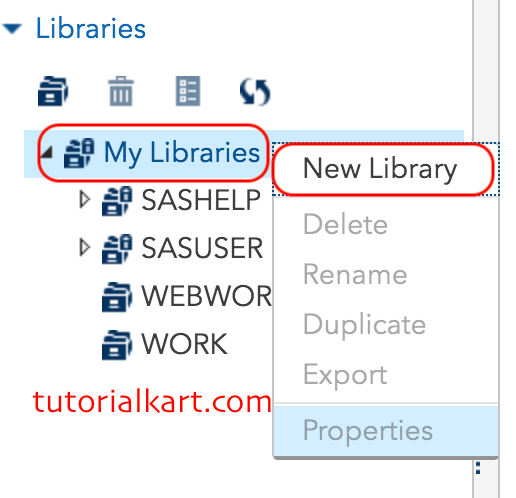
In the New Library window, enter TKARTLIB as the library name. Keep the default Base SAS engine when the target is a normal directory containing native SAS files. Select the startup option only if the library should be assigned automatically in future sessions.
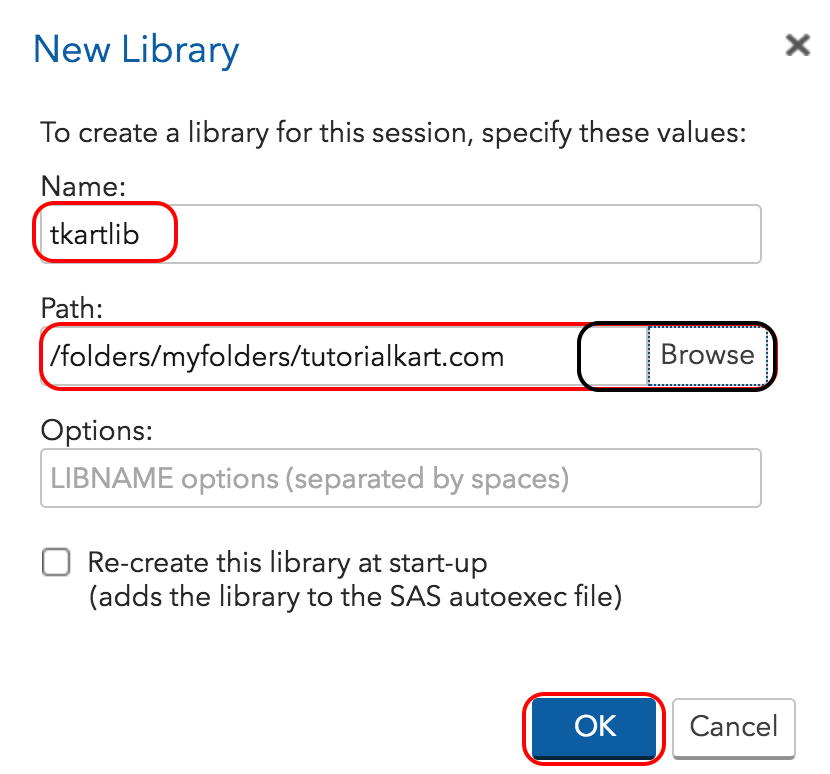
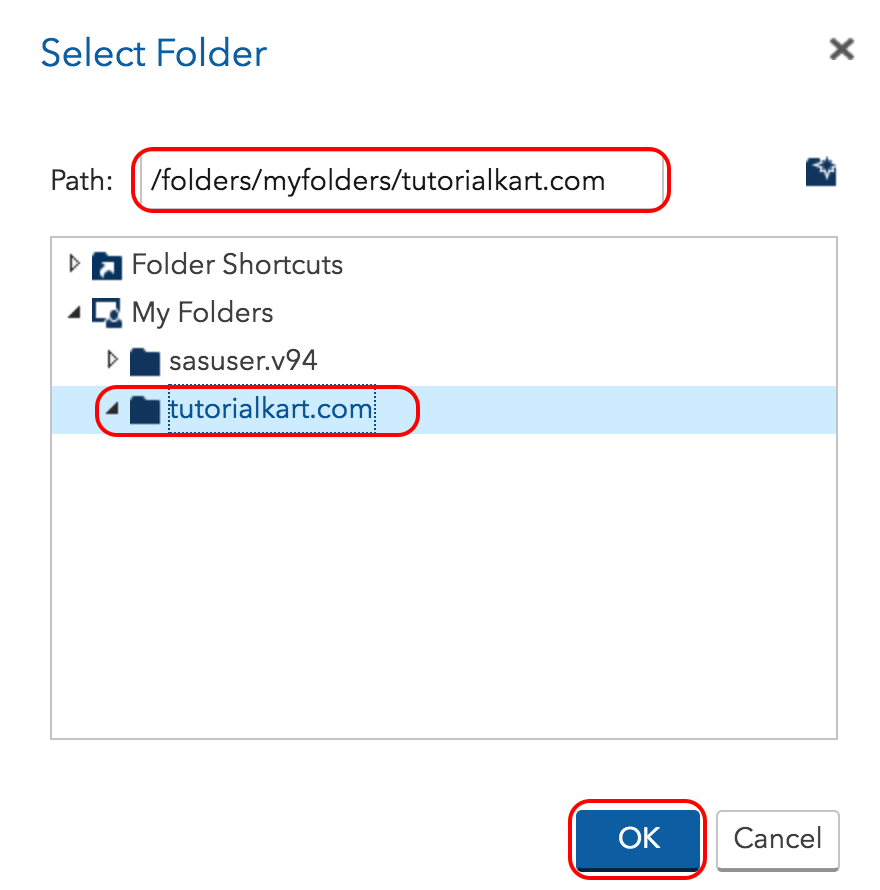
Enter or browse to the directory that will contain the SAS files. The directory must already exist, and the account running SAS must have the required read and write permissions.
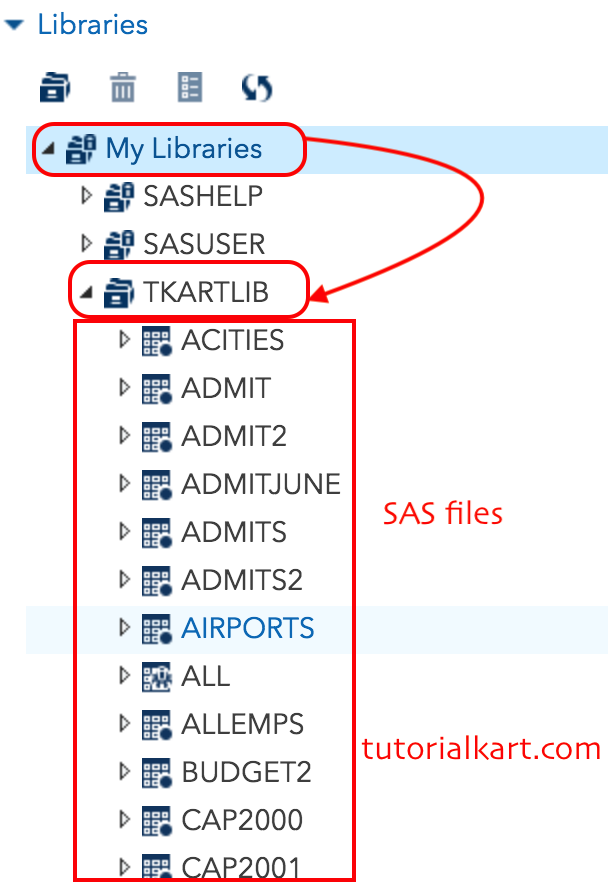
Select OK to assign the library. TKARTLIB should then appear in the list of active SAS libraries. Expanding it displays the members SAS can recognize at that location.
Creating a SAS Library Using the LIBNAME Statement
In SAS Studio, create or open a SAS program and submit a LIBNAME statement. The path must be accessible from the machine or compute server on which SAS runs. A path on the user’s local computer will not work when SAS is executing on a remote server unless that location is mounted or otherwise exposed to the server.
Libname prasanth '/folders/myfolders/tutorialkart.com';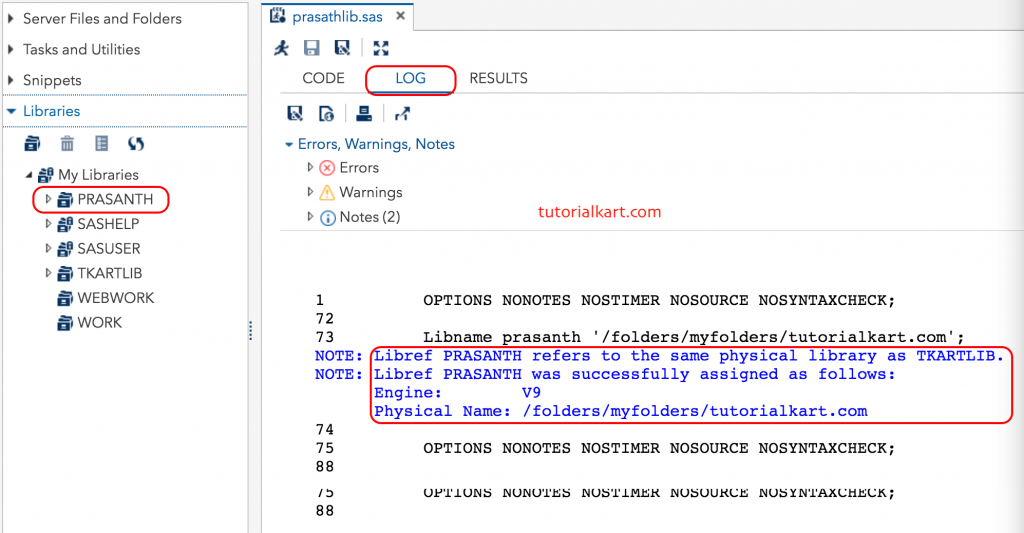
After the statement runs successfully, the PRASANTH libref points to the specified directory. Review the SAS log before using the library. A successful assignment is normally confirmed by a note stating that the libref was assigned.
General LIBNAME Statement Syntax
LIBNAME libref <engine> 'physical-location' <options>;The engine can be omitted when SAS can use the default engine for native SAS files. External data sources may require an access engine, connection options, and separately licensed or installed SAS/ACCESS software.
libname tkartlib '/projects/tutorialkart/data';

/* Display information about the assignment. */
libname tkartlib list;

/* Remove the assignment without deleting the data files. */
libname tkartlib clear;
Using a SAS Library to Read and Create Data Sets
Once a library has been assigned, its members can be used in DATA steps and procedures. The following program reads an existing permanent data set and creates another permanent data set in the same library.
libname tkartlib '/projects/tutorialkart/data';

data tkartlib.active_customers;
    set tkartlib.customers;
    where account_status = 'ACTIVE';
    keep customer_id customer_name account_status;
run;

proc print data=tkartlib.active_customers;
run;
The SET statement reads observations from TKARTLIB.CUSTOMERS. The DATA statement creates TKARTLIB.ACTIVE_CUSTOMERS. Because both names include a permanent libref, the new data set remains in that location after the session ends.
Creating a New SAS Data Set from an Existing Data Set
A new data set can be created from an existing member with a DATA step. Filters, calculated variables, renaming, and column selection can be applied while the observations are read.
data tkartlib.order_totals;
    set tkartlib.orders;
    order_total = quantity * unit_price;
    format order_total dollar12.2;
    keep order_id customer_id quantity unit_price order_total;
run;
The FORMAT statement controls how ORDER_TOTAL is displayed. It does not change the underlying numeric value stored in the data set.
SAS Informats and Formats in Library Data Sets
An informat tells SAS how to interpret source values when reading them. A format tells SAS how stored values should be displayed. Informats are mainly associated with input conversion, while formats affect presentation.
data tkartlib.payments;
    input payment_id payment_date :date9. amount :comma12.2;
    format payment_date date9. amount comma12.2;
    datalines;
1001 15JUN2026 1,250.50
1002 16JUN2026 875.00
;
run;
Here, the DATE9. and COMMA12.2 informats convert text into SAS numeric values. The formats then control how those values appear in reports. A format can be changed without rereading the source data, but correcting a value that was interpreted with the wrong informat may require reading the original text again or explicitly converting the stored value.
Internal and External SAS Library Engines
A SAS engine provides the rules SAS uses to access a library. The correct engine depends on where the data is stored.
- Native SAS engine: Reads and writes SAS files stored in a supported directory format.
- Interface or access engine: Connects SAS to an external database or file format through the relevant SAS/ACCESS product.
- Metadata-aware or environment-specific engine: May be used in managed SAS platforms where library definitions and credentials are administered centrally.
An external database library does not necessarily behave exactly like a directory of native SAS data sets. Supported data types, SQL processing, naming rules, locking, transactions, and performance depend on the engine and source system.
Checking SAS Library Assignments and Contents
Use the LIBNAME statement, SAS dictionary tables, or procedures such as CONTENTS and DATASETS to inspect libraries and their members.
/* List all currently assigned libraries. */
libname _all_ list;

/* Display metadata for every data set in TKARTLIB. */
proc contents data=tkartlib._all_ nods;
run;

/* List members without opening an interactive window. */
proc datasets library=tkartlib;
    contents data=_all_ nods;
quit;
The SAS log should also be reviewed for assignment errors, missing files, invalid paths, permission failures, and engine-specific messages.
Common SAS Library Errors and Fixes
| SAS library problem | Likely cause | What to check |
|---|---|---|
| Libref is not assigned | The LIBNAME statement was not run, failed, or was cleared. | Run the assignment and inspect the SAS log. |
| Physical file does not exist | The path or member name is incorrect. | Confirm the server-side path, spelling, and file availability. |
| Insufficient authorization | The SAS process cannot read or write the location. | Check operating-system, platform, or database permissions. |
| Member is read-only | The library, file, or engine does not permit updates. | Verify access mode, file ownership, locks, and engine capabilities. |
| Data set is not visible | The file is in another directory, uses an unsupported format, or requires another engine. | Confirm the assignment, engine, extension, and member type. |
| Library disappears after restart | A LIBNAME assignment normally lasts only for the session. | Add the assignment to startup configuration or rerun it in each program. |
SAS Library Editorial QA Checklist
- Verify that
WORKis described as temporary and that its contents normally end with the SAS session. - Confirm that permanent storage and permanent assignment are treated separately; stored files may persist even when the libref is no longer assigned.
- Check that every two-level data set name follows the
libref.memberpattern. - Ensure every example path is described from the perspective of the SAS compute server, not automatically the user’s local computer.
- Confirm that the libref does not exceed eight characters and that member-name guidance matches the active SAS naming options.
- Review the SAS log after each LIBNAME example for assignment and permission errors.
- Verify that clearing a libref is not presented as deleting its directory or data sets.
- Confirm that format and informat explanations distinguish stored values from their input and display representations.
SAS Libraries FAQs
What are libraries in SAS?
SAS libraries are collections of SAS files accessed through a libref. A library can represent a directory of native SAS files or a connection to another supported data source. Programs refer to a member with a two-level name such as TKARTLIB.CUSTOMERS.
What is the purpose of a SAS library?
A SAS library identifies where data is stored and which engine SAS should use to access it. Libraries make programs easier to maintain, separate temporary data from permanent data, and provide a consistent naming method for data sets and other SAS files.
Which statement about SAS libraries is true?
A library can contain multiple SAS members, including data sets and views. The WORK library is temporary, while files in a permanent library remain in their storage location after the session. A libref is an assignment used by SAS and is not itself the physical directory.
Does clearing a SAS library delete its data sets?
No. A LIBNAME libref CLEAR; statement normally removes the current library assignment without deleting the underlying files. Data sets must be deleted through an explicit SAS operation or an appropriate external file-management process.
Why is a SAS library not available in the next session?
A LIBNAME assignment usually exists only for the current session. Run the statement again when the next session starts, place it in an autoexec or initialization process, or configure a preassigned library through the applicable SAS administration tools.
SAS Library Tutorial Summary
A SAS library connects a short libref to a storage location through an engine. Use WORK for temporary processing and a user-defined permanent library for reusable data. Libraries can be assigned through an interface or a LIBNAME statement, and their members are referenced with two-level names. Always validate the server path, engine, permissions, naming rules, and SAS log before using a library in a production program.
Continue with this SAS tutorial to study additional SAS programming concepts.