 TutorialKart.com
OpenCV Python Edge Detection with Canny
Edge detection is an image-processing technique used to identify significant changes in pixel intensity. These changes often correspond to object boundaries, lines, and changes in surface texture.
In this tutorial, we shall learn to find edges slot88 of focused objects in an image using Canny Edge Detection Technique.
OpenCV provides several ways to calculate image gradients, including Sobel and Laplacian operators. This tutorial focuses on cv2.Canny(), which applies a multi-stage algorithm to produce a binary image in which detected edge pixels are white and other pixels are black.
How OpenCV Canny Edge Detection Works
The Canny algorithm performs more than a single gradient calculation. Its main stages are:
- Noise reduction: A Gaussian filter reduces small variations that could otherwise be detected as false edges.
- Gradient calculation: Image gradients indicate the strength and direction of intensity changes.
- Non-maximum suppression: Thick gradient regions are reduced to thin candidate edges.
- Double thresholding: Candidate pixels are classified using lower and upper threshold values.
- Edge tracking by hysteresis: Weak pixels connected to strong edges are retained, while unrelated weak pixels are removed.
Syntax – cv2.Canny()
The syntax of OpenCV Canny Edge Detection function is
edges = cv2.Canny('/path/to/img', minVal, maxVal, apertureSize, L2gradient)In an actual Python program, the first argument is an image array loaded with cv2.imread(), not the file-path string itself. A practical representation of the function signature is shown below.
edges = cv2.Canny(image, threshold1, threshold2, apertureSize=3, L2gradient=False)where
| Parameter | Description |
| /path/to/img (Mandatory) | File Path of the image |
| minVal (Mandatory) | Minimum intensity gradient |
| maxVal (Mandatory) | Maximum intensity gradient |
| apertureSize (Optional) | |
| L2gradient (Optional) (Default Value : false) | If true, Canny() uses a much more computationally expensive equation to detect edges, which provides more accuracy at the cost of resources. |
The following table clarifies how these arguments are used by the current Python API.
| Argument | Purpose |
|---|---|
image | Input 8-bit image array. A grayscale image is commonly used so that thresholds apply to intensity changes directly. |
threshold1 | Lower hysteresis threshold. A candidate below this value is normally discarded. |
threshold2 | Upper hysteresis threshold. A candidate above this value is treated as a strong edge. |
apertureSize | Size of the Sobel kernel used to calculate gradients. It must be an odd supported value; the default is 3. |
L2gradient | When True, gradient magnitude is calculated with the Euclidean formula. When False, a simpler absolute-value approximation is used. |
Choosing Canny Lower and Upper Thresholds
The two threshold values control which gradients become edges. Pixels above the upper threshold are strong edges. Pixels between the thresholds are retained only when they connect to strong edges. Pixels below the lower threshold are normally removed.
- If both thresholds are too low, noise and minor texture may appear as edges.
- If both thresholds are too high, valid object boundaries may disappear.
- The values
100and200are useful starting points for some 8-bit images, but they are not universal defaults. - Thresholds should be tested against the lighting, contrast, noise level, and subject matter of the input images.
Example 1 – OpenCV Edge Detection
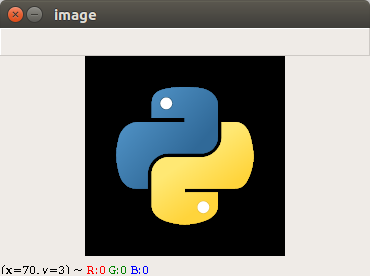
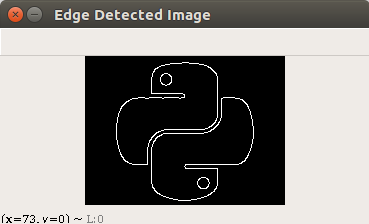
In this example, we python.png (an RGB image) as a slot GREY scale image. Then Canny() function is used to detect edges for the image.
The program loads python.png, applies Canny edge detection with lower and upper thresholds of 100 and 200, and displays the resulting binary edge map. Although OpenCV can accept the loaded color image in this example, explicitly converting an image to grayscale usually makes the preprocessing and threshold selection easier to understand and control.
edge-detection.py
import cv2

img = cv2.imread('/home/img/python.png')
edges = cv2.Canny(img,100,200)

cv2.imshow("Edge Detected Image", edges)

cv2.waitKey(0) # waits until a key is pressed
cv2.destroyAllWindows() # destroys the window showing image
Input Image
Output Image
OpenCV Canny Edge Detection with Grayscale and Gaussian Blur
Real photographs often contain sensor noise, compression artifacts, or fine texture. Converting the image to grayscale and applying a small Gaussian blur before calling cv2.Canny() can reduce fragmented or unwanted edges.
import cv2

image = cv2.imread('/home/img/python.png')

if image is None:
    raise FileNotFoundError('Could not load the input image')

gray = cv2.cvtColor(image, cv2.COLOR_BGR2GRAY)
blurred = cv2.GaussianBlur(gray, (5, 5), 0)
edges = cv2.Canny(blurred, 100, 200)

cv2.imshow('Grayscale Image', gray)
cv2.imshow('Canny Edges', edges)
cv2.waitKey(0)
cv2.destroyAllWindows()
The image is None check is useful because cv2.imread() returns None when the file cannot be loaded. Without this check, a later OpenCV operation may fail with an assertion error that does not clearly identify the incorrect path.
Save the OpenCV Edge-Detected Image
Use cv2.imwrite() when the edge map needs to be saved instead of, or in addition to, being displayed in a desktop window.
saved = cv2.imwrite('/home/img/python-edges.png', edges)

if not saved:
    raise OSError('OpenCV could not save the edge image')
The saved edge map is a single-channel image. White pixels represent detected edges, while black pixels represent areas that were not retained as edges.
Canny, Sobel, and Laplacian Edge Detection in OpenCV
| OpenCV method | Typical use | Result characteristics |
|---|---|---|
cv2.Canny() | Producing a clean binary edge map | Includes suppression, two thresholds, and hysteresis to create thin connected edges. |
cv2.Sobel() | Measuring horizontal or vertical intensity gradients | Preserves signed or directional gradient information and requires additional processing to create a binary edge map. |
cv2.Laplacian() | Measuring rapid intensity changes in multiple directions | Uses a second derivative and can be sensitive to image noise. |
Canny is generally suitable when the required output is a thin binary boundary map. Sobel is useful when gradient direction matters, while Laplacian can identify intensity changes without selecting a particular direction.
Common OpenCV Edge Detection Problems
cv2.imread() returns None
Check that the path is correct, the file exists, and OpenCV supports its format. Relative paths are resolved from the program’s current working directory, which may differ from the directory containing the Python script.
Canny detects too many edges
Apply a suitable blur before edge detection, increase the threshold values, or crop the image to the relevant region. Excessive blur can remove real details, so compare the result with the original image.
Canny misses object boundaries
Reduce one or both thresholds and inspect the contrast around the missing boundary. Uneven illumination may require additional preprocessing before the same thresholds can work across the image.
cv2.imshow() does not open a window
cv2.imshow() requires a graphical desktop environment and a compatible OpenCV installation. In a notebook or headless server environment, save the result with cv2.imwrite() or display it through the environment’s plotting facilities.
OpenCV Canny Edge Detection FAQs
Does cv2.Canny() require a grayscale image?
An 8-bit single-channel grayscale image is the clearest and most common input for Canny processing. Explicit grayscale conversion also makes the threshold values easier to interpret consistently.
What do the two cv2.Canny() thresholds mean?
The lower value helps reject weak gradient candidates, and the upper value identifies strong edges. Candidates between them are retained when they connect to strong edges.
Why should an image be blurred before Canny edge detection?
Small intensity variations can create false or fragmented edges. A moderate Gaussian blur suppresses some of that variation before gradients are calculated.
What is the output type of cv2.Canny()?
The function returns an 8-bit, single-channel binary edge map with the same width and height as the input image. Retained edge pixels normally have a value of 255, and non-edge pixels have a value of 0.
OpenCV Edge Detection QA Checklist
- Confirm that
cv2.imread()successfully loaded the image before processing it. - State that
cv2.Canny()receives an image array rather than a file path. - Verify that the lower Canny threshold is less than the upper threshold.
- Explain whether grayscale conversion and Gaussian smoothing are used.
- Compare the edge map with the source image to check for missing boundaries and noise.
- Use
cv2.imwrite()when the example must run without a graphical desktop.
Conclusion
In this OpenCV Python Tutorial – Image Edge Detection, we slot gacor have learnt to find edges of objects in the specified image, using Canny Detection Algorithm.
For reliable OpenCV edge detection, load and validate the image, convert it to grayscale when appropriate, reduce noise without removing useful detail, and tune the two Canny thresholds for the actual image set. The result can then be displayed, saved, or used as input for contour detection and other computer-vision operations.