 TutorialKart.com
SAP Modules List for ERP SAP R/3 and S/4HANA Business Processes
SAP modules are application areas in SAP ERP that support specific business functions such as finance, procurement, sales, production, plant maintenance, human resources, analytics, security, and system administration. In SAP R/3 and later SAP ERP landscapes, these modules are integrated so that a transaction entered in one area can update related data in another area.
For example, a goods receipt in materials management can update inventory quantities, create accounting entries in financial accounting, and affect production or sales availability depending on the business process. This integration is the main reason SAP modules are normally studied as connected process areas, not as isolated software screens.
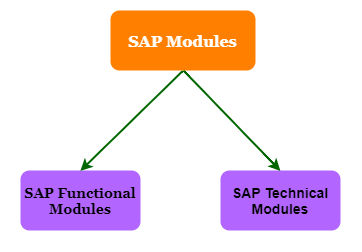
SAP Modules are commonly grouped into two practical categories: SAP functional modules and SAP technical modules. Functional modules map business operations such as finance, sales, purchasing, manufacturing, projects, quality, and HR. Technical modules support development, administration, integration, security, analytics, and platform services.
How SAP R/3 Modules Work Together in an ERP System
SAP R/3 was designed around enterprise-wide integration. The term R/3 refers to the classic three-tier architecture: presentation layer, application layer, and database layer. In daily use, users usually work with transactions, master data, configuration, reports, and documents inside one or more modules.
A simple order-to-cash process shows the module integration clearly. A sales order is created in SAP SD, inventory is checked from SAP MM, delivery and goods issue update logistics, billing creates revenue-related entries in SAP FI, and profitability can be analysed in SAP CO. Similar integration exists for procure-to-pay, plan-to-produce, hire-to-retire, and project-to-settlement processes.
Complete List of SAP Functional Modules
SAP functional modules are used by business process consultants, end users, functional analysts, and implementation teams. The exact module names and product packaging may vary between SAP ECC, SAP S/4HANA, SAP SuccessFactors, SAP Ariba, SAP CRM, and other SAP solutions, but the business areas below are commonly used when discussing ERP SAP modules.
| S.no | Name of Functional Module | SAP Module | Main business use |
| 1 | Financial Accounting Module | SAP FI | General ledger, accounts payable, accounts receivable, asset accounting, financial statements |
| 2 | Controlling Module | SAP CO | Cost centres, internal orders, product costing, profitability analysis, management reporting |
| 3 | Material Management Module | SAP MM | Procurement, purchasing, inventory management, material master data, goods movement |
| 4 | Sales & Distribution Module | SAP SD | Sales orders, pricing, delivery, billing, customer shipping and distribution |
| 5 | Production Planning Module | SAP PP | Demand planning, production orders, bill of materials, routing, manufacturing control |
| 6 | Quality Management Module | SAP QM | Quality inspection, quality planning, inspection lots, certificates, quality notifications |
| 7 | Project System Module | SAP PS | Project structures, WBS elements, networks, budgeting, project settlement |
| 8 | Human Capital Management Module | SAP HCM | Personnel administration, time management, payroll, organisational management |
| 9 | Investment Management Module | SAP IM | Capital investment planning, appropriation requests, investment programs, budgeting |
| 10 | Financial Supply Chain Management Module | SAP FSCM | Credit management, collections, dispute management, treasury-related finance processes |
| 11 | Customer Relationship Management Module | SAP CRM | Customer interactions, marketing, sales, service, opportunity and activity management |
| 12 | Warehouse Management Module | SAP WM | Bin management, picking, putaway, stock placement, warehouse movements |
| 13 | Supplier Relationship Management Module | SAP SRM | Supplier collaboration, sourcing, procurement support, supplier performance processes |
| 14 | Advanced Planning & Optimization Module | SAP APO | Supply chain planning, demand planning, production planning, global availability checks |
| 15 | Plant Maintenance Module | SAP PM | Equipment master data, maintenance orders, breakdown maintenance, preventive maintenance |
| 16 | Product Life Cycle Management Module | SAP PLM | Product data, engineering changes, document management, product development support |
| 17 | Treasury Management Module | SAP TR | Cash, liquidity, treasury transactions, risk-related finance activities |
| 18 | Logistics Execution Module | SAP LE | Shipping, transportation, delivery processing, logistics execution activities |
| 19 | Banking Module | SAP Banking | Banking industry processes, financial services operations, account-related processes |
| 20 | Environment, Health & Safety Module | SAP EHS | Product safety, incident handling, hazardous substance management, compliance support |
| 21 | Governance, Risk and Compliance Module | SAP GRC | Access control, risk management, compliance monitoring, process controls |
SAP FI and SAP CO Modules for Finance and Controlling
SAP FICO is the common combined name used for SAP FI and SAP CO. SAP FI focuses on external financial accounting, while SAP CO focuses on internal cost and management accounting. In many projects these two areas are closely connected because financial postings often need cost objects, profit centres, cost centres, internal orders, or profitability segments.
For example, when an organisation purchases an asset, the transaction can affect asset accounting, vendor accounting, general ledger accounting, tax accounts, and cost reporting depending on the configuration. The important sub-modules of SAP FI & SAP CO are:
- General ledger accounting
- Accounts payable
- Accounts receivable
- Asset Accounting
- Bank accounting
- Cost center accounting
- Internal orders
- Profit center accounting
- Product costing
- Profitability analysis
SAP MM Module for Procurement and Inventory Management
SAP MM stands for Materials Management. It supports procurement, material valuation, inventory management, goods receipt, goods issue, stock transfer, and material master data. SAP MM is strongly integrated with SAP FI, SAP SD, SAP PP, SAP QM, SAP WM, and SAP PM.
A common procure-to-pay flow starts with a purchase requisition, continues with a purchase order, goods receipt, invoice verification, and vendor payment. The important sub-modules and process areas of SAP MM are:
- Purchasing
- Inventory management
- Material requirement planning
- Material master data
- Invoice verification
- Service procurement
- Source determination and vendor evaluation
SAP SD Module for Sales, Delivery and Billing
SAP SD stands for Sales and Distribution. It supports the order-to-cash cycle, including customer master data, sales order processing, pricing, availability check, delivery, picking, goods issue, billing, and customer account updates. SAP SD is usually connected with SAP MM for inventory, SAP FI for accounting, and SAP CO for profitability reporting.
- Sales order processing
- Pricing and condition records
- Shipping and delivery
- Billing and invoicing
- Credit and debit memo processing
- Customer master data
SAP PP Module for Production Planning and Manufacturing
SAP PP stands for Production Planning. It is used by manufacturing organisations to plan and control production. SAP PP works with material master data, bill of materials, work centres, routings, production versions, production orders, capacity planning, and material requirements planning.
- Bill of materials
- Work centres and routings
- Material requirements planning
- Production orders
- Capacity planning
- Shop floor control
SAP HCM and SAP HR Modules for Employee Processes
SAP HR is also called SAP HCM, or Human Capital Management. It supports employee-related processes such as personnel administration, organisation management, time management, payroll, benefits, recruitment, personnel development, and reporting. In newer SAP landscapes, many HR cloud processes are also handled through SAP SuccessFactors, depending on the organisation’s system design.
The important sub-modules of SAP HR and SAP HCM are:
- Personnel administration
- Organisational management
- Personnel development
- Time management
- Payroll management
- Recruitment
- Benefits administration
SAP PM, QM, PS and WM Modules in Logistics Operations
Several SAP functional modules support specialised logistics and operational processes beyond basic purchasing and sales.
- SAP PM is used for plant maintenance activities such as preventive maintenance, corrective maintenance, equipment records, maintenance notifications, and maintenance orders.
- SAP QM supports quality planning, inspection processing, quality notifications, and quality certificates.
- SAP PS supports project planning, budgeting, execution, monitoring, and settlement through work breakdown structures and networks.
- SAP WM supports warehouse bin-level stock management, picking, putaway, and movement control in warehouse operations.
Complete List of SAP Technical Modules
SAP technical modules are used by developers, system administrators, security consultants, integration consultants, data specialists, analytics teams, and platform support teams. These modules do not usually own a business process from end to end; instead, they make SAP applications configurable, secure, integrated, extensible, and reportable.
| S.no | Name of Technical Module | Module | Main technical use |
| 1 | Advanced Business Application Programming | SAP ABAP | Custom reports, enhancements, interfaces, forms, workflow logic, backend development |
| 2 | Security Module | SAP Security | User roles, authorisations, access control, segregation of duties support |
| 3 | Basis Module | SAP Basis | System administration, transport management, jobs, monitoring, installation support |
| 4 | Customer Relationship Management | SAP CRM | CRM technical configuration, integration, enhancement, and support activities |
| 5 | Business Intelligence/ Business Warehouse | SAP BI/BW | Data warehousing, extraction, transformation, reporting, analytical modelling |
| 6 | High Performance Analytics Appliance Module | SAP HANA | In-memory database, data modelling, calculation views, performance-oriented analytics |
| 7 | Business Planning and Consolidation | SAP BPC | Planning, budgeting, forecasting, financial consolidation support |
| 8 | Application Link Enabling | SAP ALE | Distributed system communication, IDoc processing, cross-system integration |
| 9 | Business Objects Data Services | SAP BODS | Data extraction, transformation, loading, migration, and data quality processes |
| 10 | Business Objects Module | SAP BO/BOBJ | Business reporting, dashboards, semantic layers, enterprise analytics |
| 11 | NetWeaver | SAP NetWeaver | Technology foundation for older SAP landscapes, integration and application platform services |
| 12 | FIORI user interface module | SAP Fiori | Role-based SAP apps, launchpad design, user experience and UI access |
| 13 | Solution Manager | SAP Solution Manager | Application lifecycle management, monitoring, change control, implementation support |
| 14 | Master Data Management | SAP MDM | Master data governance and consolidation in applicable SAP landscapes |
| 15 | Business One Module | SAP B1 | Small and mid-sized business ERP implementation and support |
| 16 | Governance, Risk and Compliance Module | SAP GRC | Access risk analysis, compliance controls, audit support, role governance |
| 17 | Enterprise Asset Management | SAP EAM | Technical and process support for asset lifecycle and maintenance operations |
| 18 | Testing Module | SAP Testing | Functional testing, regression testing, test automation, integration testing support |
| 19 | SAP Cloud Platform | SAP Cloud | Cloud extension, application development, integration, and platform services |
| 20 | Web Dynpro | SAP Web Dynpro | Older SAP web application development framework for ABAP and Java scenarios |
| 21 | Exchange Infrastructure Module | SAP XI | Older integration middleware used for message exchange between systems |
SAP ABAP, SAP Basis, SAP Security and SAP HANA Explained
Among technical SAP modules, four areas are commonly discussed by learners and project teams:
- SAP ABAP is the programming language and development environment used for many custom reports, enhancements, interfaces, forms, and backend logic in SAP systems.
- SAP Basis handles system-level administration such as client management, transport routes, background jobs, user administration support, monitoring, and system health tasks.
- SAP Security focuses on roles, authorisations, user access, access risk, and controls. In larger organisations, SAP Security is often connected with SAP GRC.
- SAP HANA is SAP’s in-memory database technology. It is important in SAP S/4HANA, analytics, data modelling, and performance-focused applications.
SAP Functional Modules vs SAP Technical Modules
| Comparison point | SAP Functional Modules | SAP Technical Modules |
| Primary focus | Business process design and configuration | Development, administration, security, integration, and platform support |
| Typical users | Functional consultants, business analysts, process owners, key users | ABAP developers, Basis administrators, security consultants, integration consultants, data specialists |
| Examples | SAP FI, CO, MM, SD, PP, QM, PM, PS, HCM | SAP ABAP, Basis, Security, BW, HANA, BODS, Fiori, Solution Manager |
| Work output | Configuration, process flows, master data rules, testing, user training | Programs, interfaces, authorisation roles, system setup, transports, technical monitoring |
| Business dependency | Requires strong process understanding | Requires strong technical and system understanding |
Major SAP Business Process Flows and Their Related Modules
The best way to understand the SAP modules list is to connect each module with a real business process. Most SAP implementation projects are planned around process flows rather than around module names alone.
| Business process | Common SAP modules involved | What the process covers |
| Order to cash | SAP SD, MM, FI, CO, LE, WM | Sales order, delivery, goods issue, billing, customer accounting, profitability |
| Procure to pay | SAP MM, FI, CO, QM, WM | Purchase requisition, purchase order, goods receipt, invoice verification, vendor payment |
| Plan to produce | SAP PP, MM, QM, CO, PM | Production planning, material requirements, production orders, quality checks, cost collection |
| Record to report | SAP FI, CO, FSCM, TR | Financial postings, closing activities, reporting, controlling, treasury-related finance processes |
| Hire to retire | SAP HCM, FI, CO | Employee master data, time, payroll, organisational assignments, cost postings |
| Maintain to operate | SAP PM, MM, FI, CO, QM | Maintenance planning, spare parts, work orders, breakdown processing, cost tracking |
SAP ECC, SAP R/3 and SAP S/4HANA Module Naming Differences
Many learners search for SAP R/3 modules because older training materials and project documents use the R/3 or ECC terminology. Modern SAP landscapes may use SAP S/4HANA, SAP SuccessFactors, SAP Ariba, SAP Concur, SAP Fieldglass, SAP Analytics Cloud, and other SAP cloud products. Because of this, the same business area may appear with a newer product name or a changed implementation approach.
For example, SAP FI and SAP CO remain important finance concepts, but in SAP S/4HANA the finance area is often discussed as SAP S/4HANA Finance. SAP HR or SAP HCM may be used in older ERP systems, while many organisations use SAP SuccessFactors for cloud HR processes. SAP WM may be replaced or extended by SAP Extended Warehouse Management in more advanced warehouse landscapes.
Therefore, when choosing a module to learn, check whether your target role is based on SAP ECC, SAP S/4HANA, a cloud product, or a hybrid landscape. The business concepts remain useful, but transaction codes, user interfaces, data models, and implementation tools can differ.
How to Choose an SAP Module for Learning
There is no single best SAP module for every learner. A better approach is to choose a module based on your education, work experience, business domain, and interest in functional or technical work.
| Your background or interest | SAP modules to consider | Reason |
| Accounting, finance, commerce, audit | SAP FI, SAP CO, SAP FSCM, SAP TR | These modules match financial accounting, controlling, reporting, and treasury processes. |
| Procurement, stores, supply chain | SAP MM, SAP WM, SAP EWM, SAP SRM | These modules match purchasing, inventory, vendor processes, and warehouse operations. |
| Sales, distribution, customer service | SAP SD, SAP CRM, SAP CS | These modules match customer orders, pricing, delivery, billing, and service processes. |
| Manufacturing or engineering | SAP PP, SAP QM, SAP PM, SAP PLM | These modules match production, quality, maintenance, and product lifecycle processes. |
| Human resources or payroll | SAP HCM, SAP SuccessFactors | These areas match employee master data, payroll, time, recruitment, and HR operations. |
| Programming or software development | SAP ABAP, SAP Fiori, SAP UI5, SAP BTP | These areas involve development, extensions, UI apps, APIs, and custom logic. |
| System administration or access control | SAP Basis, SAP Security, SAP GRC | These areas focus on system operations, users, authorisations, monitoring, and controls. |
| Data, reporting, analytics | SAP BW, SAP BO/BOBJ, SAP HANA, SAP Analytics Cloud | These areas focus on reporting models, dashboards, data extraction, and analytics. |
Note: Every SAP module can be useful in the right project context. Demand depends on industry, country, company landscape, project type, migration plans, and the learner’s existing skill set. Avoid choosing a module only because it is described as popular; choose it because it fits the process or technical work you can understand and practise.
Quick Reference SAP Modules Abbreviation List
| Abbreviation | Full form or common meaning |
| SAP FI | Financial Accounting |
| SAP CO | Controlling |
| SAP FICO | Financial Accounting and Controlling |
| SAP MM | Materials Management |
| SAP SD | Sales and Distribution |
| SAP PP | Production Planning |
| SAP QM | Quality Management |
| SAP PM | Plant Maintenance |
| SAP PS | Project System |
| SAP HCM | Human Capital Management |
| SAP HR | Human Resources |
| SAP WM | Warehouse Management |
| SAP CRM | Customer Relationship Management |
| SAP SRM | Supplier Relationship Management |
| SAP APO | Advanced Planning and Optimization |
| SAP PLM | Product Lifecycle Management |
| SAP GRC | Governance, Risk and Compliance |
| SAP ABAP | Advanced Business Application Programming |
| SAP BW | Business Warehouse |
| SAP BO/BOBJ | BusinessObjects |
| SAP BODS | BusinessObjects Data Services |
| SAP BPC | Business Planning and Consolidation |
| SAP HANA | High-performance Analytic Appliance, commonly used for SAP’s in-memory database platform |
Beginner Learning Path for ERP SAP Modules
If you are new to SAP, start with ERP concepts before going deep into one module. A practical learning order is:
- Understand what ERP means and why integrated business data is used.
- Learn master data basics such as company code, plant, storage location, customer, vendor, material, cost centre, and profit centre.
- Study one end-to-end process such as order to cash or procure to pay.
- Choose one main module such as SAP FI, MM, SD, PP, HCM, ABAP, Basis, or Security.
- Practise configuration or transactions using a training system where available.
- Learn integration points with at least two related modules.
- Read project documents, test scripts, business process flows, and issue logs to understand real implementation work.
You can continue with our SAP tutorials for module-wise lessons and examples.
Common Mistakes When Reading an SAP Modules List
- Assuming every SAP module is a separate product: Some names refer to ERP application components, some to technical areas, and some to separate SAP products or newer cloud solutions.
- Mixing functional and technical roles: A functional consultant configures and tests business processes, while a technical consultant usually develops, administers, integrates, or secures systems.
- Choosing a module only by popularity: A module is easier to learn when it matches your education or work experience.
- Ignoring integration: SAP projects rarely use one module alone. FI connects with MM, SD, CO, PM, PS, and many other areas.
- Using only old R/3 names for new projects: Many companies now use SAP S/4HANA or cloud products, so check the current system landscape before preparing for a role.
SAP Modules List FAQ
What are the main modules of SAP R/3?
The main SAP R/3 modules include SAP FI, CO, MM, SD, PP, QM, PM, PS, HCM, WM, CRM, SRM, APO, PLM, GRC, ABAP, Basis, Security, BW, and other supporting areas. In practice, organisations use the modules that match their business processes and system landscape.
What is the difference between SAP FI and SAP CO?
SAP FI handles external financial accounting such as general ledger, accounts payable, accounts receivable, and asset accounting. SAP CO handles internal management accounting such as cost centres, internal orders, product costing, profit centres, and profitability analysis. They are often studied together as SAP FICO because they are closely integrated.
Is SAP HCM the same as SAP HR?
SAP HR is the older common name, while SAP HCM stands for Human Capital Management. Both terms are often used for employee-related ERP processes such as personnel administration, time management, payroll, and organisational management. In newer cloud-focused landscapes, SAP SuccessFactors may also be used for HR processes.
Which SAP module is best for beginners?
The best SAP module for a beginner depends on background. Finance learners can start with SAP FI or CO, supply chain learners with SAP MM or SD, manufacturing learners with SAP PP or QM, HR learners with SAP HCM, programmers with SAP ABAP, and system administration learners with SAP Basis or Security.
Are SAP technical modules required for functional consultants?
A functional consultant does not need to become a developer or Basis administrator, but basic technical understanding is useful. Knowledge of transports, authorisations, master data, integration points, debugging basics, and reporting helps functional consultants work better with technical teams.
Editorial QA Checklist for This SAP Modules List
- Confirm that SAP FI, CO, MM, SD, PP, QM, PM, PS, HCM, WM, and related functional modules are described by business process, not only by abbreviation.
- Check that SAP ABAP, Basis, Security, HANA, BW, BODS, Fiori, and other technical modules are clearly separated from functional modules.
- Review whether older SAP R/3 and ECC terms are explained without implying that all organisations use the same current product landscape.
- Verify that module recommendations are based on learner background and role fit, not unsupported salary or market-demand claims.
- Ensure all existing TutorialKart SAP links and the existing ERP SAP modules image remain unchanged.
This SAP modules list can be used as a starting point to understand SAP ERP structure. After the list is clear, the next step is to study one module in detail and then learn how it integrates with other SAP modules in complete business processes.