 TutorialKart.com
Before going to Salesforce.com training, it is useful to understand what is an ERP, what is CRM, and the difference between ERP and CRM. Salesforce is primarily a CRM platform, while ERP systems are mainly used to manage internal business resources such as finance, inventory, procurement, manufacturing, and supply chain operations.
ERP and CRM solve different business problems. ERP focuses on how the business runs internally. CRM focuses on how the business manages customers, prospects, sales, service, and relationships. Many organizations use both systems together, because a customer order may begin in a CRM system and then move into an ERP system for fulfilment, billing, inventory, and accounting.
Difference between ERP and CRM in Salesforce context
The easiest way to compare ERP and CRM is to look at the main users and the business data each system manages. CRM is commonly used by sales, marketing, and service teams. ERP is commonly used by finance, operations, procurement, inventory, production, and human resource teams.
| Comparison point | ERP | CRM |
|---|---|---|
| Full form | Enterprise Resource Planning | Customer Relationship Management |
| Main focus | Internal business resources and back-office processes | Customer relationships, sales, marketing, and service |
| Typical users | Finance, inventory, procurement, manufacturing, HR, operations | Sales, marketing, customer service, account management |
| Common records | Purchase orders, invoices, stock, production orders, payroll, expenses | Leads, accounts, contacts, opportunities, cases, campaigns, activities |
| Primary business question | How do we plan, produce, supply, bill, and account for business resources? | How do we find, win, serve, retain, and understand customers? |
| Salesforce position | Salesforce is not a traditional ERP, but it can integrate with ERP systems | Salesforce is widely used as a CRM platform |
What is CRM?
Customer Relationship Management is the full form of CRM. CRM refers to the process and software used to manage customer interactions across the customer lifecycle. A CRM system helps a business store customer information, track sales opportunities, follow up with prospects, manage support cases, and analyse customer activity.
In a CRM system, customer-facing teams can see important information such as contact details, previous conversations, open deals, service issues, tasks, meetings, and account history. This helps teams work with the same customer view instead of storing information in separate spreadsheets, inboxes, or personal notes.
Different CRM products include:
- Salesforce.com CRM.
- Siebel CRM.
- Peoplesoft CRM.
- Sugar CRM.
- Microsoft Dynamics CRM and many more.
Four common types of CRM software
CRM software is often grouped by the kind of customer work it supports. In practice, one CRM product may support more than one type.
| CRM type | What it helps with | Simple example |
|---|---|---|
| Operational CRM | Day-to-day sales, marketing, and service processes | Assigning leads, creating opportunities, sending follow-up tasks, and managing cases |
| Analytical CRM | Reports, dashboards, customer analysis, and forecasting | Finding which lead sources produce the best sales pipeline |
| Collaborative CRM | Sharing customer information across departments and channels | Sales and service teams viewing the same account history |
| Strategic CRM | Long-term customer retention, loyalty, and relationship planning | Identifying important accounts and planning account growth |
What is an ERP? ERP definition for business operations
Enterprise Resource Planning is the full form of ERP. Enterprise resource planning (ERP) is business process management software that helps an organisation use integrated applications to manage internal operations. ERP systems commonly support finance, accounting, procurement, inventory, supply chain, manufacturing, project operations, services, and human resources.
An ERP system is used when a company needs one controlled system for planning resources, tracking costs, managing stock, processing purchases, recording invoices, and monitoring operational performance. ERP is therefore more back-office focused than CRM.
Different ERP products
- SAP.
- Oracle e-business suite.
- JD Edwards.
- SAGE.
- Momentum and many more.
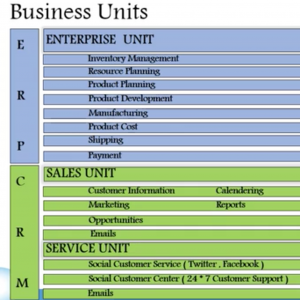
ERP vs CRM example using ProMobile Ltd
Example:- ProMobile Ltd is a company that manufactures and sells mobile phones. To understand ERP vs CRM clearly, divide the company into three business areas: enterprise operations, sales, and service.
Business Units of Pro Mobile Ltd.
Based on this example, you can understand how ERP and CRM are connected but not identical.
ERP work in the ProMobile manufacturing unit
Enterprise Unit.(manufacturing unit).
The main aim of this manufacturing unit is to manufacture mobiles. In the enterprise unit, the company plans, purchases, produces, stores, ships, and records the cost of products. These activities are typically handled by ERP.
- Inventory Management.
- Resource Planning.
- Product Planning.
- Manufacturing.
- Product Cost.
- Shipping.
- Payment.
CRM work in the ProMobile sales unit
Sales Unit.
After manufacturing mobile phones, the company has to sell the product. The sales unit works directly with leads, customers, distributors, and accounts. This is CRM work because the focus is on customer relationships and sales pipeline management.
- Customer Information.
- Marketing.
- Opportunities.
- Emails.
- Calendars.
- Reports.
CRM work in the ProMobile service unit
Service Unit.
After selling a mobile phone, the product may require service. The service unit handles customer issues, service requests, warranties, repair status, and support communication. This is also CRM work because it is customer-facing.
- Social Customer Service.
- Customer Care.
- Emails.
- Case tracking.
- Warranty or entitlement information.
- Service reports.
If we observe the difference between the enterprise unit, sales unit, and service unit, the main difference is that the enterprise unit is involved in back-office operations. Sales and service units are involved with customers and are therefore front-office, customer-centric teams. Sales and service teams know about customers, markets, enquiries, complaints, and buying behaviour.
So the enterprise unit is mainly handled through Enterprise resource planning (ERP), while the sales unit and service unit are mainly handled through Customer Relationship Management (CRM).
How ERP and CRM work together in a real order process
ERP and CRM should not be treated as competing systems in every case. In many companies, CRM starts the customer process and ERP completes the operational process.
- A prospect submits an enquiry. The CRM stores the lead and lead source.
- The sales team qualifies the lead and creates an opportunity in the CRM.
- The customer accepts a quote. The CRM records the deal details.
- The confirmed order is sent to the ERP for stock check, fulfilment, billing, shipping, and accounting.
- After delivery, the support team uses the CRM to handle service cases, feedback, and renewals.
This is why ERP and CRM integration is important. Without integration, sales teams may not know inventory status, finance teams may not see order context, and service teams may not know shipment or invoice details.
Is Salesforce an ERP or CRM?
Salesforce is primarily a CRM platform. It is commonly used for sales, service, marketing, customer data, automation, reports, dashboards, portals, and customer-facing workflows. Salesforce is not a traditional ERP system in the same sense as ERP products built mainly for finance, procurement, inventory, manufacturing, and core accounting.
However, Salesforce can be connected to ERP systems. For example, Salesforce may manage leads, accounts, opportunities, and support cases, while an ERP system manages invoices, stock, purchase orders, fulfilment, and financial posting. Some organisations also build custom operational apps on the Salesforce Platform, but that does not automatically make Salesforce a full ERP replacement.
When to choose ERP, CRM, or both systems
| Business need | Better starting point | Reason |
|---|---|---|
| Track leads, opportunities, customer calls, and follow-ups | CRM | The main work is customer-facing sales activity. |
| Manage support cases, customer complaints, and service history | CRM | The main work is customer service and relationship management. |
| Manage inventory, production planning, and procurement | ERP | The main work is resource planning and operational control. |
| Handle invoices, accounting, cost control, and financial posting | ERP | The main work belongs to finance and back-office operations. |
| Connect quote-to-order, shipping, billing, and customer support | Both ERP and CRM | CRM handles customer interaction, while ERP handles operational execution. |
ERP and CRM reference links for further reading
For current terminology and product positioning, compare beginner explanations with official product documentation before making implementation decisions.
- Salesforce explanation of ERP vs CRM
- Salesforce explanation of ERP
- Salesforce official overview
- IBM overview of ERP vs CRM
- NetSuite comparison of ERP and CRM
ERP vs CRM FAQ for Salesforce learners
What is the main difference between ERP and CRM?
The main difference is focus. ERP manages internal resources and back-office processes such as finance, inventory, procurement, manufacturing, and operations. CRM manages customer-facing processes such as leads, sales opportunities, customer service, marketing, and relationship history.
Is Salesforce an ERP or CRM?
Salesforce is primarily a CRM platform. It can integrate with ERP systems and can support custom business applications, but it is not a traditional ERP system for core finance, inventory, procurement, and manufacturing by default.
What are the 4 types of CRM?
The four common types of CRM are operational CRM, analytical CRM, collaborative CRM, and strategic CRM. Operational CRM supports daily sales and service work, analytical CRM supports reporting and insights, collaborative CRM supports sharing customer information across teams, and strategic CRM supports long-term customer relationship planning.
Can ERP and CRM be used together?
Yes. Many organizations use CRM for customer-facing work and ERP for operational execution. For example, a deal may be created in CRM and then passed to ERP for order fulfilment, billing, shipment, inventory update, and accounting.
Which system should a company implement first: ERP or CRM?
It depends on the most urgent business problem. If the company mainly needs better lead tracking, sales pipeline visibility, and customer support, CRM is usually the first focus. If the company mainly needs inventory control, accounting, procurement, or production planning, ERP is usually the first focus.
ERP vs CRM editorial QA checklist
- Check that Salesforce is described as a CRM platform, not as a traditional ERP system.
- Keep ERP examples focused on finance, inventory, procurement, manufacturing, operations, and resource planning.
- Keep CRM examples focused on leads, accounts, contacts, opportunities, cases, campaigns, activities, and customer relationship history.
- Make sure the ProMobile Ltd example clearly separates back-office ERP work from front-office CRM work.
- When adding future examples, explain where ERP and CRM data should integrate, especially for quote-to-order, billing, shipment, and service workflows.