 TutorialKart.com
What Is an Account in Accounting?
In accounting, an account is a separate record used to classify, summarize, and track financial transactions of a similar nature. An account may relate to an asset, liability, capital, revenue, expense, person, organization, bank, supplier, or customer.
For example, all cash receipts and cash payments are recorded in the Cash Account, while transactions involving a particular supplier may be recorded in that supplier’s account. Maintaining separate accounts makes it possible to determine the balance and transaction history of each accounting item.
Common examples of accounts include Cash Account, Bank Account, Sales Account, Purchases Account, Rent Expense Account, Accounts Receivable, Accounts Payable, and Capital Account.
Account Definition and Meaning with an Example
An account can be defined as a summarized record of increases, decreases, and balances relating to one accounting element during a specified period.
Suppose a business starts with $10,000 in cash, purchases office supplies for $1,200 in cash, and receives $3,000 from a customer. These transactions affect the Cash Account as follows:
| Transaction | Increase in cash | Decrease in cash | Cash balance |
|---|---|---|---|
| Opening cash introduced | $10,000 | — | $10,000 |
| Office supplies purchased | — | $1,200 | $8,800 |
| Cash received from customer | $3,000 | — | $11,800 |
The Cash Account brings all cash-related transactions together and shows that the business has a closing cash balance of $11,800.
T-Account Format in Accounting
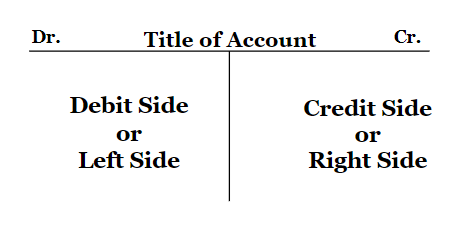
An account is often represented in the form of the letter “T” and is therefore called a T-account. The vertical line separates the two sides, while the account title appears above the horizontal line.
The left side of a T-account is the debit side, and the right side is the credit side. Whether a debit or credit increases an account depends on the type of account.
| Debit side | Credit side |
|---|---|
| Appears on the left side of an account | Appears on the right side of an account |
| Usually increases assets and expenses | Usually increases liabilities, capital, and income |
| Usually decreases liabilities, capital, and income | Usually decreases assets and expenses |
Every transaction is analyzed using the rules of debit and credit. The appropriate account is then debited or credited according to the nature of the transaction and the applicable rules of accounting.
Proforma of a Ledger Account
A ledger account records transactions under an individual account heading. In the traditional ledger format, debit entries are recorded on the left side and credit entries are recorded on the right side.
The word “To” is traditionally written before the particulars on the debit side, while the word “By” is written before the particulars on the credit side. Many computerized accounting systems do not use these prefixes, but they remain common in manual accounting formats.

A traditional ledger account contains eight columns in total. Four columns appear on the debit side and four corresponding columns appear on the credit side.
- The left side of the account records debit entries.
- The right side of the account records credit entries.
- Each side normally contains columns for Date, Particulars, Journal Folio, and Amount.
- Transactions are posted from the journal or another book of original entry.
- The final difference between the debit and credit totals represents the account balance.
Columns Used in a Ledger Account
The following columns appear on both the debit and credit sides of a traditional ledger account:
- Date: Records the date on which the transaction occurred or was entered in the books.
- Particulars: Shows the name of the corresponding account and may include a brief transaction description.
- J.F.: Journal Folio indicates the journal page or reference from which the transaction was posted.
- Amount: Shows the monetary value of the debit or credit entry.
How an Account Records Debit and Credit Entries
Each business transaction affects at least two accounts under the double-entry system. One account is debited and another account is credited by an equal amount.
For example, when a business purchases furniture for $2,500 in cash:
- Furniture Account is debited by $2,500 because the value of an asset increases.
- Cash Account is credited by $2,500 because the value of cash decreases.
| Account | Debit | Credit |
|---|---|---|
| Furniture Account | $2,500 | — |
| Cash Account | — | $2,500 |
The total debit and total credit are equal, which preserves the accounting equation.
Account Balance and Balancing an Account
The balance of an account is the difference between the total debit amount and the total credit amount recorded in that account.
- If the debit total is greater than the credit total, the account has a debit balance.
- If the credit total is greater than the debit total, the account has a credit balance.
- If both totals are equal, the account has no balance.
At the end of an accounting period, the smaller side is increased by entering the balancing figure. The totals are then made equal, and the balance is carried forward to the next period where appropriate.
Traditional Types of Accounts
Under the traditional classification, accounts are divided into three main types:
- Personal Accounts: Accounts relating to individuals, firms, companies, banks, and other organizations.
- Real Accounts: Accounts relating to tangible and intangible assets, such as cash, machinery, buildings, goodwill, and patents.
- Nominal Accounts: Accounts relating to expenses, losses, incomes, and gains, such as rent, salary, commission received, and discount allowed.
See Types of Account for a detailed explanation of each classification and its debit and credit rules.
Modern Classification of Accounts
In modern accounting, accounts are commonly classified according to the elements of the accounting equation and financial statements.
| Account type | Meaning | Examples | Normal balance |
|---|---|---|---|
| Asset | Resources controlled by the business | Cash, inventory, equipment, accounts receivable | Debit |
| Liability | Amounts owed by the business | Loans, accounts payable, accrued expenses | Credit |
| Equity | Owner’s residual interest in the business | Capital, retained earnings | Credit |
| Revenue | Income earned from business activities | Sales revenue, service revenue | Credit |
| Expense | Costs incurred to earn revenue | Rent, wages, electricity, depreciation | Debit |
This classification helps connect individual accounts with the balance sheet, income statement, and accounting equation.
Difference Between an Account, Journal, and Ledger
| Accounting record | Purpose | Arrangement |
|---|---|---|
| Journal | Records transactions initially through journal entries | Chronological order |
| Account | Tracks transactions relating to one specific accounting item | Debit and credit entries for that item |
| Ledger | Contains all individual accounts maintained by the business | Account-wise classification |
A transaction is first analyzed and recorded in a journal. The debit and credit entries are then posted to the respective accounts in the ledger. This process converts a chronological record into an account-wise record.
Why Accounts Are Maintained in Accounting
- To classify transactions of a similar nature in one place
- To determine the balance of cash, bank, assets, liabilities, income, and expenses
- To identify amounts receivable from customers and payable to suppliers
- To prepare a trial balance and detect certain recording errors
- To support the preparation of financial statements
- To provide a transaction history for review, reconciliation, and audit
- To compare account balances across accounting periods
Examples of Common Business Accounts
| Account | Account category | What it records |
|---|---|---|
| Cash Account | Asset | Cash receipts and cash payments |
| Bank Account | Asset | Deposits, withdrawals, and bank transactions |
| Accounts Receivable | Asset | Amounts owed by customers |
| Accounts Payable | Liability | Amounts owed to suppliers |
| Sales Account | Revenue | Revenue from the sale of goods |
| Rent Account | Expense | Rent incurred for business premises |
| Capital Account | Equity | Owner’s investment and related adjustments |
Posting Journal Entries into Ledger Accounts
Posting is the process of transferring debit and credit information from a journal entry to the individual accounts in the ledger.
For every journal entry:
- Identify the account that has been debited.
- Record the amount on the debit side of that account.
- Identify the account that has been credited.
- Record the amount on the credit side of that account.
- Enter the relevant date, particulars, journal folio, and amount.
- Confirm that the debit and credit amounts are equal.
Journal entries and their posting process are explained further in journal entries in accounting.
Frequently Asked Questions About Accounts in Accounting
What is the basic definition of an account?
An account is a classified record of financial transactions relating to a particular asset, liability, equity item, income, expense, person, or organization.
What is an example of an account in accounting?
A Cash Account is an example of an account. It records all increases and decreases in the cash held by a business and shows the resulting cash balance.
What are the main types of accounts?
Under traditional classification, the three main types are Personal, Real, and Nominal Accounts. Under modern classification, accounts are commonly grouped as assets, liabilities, equity, revenue, and expenses.
Why does an account have a debit side and a credit side?
The two sides are used to record the dual effect of transactions under double-entry accounting. Debits are entered on the left and credits are entered on the right.
What is the difference between an account and an account balance?
An account is the complete record of transactions relating to an accounting item. The account balance is the net difference between the debit and credit totals in that record.
Account in Accounting Editorial QA Checklist
- Confirm that the definition explains an account as a classified record rather than a single transaction.
- Check that the debit side is shown on the left and the credit side on the right.
- Verify that every double-entry example contains equal debit and credit amounts.
- Distinguish clearly between an individual account, a journal, and the complete ledger.
- Check that traditional and modern account classifications are not presented as the same system.
- Verify that asset and expense accounts normally have debit balances, while liability, equity, and revenue accounts normally have credit balances.
- Ensure that all account balances and monetary examples are calculated correctly.
- Confirm that the Date, Particulars, Journal Folio, and Amount columns are described accurately.