 TutorialKart.com
An inspection plan in SAP Quality Management defines how a material must be inspected. It contains the inspection operations, work centers, control keys, master inspection characteristics, sampling requirements, and lot-size validity used during quality inspection.
You can create a material-specific inspection plan with transaction code QP01. The plan can later be selected when SAP creates an inspection lot for processes such as goods receipt inspection, in-process inspection, final inspection, or other configured inspection types.
QP01 transaction details for creating an SAP QM inspection plan
| Transaction code | QP01 |
| SAP Menu Path | SAP Menu > Logistics > Quality Management > Quality Planning > Inspection Plan > Create |
Before starting, confirm that the required material, plant, work center, control key, inspection characteristics, and sampling data have been created where applicable. The exact fields available can vary according to the SAP release and your organization’s configuration.
Step 1: Open the SAP QM inspection plan creation screen
Execute SAP transaction code QP01 in the SAP command field.
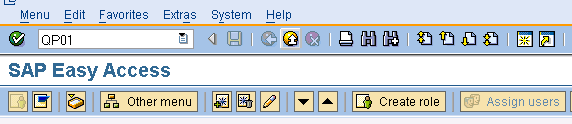
Step 2: Enter the material and plant for the inspection plan
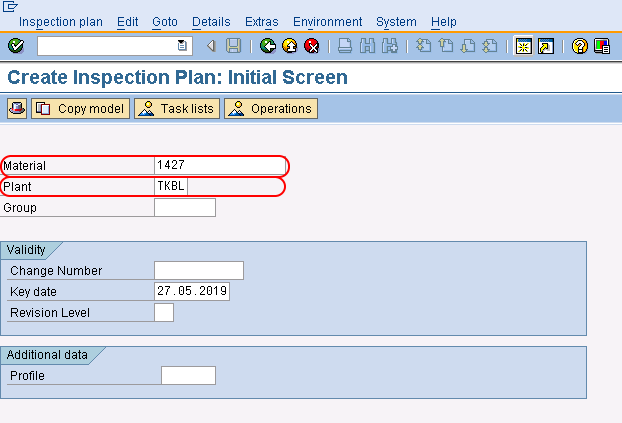
On the Create Inspection Plan: Initial Screen, enter the material and plant for which the plan must be created.
- Material: Enter the material number that will use the inspection plan.
- Plant: Enter the relevant plant code.
- Key date: If displayed, verify the date from which the task-list data must be valid.
- Press Enter to continue.
Step 3: Maintain inspection plan header details, usage, status, and lot size
On the Create Inspection Plan: Header Details screen, maintain the information that controls where and when the inspection plan can be selected.
- Description: Enter a clear description that identifies the purpose of the inspection plan.
- Usage: Select the task-list usage appropriate for the business process. The available values depend on SAP configuration.
- Status: Select a status that permits the plan to be used for inspection-lot processing. A plan that is not released may not be selected automatically.
- From lot size: Enter the lowest inspection-lot quantity for which this plan is valid, or leave it blank when permitted by configuration.
- To lot size: Enter the highest lot quantity for which the plan is valid.
- Dynamic modification: Maintain the dynamic modification rule when inspection stages or skip-lot processing are required.
- Inspection points: Maintain inspection-point settings when results must be recorded for time-based, quantity-based, equipment-based, or other configured inspection points.
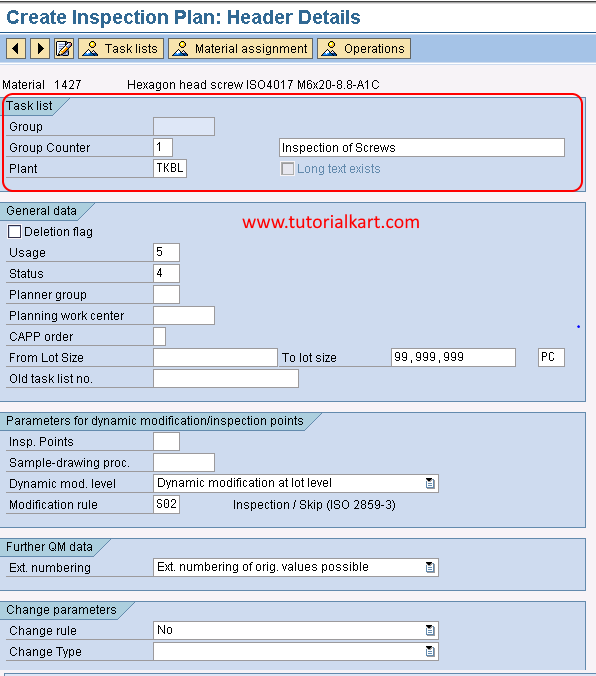
After maintaining the required header data, open the Task List or overview section to continue with the operation details.
Step 4: Review the inspection plan task-list overview
The task-list overview displays the inspection plan group, group counter, material assignment, validity, and lot-size range. Review these values before creating inspection operations.
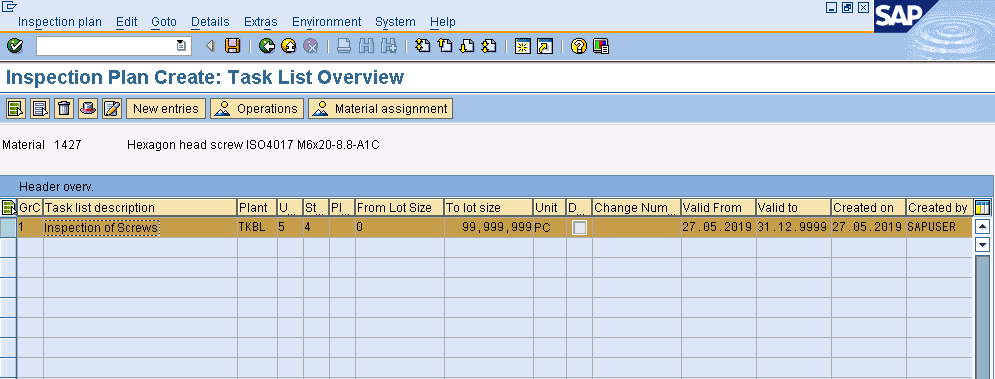
Choose Operations to define where the inspection work is performed and which inspection characteristics belong to each operation.
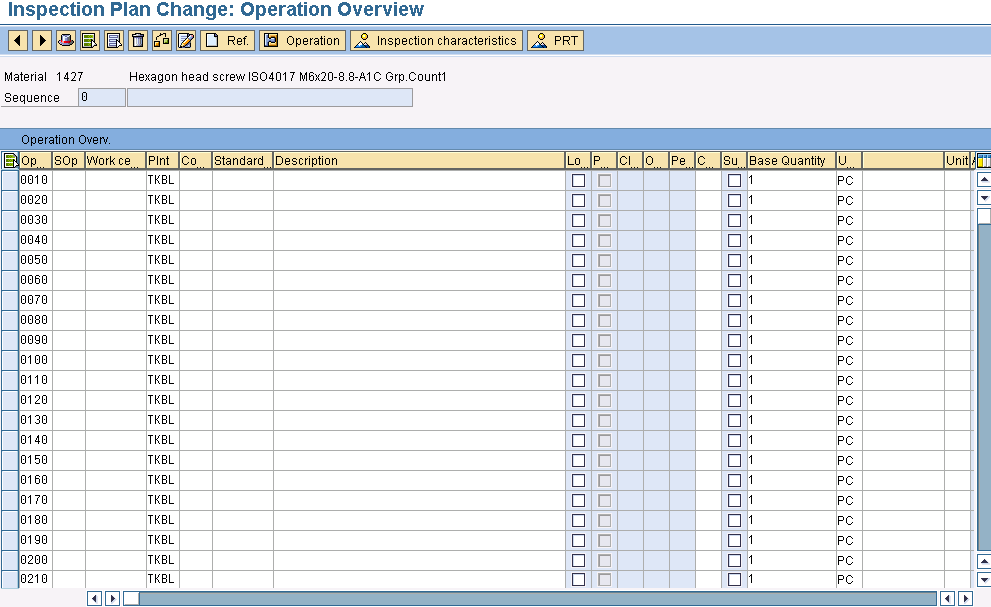
Step 5: Create inspection operations with a work center and control key
On the inspection plan operation overview, create one or more operations for the required inspection activities.
- Operation number: Use a sequence such as 0010, 0020, and 0030 so that additional operations can be inserted later.
- Work center: Enter the work center responsible for performing the inspection.
- Control key: Enter the configured control key that determines how the operation is processed.
- Operation description: Enter a meaningful description, such as incoming visual inspection, dimensional inspection, or laboratory testing.
- Standard values: Maintain setup, machine, or labor values when required by the work-center and costing configuration.
Step 6: Assign master inspection characteristics to each operation
An operation defines the inspection stage, but the inspection characteristics define what must be measured, checked, or evaluated. Select an operation and open the inspection-characteristics overview.
- Assign an existing master inspection characteristic when standardized inspection criteria are maintained centrally.
- Enter the characteristic version when version management is active.
- Confirm whether the characteristic is quantitative or qualitative.
- Maintain target values, lower limits, upper limits, selected sets, catalogs, or valuation rules as required.
- Assign an inspection method when the test procedure must be documented.
- Maintain result-recording and confirmation settings according to the inspection process.
Using master inspection characteristics helps keep specifications consistent across multiple inspection plans. Characteristics can also be maintained directly in the plan when permitted, but centrally managed characteristics are generally easier to reuse and control.
Step 7: Add a sampling procedure to the inspection characteristic
Assign a sampling procedure when SAP must calculate the number of units, containers, or samples to inspect. The sampling procedure can use a fixed sample, percentage sample, sampling scheme, or another configured sampling method.
- Open the control indicators or sampling data for the inspection characteristic.
- Enter the required sampling procedure.
- Verify the valuation mode and sample calculation.
- Confirm that the procedure is compatible with the qualitative or quantitative characteristic.
If no sampling procedure is assigned, the sample size may be determined by other characteristic settings or business-process configuration.
Step 8: Save the inspection plan and record its plan group
After entering the header, operations, inspection characteristics, and sampling data, select the save icon. SAP creates or updates the inspection plan and displays a confirmation message containing the plan group.

Record the generated plan group and group counter. These values are useful when displaying or changing the inspection plan later.
How SAP assigns an inspection plan to a material
When you enter a material and plant in QP01, SAP creates the material assignment as part of the inspection plan. During inspection-lot creation, SAP can search for a valid plan by evaluating criteria such as:
- Material and plant
- Task-list usage
- Inspection plan status
- Validity date
- Inspection-lot quantity and lot-size interval
- Inspection type and configured task-list selection rules
- Other configured selection criteria
If more than one valid plan matches the same material and plant, SAP may select a plan according to the configured selection rules or require manual assignment.
SAP inspection plan transaction codes used after QP01
| Transaction code | Purpose |
|---|---|
| QP01 | Create an inspection plan |
| QP02 | Change an existing inspection plan |
| QP03 | Display an inspection plan |
Additional transactions may be used for master inspection characteristics, inspection methods, sampling procedures, work centers, and inspection-lot processing. The transactions available to a user depend on authorization and the installed SAP solution.
SAP inspection plan tables commonly used for reporting
Inspection plan data is stored across several task-list and Quality Management tables rather than in one table. Commonly referenced tables include:
| Table | Inspection plan data |
|---|---|
| PLKO | Task-list header data |
| PLPO | Task-list operation data |
| MAPL | Assignment of a task list to a material |
| PLAS | Selection of task-list operations |
| PLMK | Inspection characteristics assigned within the task list |
| QPMK | Master inspection characteristic data |
Table relationships should be interpreted carefully because task-list records commonly use keys such as task-list type, group, group counter, internal counters, nodes, and validity information. Use standard SAP reports, APIs, or supported data models where available instead of updating these tables directly.
Why an SAP inspection plan is not selected for an inspection lot
If an inspection lot does not receive the expected inspection plan, check the following conditions:
- The inspection plan is assigned to the correct material and plant.
- The plan status permits use in inspection processing.
- The key date falls within the plan’s validity period.
- The inspection-lot quantity falls within the maintained lot-size range.
- The plan usage is permitted by the task-list selection configuration.
- The material has the required inspection type active in the Quality Management view.
- The operations contain valid inspection characteristics.
- Required master data, such as the work center or sampling procedure, is valid on the inspection date.
- No competing plan is being selected by a higher-priority rule.
SAP QM inspection plan example
For an incoming inspection of a purchased component, a basic inspection plan could contain the following structure:
| Operation | Inspection activity | Example characteristics |
|---|---|---|
| 0010 | Visual inspection | Surface condition, damage, packaging condition |
| 0020 | Dimensional inspection | Length, width, diameter, thickness |
| 0030 | Functional inspection | Operating result, pass/fail test, performance value |
The actual operations, tolerances, catalogs, methods, and sample sizes must be based on the approved quality specification for the material.
Inspection plan creation checks before testing QP01 data
- Confirm that the material and plant are correct.
- Verify that the inspection plan has a meaningful description.
- Check the usage, status, validity date, and lot-size range.
- Confirm that each operation has a valid work center and control key.
- Verify that all required inspection characteristics are assigned.
- Check specification limits, selected sets, catalogs, and valuation settings.
- Confirm that sampling procedures calculate the expected sample size.
- Save the plan and note the plan group and group counter.
- Create or review a test inspection lot to confirm that the correct plan is selected.
Frequently asked questions about SAP inspection plans
What is the transaction code for creating an inspection plan in SAP QM?
The transaction code is QP01. Use QP02 to change an inspection plan and QP03 to display one.
How is an inspection plan assigned to a material in SAP?
Enter the material and plant on the QP01 initial screen. SAP stores the material-to-task-list assignment with the inspection plan. The plan must also have suitable usage, status, validity, and lot-size data for inspection-lot selection.
Which SAP table contains the material assignment for an inspection plan?
The MAPL table is commonly used for material-to-task-list assignments. Inspection plan header, operation, and characteristic data is stored in related tables such as PLKO, PLPO, and PLMK.
Can one material have multiple inspection plans?
Yes. A material can have multiple plans or group counters with different usages, statuses, validity periods, lot-size ranges, or inspection content. The applicable plan is determined by task-list selection rules and inspection-lot data.
Why are master inspection characteristics added to an inspection plan?
Master inspection characteristics define reusable inspection requirements such as measurements, qualitative checks, tolerances, catalogs, methods, and control indicators. Assigning them to plan operations ensures that the required results can be recorded during inspection.