 TutorialKart.com
Create a Master Inspection Characteristic in SAP QM
A master inspection characteristic, commonly called an MIC, is reusable inspection master data in SAP Quality Management. It defines what must be inspected, how results are recorded, and which specifications or acceptance limits apply.
This tutorial explains how to create a master inspection characteristic with transaction code QS21. The example uses a quantitative characteristic with a target value and tolerance limits. The fields available on your screens may vary according to the SAP release, configuration, authorization, and selected control indicators.
| SAP transaction code | QS21 |
| Display transaction | QS23 |
| SAP menu path | SAP Menu > Logistics > Quality Management > Quality Planning > Basic Data > Inspection Characteristic > Create |
| Master data object | Master inspection characteristic |
| Typical use | Inspection plans, material specifications, results recording, and quality certificates |
Information Required Before Creating the SAP QM Inspection Characteristic
Before starting QS21, determine the inspection requirement and the values that must be controlled. For a quantitative characteristic, prepare the following information:
- Plant in which the master inspection characteristic will be maintained.
- Unique master inspection characteristic key.
- Short text and detailed description.
- Characteristic type, such as quantitative or qualitative.
- Unit of measurement.
- Target value and permitted lower and upper limits.
- Sampling, results-recording, and valuation requirements.
- Required status and reference characteristic settings.
The characteristic should be designed for reuse. Avoid creating several MICs for the same inspection requirement unless plants, units, methods, specifications, or business processes require separate master records.
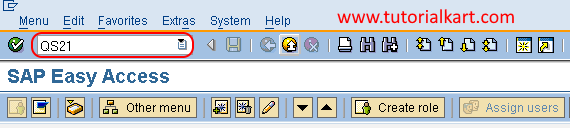
Step 1: Open Transaction QS21
Execute transaction code “QS21” in the SAP command field.
Step 2: Enter the Plant and Master Inspection Characteristic Key
On the Create Master Inspection Characteristic: Initial Screen, enter the organizational and identification details for the new MIC.
- Plant: Enter the plant in which the characteristic will be created and used.
- Master Insp. Charc.: Enter a unique key that identifies the master inspection characteristic.
- Key date: Where available, confirm the validity date from which the characteristic should apply.
- Copy model: Use this only when an existing characteristic is suitable as a template. Review all copied values before saving.
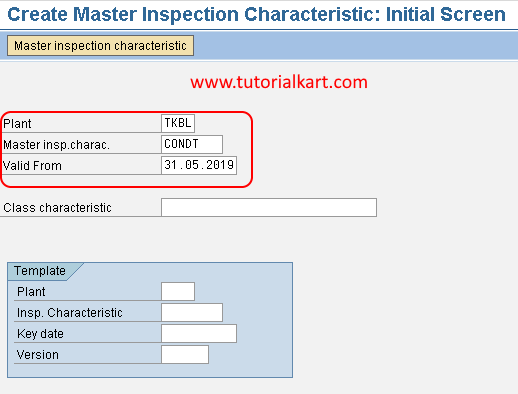
Press Enter to continue to the general data screen.
Step 3: Maintain General Data for the Master Inspection Characteristic
On the Create Master Inspection Characteristic: General Data screen, maintain the description, characteristic type, status, and reference settings required by your quality process.
- Control data: Select the appropriate characteristic type. In this example, choose a quantitative characteristic.
- Status: Select a status that permits the intended use. Use Released only after the master data has been reviewed and is ready for operational use.
- Reference characteristic: Choose the complete-copy or reference model required by your organization’s master-data design.
- Short text: Enter a concise, recognizable name for the inspection characteristic.
- Search field: Enter a useful search term or classification key where required.
- Description: Enter enough detail for planners and inspectors to understand exactly what is measured or evaluated.
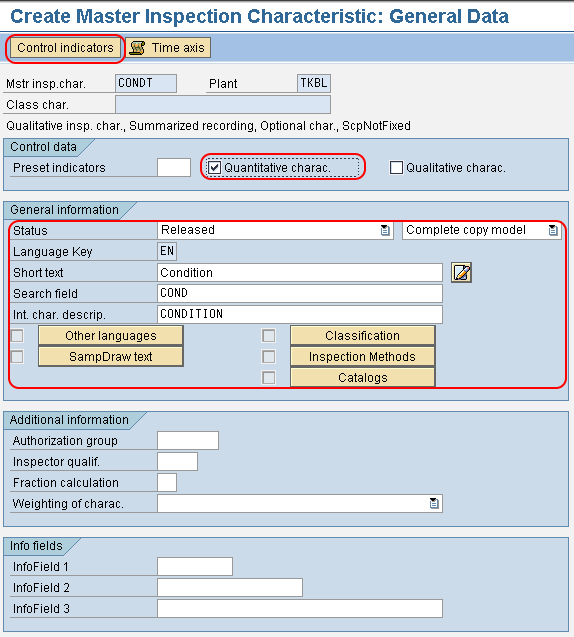
After entering the general data, choose Control Indicators. These indicators determine how SAP handles sampling, result entry, valuation, documentation, and other inspection functions.
Step 4: Configure the Characteristic Control Indicators
On the Edit Characteristic Control Indicators screen, select only the indicators required by the inspection process. The available options are grouped by function and can include the following areas:
- Type: Determines whether the characteristic is quantitative or qualitative and whether specifications are maintained.
- Sample: Controls how sample-related values are handled for the characteristic.
- Results confirmation: Determines how inspection results are recorded, summarized, or confirmed.
- Documentation: Controls whether additional documentation or long text is required.
- Valuation: Determines whether and how the recorded result is valuated against the specification.
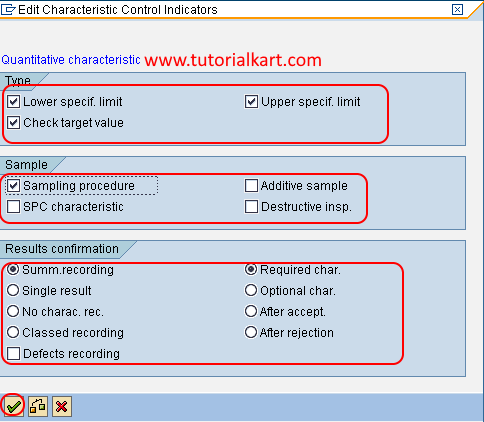
Some control indicators open additional screens or require related settings. Select the required fields and press Enter to continue.
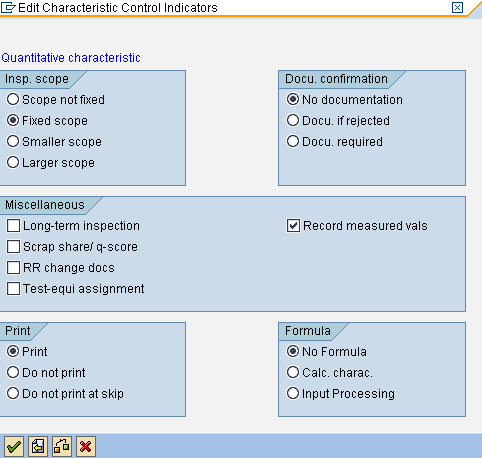
Review the selected indicators carefully. They influence later processing in inspection plans and results recording, so they should match the actual inspection procedure rather than being selected by default.
Step 5: Enter Tolerance and Quantitative Specification Data
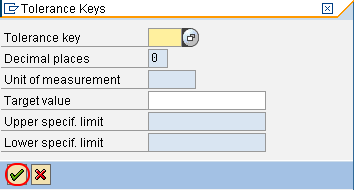
The tolerance-key screen appears when the selected control indicators require quantitative specifications. Enter or confirm the tolerance-related settings, and press Enter to continue.
On the quantitative data screen, maintain the numerical specification used to evaluate inspection results.
- Unit of measurement: Enter the unit in which the result will be recorded, such as millimetres, kilograms, seconds, or degrees Celsius.
- Target value: Enter the desired or nominal result.
- Lower specification limit: Enter the lowest acceptable result when a lower limit applies.
- Upper specification limit: Enter the highest acceptable result when an upper limit applies.
- Decimal places: Confirm that the number of decimal places supports the precision of the measuring equipment and specification.
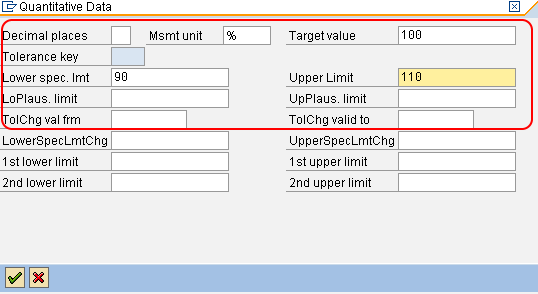
Check that the lower limit is less than or equal to the target value and that the target value is less than or equal to the upper limit. Also verify that the unit and decimal precision are consistent with the inspection method.
Step 6: Save and Verify the New SAP QM MIC
After maintaining the required general data, control indicators, and quantitative values, choose the Save icon to store the master inspection characteristic in SAP.
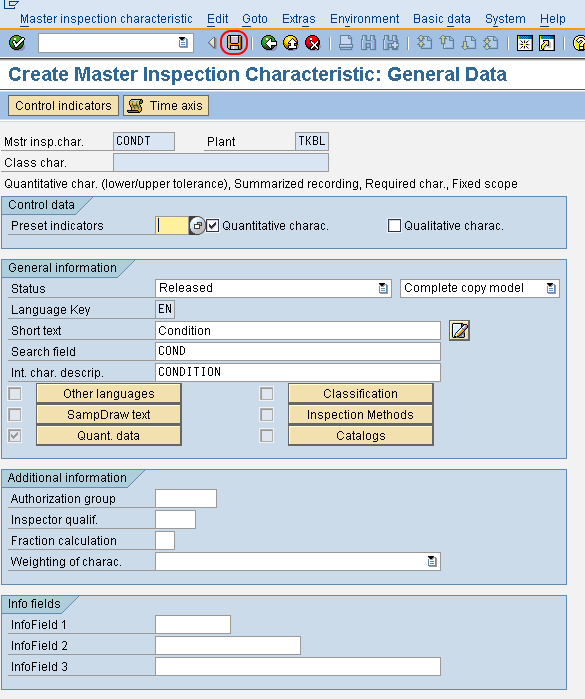
SAP displays a confirmation message after the characteristic is created.

Use transaction QS23 to display the saved master inspection characteristic and verify its plant, status, descriptions, control indicators, unit, target value, and specification limits. The MIC can then be assigned where required, such as in an inspection plan or certificate-related quality process.
Quantitative and Qualitative Master Inspection Characteristics
| Characteristic type | How results are recorded | Typical master data | Example |
|---|---|---|---|
| Quantitative | As a measured numerical value | Unit, target value, lower limit, upper limit, decimal places | Diameter, weight, temperature, pressure |
| Qualitative | As an attribute, code, or selected value | Selected set, code group, catalog, valuation rule | Colour, surface condition, pass or fail |
Choose the type according to the way the inspection result is actually obtained. Do not configure a measured numerical requirement as a qualitative MIC merely to simplify data entry, because doing so can remove useful specification and tolerance controls.
SAP QM MIC Validation Checklist
- Confirm that the MIC key is unique and follows the organization’s naming convention.
- Verify that the plant is correct before saving.
- Check that the characteristic is quantitative or qualitative as required by the inspection method.
- Confirm that the unit of measurement matches the measuring instrument and specification.
- Verify the target value, lower limit, upper limit, and decimal precision.
- Review sampling, results-recording, valuation, and documentation control indicators.
- Release the MIC only after its data has been reviewed.
- Display the saved record in QS23 before assigning it to an inspection plan.
Frequently Asked Questions About Master Inspection Characteristics
What is a master inspection characteristic in SAP QM?
A master inspection characteristic is reusable SAP QM master data that defines an inspection requirement. It can contain descriptions, control indicators, quantitative specifications, qualitative codes, sampling-related settings, and other information used during inspection planning and results recording.
Which transaction code creates a master inspection characteristic?
Use transaction code QS21 to create a master inspection characteristic. The characteristic is normally maintained for a specific plant.
Which transaction code displays a master inspection characteristic?
Use transaction code QS23 to display a master inspection characteristic. This is useful for verifying the saved status, descriptions, control indicators, and specification values.
How are characteristic values created in SAP QM?
For a quantitative MIC, maintain values such as the unit, target value, and lower and upper specification limits. For a qualitative MIC, results are commonly controlled through catalogs, code groups, selected sets, or predefined attribute values, depending on the configured process.
Why can a master inspection characteristic not be used in an inspection plan?
Common causes include an incorrect plant, a status that does not permit use, a validity date outside the plan’s key date, missing required data, or incompatible characteristic settings. Display the MIC in QS23 and verify its plant, status, validity, and control indicators.