 TutorialKart.com
An inspection lot in SAP Quality Management is the operational record used to plan an inspection, record results, document defects, valuate inspection characteristics, and complete the process with a usage decision. The inspection lot connects the material, plant, inspection type, inspection specifications, quantity, dates, and stock-related data required for quality processing.
SAP can create inspection lots automatically from business transactions such as a goods receipt, production order, delivery, or stock transfer. Users can also create an inspection lot manually with transaction code QA01 when the inspection must be started independently of an automatic logistics event.
QA01 transaction details for manual inspection lot creation
| Transaction code | QA01 |
| SAP Path | SAP Menu > Logistics > Quality Management > Quality Management > Quality Inspection > Inspection Lot > Create |
| Purpose | Create an inspection lot manually for a material and plant |
The fields available in QA01 depend on the inspection lot origin, inspection type, material master settings, and SAP configuration. Before creating the lot, verify that a valid inspection type is active for the material in the relevant plant.
Inspection type setup required before using QA01
If the material does not have an inspection type that is valid for manual lot creation, SAP may display a message such as No valid inspection type for material. The inspection setup must then be maintained in the Quality Management view of the material master.

Step 1: Open the material master Quality Management view in MM02
Execute transaction code MM02, enter the required material number, and select the organizational levels for the plant in which the inspection lot will be created.
Select the Quality Management view and continue to the material master data.
Step 2: Open the inspection setup for the material and plant
In the Quality Management view, review the procurement and inspection-related settings, and then choose Inspection setup.
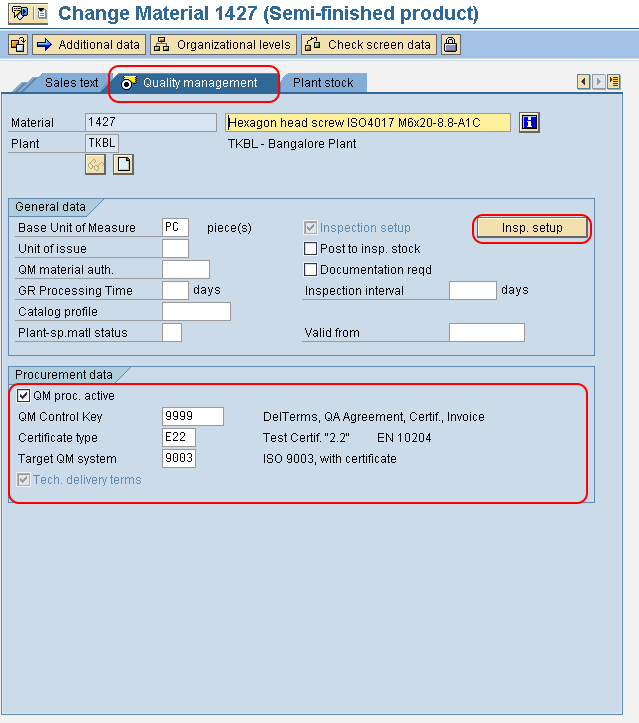
Step 3: Add an inspection type valid for manual lot creation
On the inspection setup screen, choose the option to create or add an inspection type.
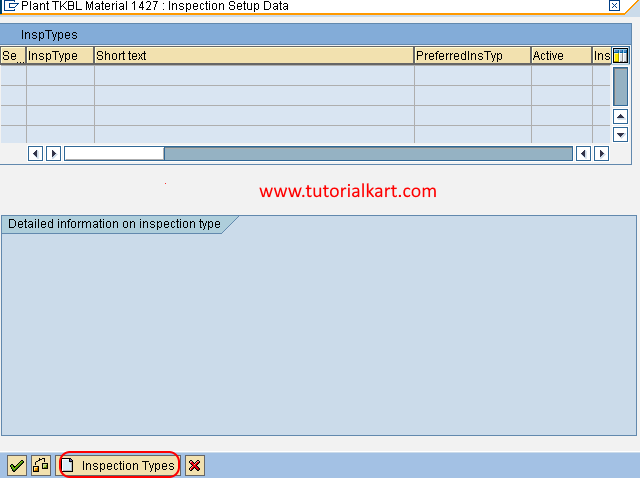
Select the inspection type required for the process and press Enter. In this example, inspection type 89 is assigned to the material.
Inspection type 89 is commonly associated with miscellaneous or manually triggered inspections, but the exact inspection type and control settings must follow the configuration used in your SAP system.
Step 4: Review the inspection type control indicators
Review the control indicators maintained for the selected inspection type. These settings determine how the inspection lot behaves, including whether an inspection plan is selected, whether specifications are assigned automatically, and how stock or results processing is controlled.
In the example shown, the automatic assignment option has been removed. Do not copy this setting without checking the intended inspection process, because task-list assignment requirements can differ between implementations.
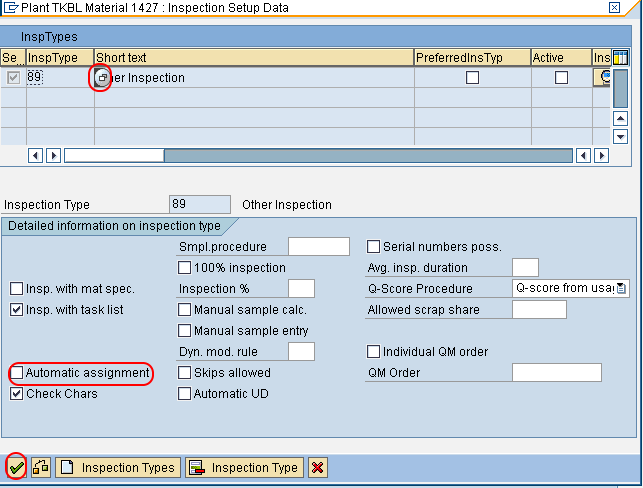
Save the material master after confirming that the inspection type is active and valid for the required plant.
How to create an inspection lot manually with QA01
Step 1: Start manual inspection lot creation in QA01
Execute transaction code QA01 in the SAP command field.
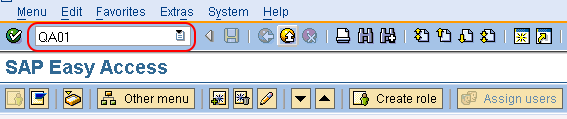
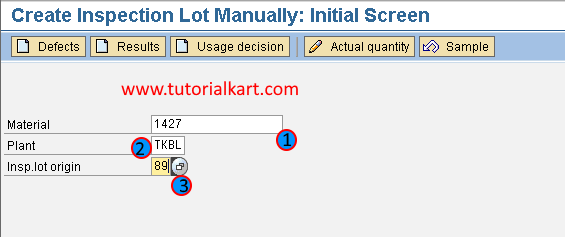
Step 2: Enter the material, plant, and inspection lot origin
On the Create Inspection Lot Manually: Initial Screen, enter the basic data used to identify the inspection process.
- Material: Enter the material number to be inspected.
- Plant: Enter the plant in which the inspection will be managed.
- Inspection lot origin: Enter the origin that represents how the inspection lot is created and processed.
- Inspection type: If SAP displays more than one valid inspection type for the selected origin, choose the one required for the process.
The inspection lot origin is a system-defined category. It controls the business context of the lot and influences which inspection types and fields are available. Standard origins are delivered by SAP and are used according to the configured inspection process.
After entering the material, plant, and inspection lot origin, press Enter to continue.
Step 3: Maintain inspection lot quantity and dates
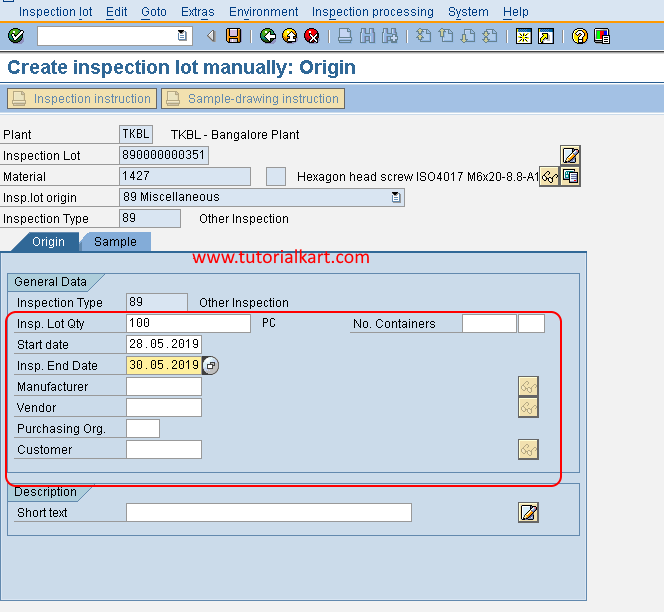
On the origin-specific inspection lot screen, maintain the quantity and scheduling data required for the inspection.
- Inspection lot quantity: Enter the quantity that must be inspected.
- Base unit of measure: Confirm that the unit displayed for the lot quantity is correct.
- Start date: Enter the planned starting date of the inspection.
- End date: Enter the planned completion date of the inspection.
- Batch: Enter a batch when the material is batch-managed and the inspection applies to a specific batch.
- Storage location: Maintain the location when it is required by the origin or stock-related process.
- Short text: Add a clear description when the field is available so that the purpose of the manual lot can be identified later.
Step 4: Verify inspection specifications before saving the lot
Before saving, check whether SAP has assigned the expected inspection plan or material specification. The available inspection characteristics determine what can be recorded during results recording.
- Confirm that the expected inspection type is active.
- Check whether an inspection plan has been selected when task-list assignment is required.
- Verify the plan usage, status, validity date, and lot-size range.
- Confirm that the inspection characteristics are available for results recording.
- Review the sample size when a sampling procedure is assigned.
Step 5: Save the manually created inspection lot
Choose the save icon after reviewing the inspection lot data. SAP generates an inspection lot number and displays it in the confirmation message.
Record the inspection lot number. It is required for later activities such as displaying the lot, recording inspection results, documenting defects, and making a usage decision.
Manual and automatic inspection lot creation in SAP QM
| Creation method | How the inspection lot is triggered | Typical use |
|---|---|---|
| Manual creation | A user creates the lot with QA01 | Ad hoc inspections, miscellaneous inspections, retesting, or inspections not triggered by a logistics document |
| Automatic creation | SAP creates the lot when a configured business transaction is posted | Goods receipt, production, delivery, stock transfer, recurring inspection, or other integrated processes |
Automatic inspection lot creation depends on the inspection type being active in the material master and on the relevant logistics event. For example, a goods receipt inspection lot can be generated when a receipt is posted for a material whose procurement inspection settings are active.
Manual lot creation does not replace the integrated automatic process. It is normally used when the inspection must be initiated separately and the selected inspection lot origin permits manual creation.
Inspection lot data used during SAP QM processing
After an inspection lot is created, it can contain or reference the following information:
- Material, plant, batch, and quantity
- Inspection lot origin and inspection type
- Inspection plan or material specification
- Inspection operations and characteristics
- Sampling procedure and calculated sample size
- Inspection start and end dates
- Results, valuations, and characteristic status
- Defect records and quality notifications where applicable
- Usage decision and stock posting information
SAP transaction codes used after creating an inspection lot
| Transaction code | Purpose |
|---|---|
| QA01 | Create an inspection lot manually |
| QA02 | Change an inspection lot |
| QA03 | Display an inspection lot |
| QA32 | Process or monitor inspection lots through the inspection lot worklist |
| QE51N | Record inspection results using the worklist |
| QA11 | Record a usage decision for an inspection lot |
The transactions available to a user depend on authorization, SAP release, and system configuration.
Why SAP does not create or save the inspection lot
When QA01 does not create the expected inspection lot, review the following conditions:
- No valid inspection type is active for the material and plant.
- The inspection type is inactive or its preferred inspection type settings are inconsistent.
- The selected inspection lot origin is not compatible with the active inspection type.
- The inspection lot quantity or unit of measure is missing or invalid.
- The material is batch-managed, but the required batch has not been entered.
- No valid inspection plan can be selected when inspection specifications are mandatory.
- The inspection plan is not released, is outside its validity period, or does not cover the lot quantity.
- The user does not have authorization to create inspection lots for the plant or origin.
- Mandatory origin-specific fields have not been completed.
Why an inspection plan is not assigned to the manual lot
If the inspection lot is created without the expected inspection plan, check the task-list selection conditions:
- The inspection plan is assigned to the same material and plant.
- The inspection plan usage is permitted for the selected inspection type.
- The plan status allows use in inspection processing.
- The inspection lot key date falls within the plan validity period.
- The inspection lot quantity falls within the plan’s lot-size interval.
- The material assignment and group counter are valid.
- Automatic task-list assignment is active when required.
QA checklist for a manually created SAP inspection lot
- Verify the material number and plant.
- Confirm that the intended inspection type is active in the material master.
- Check that the selected inspection lot origin matches the business purpose.
- Validate the inspection lot quantity and unit of measure.
- Enter the batch and storage location when required.
- Review the start date and end date.
- Confirm that the correct inspection plan or specification is assigned.
- Check that inspection characteristics and sample sizes are available.
- Save the lot and record the generated inspection lot number.
- Open the lot in QA03 or QA32 and verify that it is ready for results recording.
Frequently asked questions about manual inspection lots in SAP
Which transaction code creates an inspection lot manually in SAP QM?
Use transaction code QA01 to create an inspection lot manually. QA02 is used to change a lot, and QA03 is used to display it.
Why does QA01 show no valid inspection type for the material?
This message usually means that the material does not have an active inspection type compatible with the selected inspection lot origin in the relevant plant. Maintain the inspection setup in the Quality Management view of MM02 and verify the inspection type control indicators.
How are inspection lots created automatically in SAP?
SAP creates inspection lots automatically when a configured business event occurs, such as a goods receipt, production posting, delivery, stock transfer, or scheduled recurring inspection. The corresponding inspection type must be active for the material and plant.
Can QA01 create an inspection lot without an inspection plan?
It depends on the inspection type and configuration. Some processes permit a lot without task-list assignment, while others require an inspection plan or material specification before results can be recorded.
What happens after an inspection lot is created?
The usual next steps are to review the lot, calculate or confirm the sample, record inspection results, document defects where necessary, complete characteristic valuations, and make the usage decision.