 TutorialKart.com
What is Microsoft Azure Storage?
Microsoft Azure Storage is a cloud storage platform for storing application data, files, messages, tables, backups, logs, and large unstructured objects. It is used by virtual machines, web applications, mobile applications, analytics workloads, and many other Azure services.
An Azure storage account is the container for Azure Storage data objects such as blobs, file shares, queues, and tables. The storage account gives your data a unique namespace in Azure and provides settings for performance, redundancy, security, networking, and access.
This tutorial explains the main Azure Storage services and then shows how to create an Azure Storage account from the Azure portal. The screenshots in this tutorial were captured from an older Azure portal layout, so some labels may look different in the current portal, but the storage account concepts remain the same.
Core Azure Storage services inside a storage account
A standard general-purpose storage account can be used for several storage services. The service you choose depends on the type of data and how your application needs to access it.
| Azure Storage service | Used for | Common example |
|---|---|---|
| Blob Storage | Object storage for unstructured data | Images, videos, documents, backups, logs, and application files |
| Azure Files | Managed file shares | Shared folders accessed by applications, users, or servers |
| Queue Storage | Simple message queues | Passing messages between application components |
| Table Storage | NoSQL key-value data | Large volumes of structured or semi-structured entities |
Azure Blob Storage for unstructured data
Blob stands for Binary Large Object. Azure Blob Storage is designed for unstructured data such as documents, files, images, videos, logs, backups, and virtual hard disk files. It is commonly used when data does not need to follow a fixed table schema.
Blob data is stored in containers inside a storage account. For cost management, Blob Storage also supports access tiers such as hot, cool, cold, and archive, depending on how often the data is accessed.
Azure Table Storage for NoSQL key-value data
Table Storage is a NoSQL data store for large amounts of structured or semi-structured non-relational data. It is useful when you need fast access to entities by partition and row key, but you do not need relational database features such as joins and foreign keys.
Azure Queue Storage for application messages
Queue Storage provides reliable message storage for communication between application components. A common use case is asynchronous processing, where one component adds messages to a queue and another component processes them later.
For example, a web application can place a message in a queue when a user uploads a file. A background worker can then read the message and process the file without making the user wait.
Azure Files for managed file shares
Azure Files is used to create managed file shares in Azure. These shares can be accessed by applications and systems using file sharing protocols such as SMB, and in supported scenarios NFS. Azure Files is useful when an application expects a shared file system instead of object storage.
How to create an Azure Storage account
To use Azure Storage services, create a storage account first. After the storage account is created, you can create containers, file shares, queues, or tables within that account and then upload or manage data.
Azure Storage Account is the basic management unit for Azure Storage. It controls the namespace, endpoints, redundancy, access settings, networking rules, encryption settings, and supported storage services. Azure Storage accounts can be created from the Azure portal, Azure CLI, Azure PowerShell, ARM templates, Bicep, or Terraform.
Azure Storage account settings to decide before creation
| Setting | What to choose | Why it matters |
|---|---|---|
| Subscription | The Azure subscription where billing and ownership are managed | Controls where the storage account resource is created |
| Resource group | An existing or new resource group | Groups related Azure resources together |
| Storage account name | A globally unique lowercase name | Used in service endpoints such as blob and file URLs |
| Region | The Azure region closest to your users or workload | Affects latency, availability options, and compliance needs |
| Performance | Standard for most general workloads, Premium for selected high-performance workloads | Affects supported services, performance, and cost |
| Redundancy | LRS, ZRS, GRS, RA-GRS, GZRS, or RA-GZRS depending on requirement and region | Controls how copies of data are stored for durability and availability |
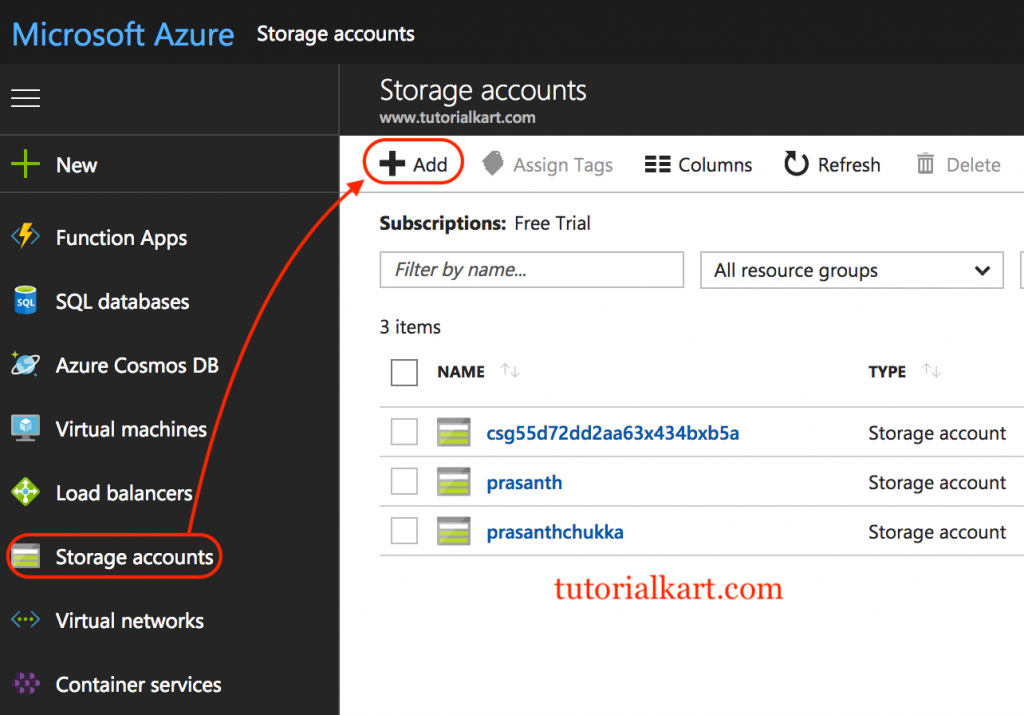
- To create Microsoft Azure Storage account, navigate to Storage accounts | +Add.
Enter the storage account name, select the subscription and resource group, choose the region, and select the required performance and redundancy options. In older portal screens, you may see fields such as deployment model or account kind. In current Azure portal screens, a standard general-purpose v2 storage account is normally used for most blob, file, queue, and table storage scenarios.
The storage account name must be unique across Azure, must use lowercase letters and numbers, and is used as part of service endpoint URLs. For example, a blob endpoint uses a pattern similar to https://accountname.blob.core.windows.net.
Azure Storage redundancy choices during account creation
Azure keeps multiple copies of storage data based on the redundancy option selected for the account. The available options can vary by region, account type, and service.
- Locally redundant storage (LRS): Stores copies within a single data center in the primary region.
- Zone-redundant storage (ZRS): Stores copies across availability zones in the primary region where supported.
- Geo-redundant storage (GRS): Replicates data to a secondary region for regional disaster recovery.
- Read-access geo-redundant storage (RA-GRS): Provides read access to replicated data in the secondary region.
- Geo-zone-redundant options: Some regions and account types also support GZRS and RA-GZRS.
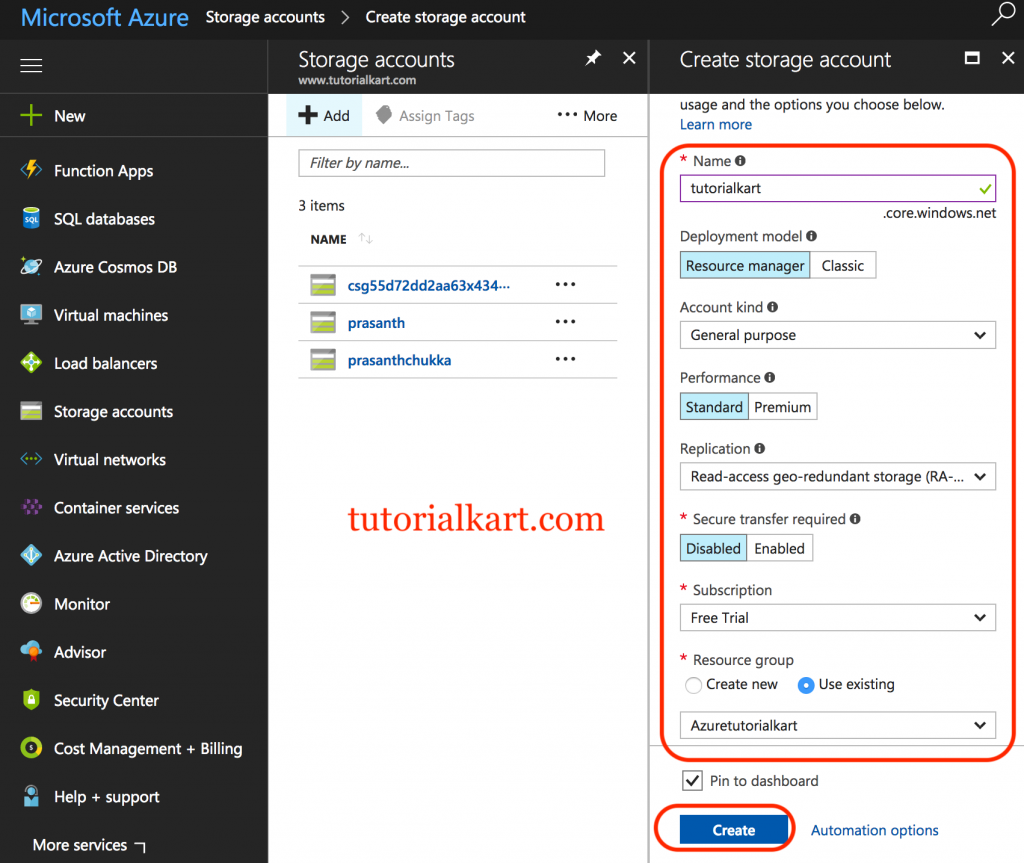
- Select subscription and resource group. Create new resource group if no resource group is available.
- Review the storage account configuration, validate the settings, and finally click on Create.
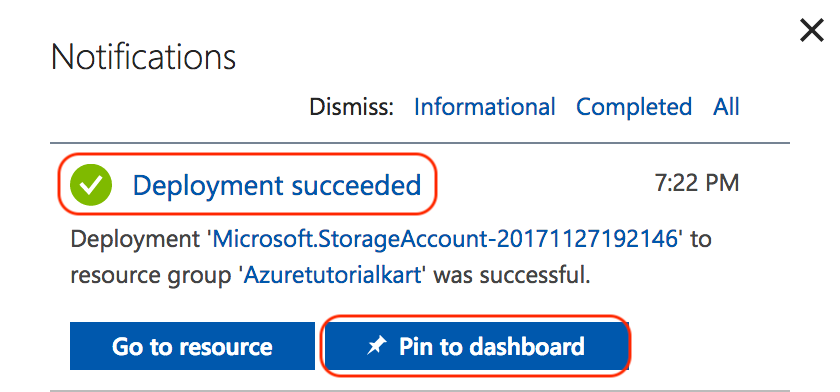
Now our Azure Data Storage account called ‘tutorialkart’ deployed successfully as shown above.
Navigating to the created Azure Storage account
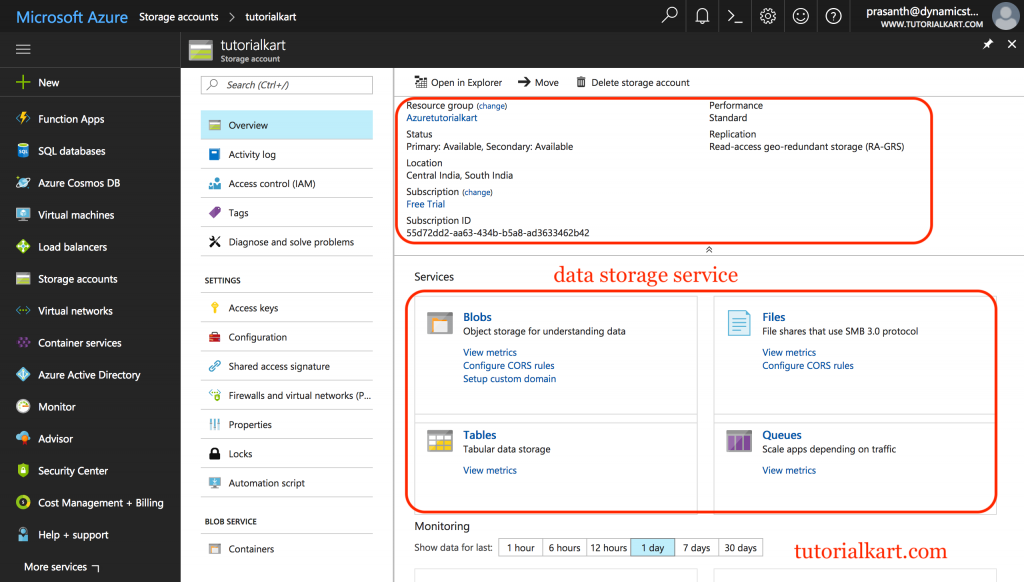
- Click on the ‘Storage account‘ as shown below.

After you open the storage account, you can view its overview, endpoints, access keys, networking options, data protection settings, encryption settings, and storage services. The available services depend on the type of storage account that you created.
Security checks after creating an Azure Storage account
After the account is created, review the security and access settings before storing production data.
- Use Microsoft Entra ID where possible: Prefer role-based access control for supported storage operations instead of sharing account keys widely.
- Review public access: Keep anonymous access disabled unless a specific public blob scenario requires it.
- Restrict network access: Use firewall, virtual network, or private endpoint settings when the storage account should not be open to all networks.
- Enable data protection features: Consider soft delete, versioning, change feed, or immutability based on the workload.
- Monitor storage activity: Use logs, metrics, alerts, and diagnostic settings to track availability, usage, and access patterns.
When to use Blob, Files, Queue, and Table Storage
| Requirement | Recommended Azure Storage service |
|---|---|
| Store images, videos, documents, backups, or log files | Blob Storage |
| Create a shared folder for applications or users | Azure Files |
| Pass messages between application components | Queue Storage |
| Store simple NoSQL entities with partition and row keys | Table Storage |
| Build big data analytics storage on top of blobs | Azure Data Lake Storage capabilities on Blob Storage |
Common mistakes while creating Azure Storage accounts
- Choosing the wrong region: Pick a region based on workload location, latency, compliance, and supported redundancy options.
- Using a weak naming plan: Storage account names are globally unique and cannot be easily changed later.
- Leaving access too open: Review public access, shared keys, SAS tokens, firewall rules, and private endpoint requirements.
- Selecting redundancy without cost review: Higher redundancy can improve resilience but may increase cost.
- Ignoring lifecycle management: For blob data, use access tiers and lifecycle rules to move or delete data when it becomes less frequently used.
Editorial QA checklist for this Azure Storage tutorial
- Confirm that the tutorial explains the storage account as the namespace and management container for blobs, files, queues, and tables.
- Check that Blob Storage, Azure Files, Queue Storage, and Table Storage are described with distinct use cases.
- Ensure portal steps mention current account settings such as subscription, resource group, region, performance, and redundancy.
- Verify that older screenshot labels are not treated as the only current Azure portal experience.
- Review security guidance for Microsoft Entra ID, public access, network restrictions, and monitoring before publishing.
FAQs on Microsoft Azure Storage accounts
What is an Azure Storage account?
An Azure Storage account is a top-level Azure resource that contains storage data objects such as blobs, file shares, queues, and tables. It provides a unique namespace and controls access, redundancy, networking, and other storage settings.
Which Azure Storage service should I use for files and images?
Use Blob Storage for unstructured objects such as images, videos, documents, logs, and backups. Use Azure Files when you need a managed file share that behaves like a shared folder.
What is the difference between Blob Storage and Azure Files?
Blob Storage is object storage for unstructured data and is accessed through blob APIs and URLs. Azure Files provides managed file shares that can be mounted or accessed by applications using file sharing protocols such as SMB and, in supported scenarios, NFS.
Can one storage account contain blobs, files, queues, and tables?
Yes, a standard general-purpose v2 storage account supports Blob Storage, Azure Files, Queue Storage, and Table Storage. Some premium or specialized account types support only selected services.
What redundancy option should I choose for an Azure Storage account?
Choose redundancy based on availability, disaster recovery, compliance, and cost requirements. LRS is local to a single data center, ZRS spreads data across zones where supported, and geo-redundant options replicate data to another region.
Microsoft Azure Storage reference links
- Microsoft Learn: Introduction to Azure Storage
- Microsoft Learn: Storage account overview
- Microsoft Learn: Create a storage account
- Microsoft Learn: Introduction to Azure Blob Storage
Azure Storage account summary : In this Microsoft Azure tutorial, we learned what Azure Storage is, how Blob Storage, Azure Files, Queue Storage, and Table Storage are used, and how to create an Azure Storage account. In the next Azure tutorial, we can create specific storage services inside the storage account.