 TutorialKart.com
What is Azure Blob Storage?
Azure Blob Storage is Microsoft’s object storage service for storing large amounts of unstructured data in the cloud. A blob can be a document, image, video, audio file, backup file, log file, archive, or any other text or binary object that does not need a fixed table schema.
Blob stands for Binary Large Object. In Azure, blobs are stored inside containers, and containers are stored inside a storage account. A storage account gives you the namespace, security settings, redundancy options, and endpoints that applications use to upload and download blob data.
For the official platform definition, see Microsoft Learn: Introduction to Azure Blob Storage.
Azure Storage account vs Azure Blob Storage
Azure Storage is the broader storage platform. A general-purpose Azure Storage account can contain several storage services, such as Blob Storage, Azure Files, Queue Storage, and Table Storage. Azure Blob Storage is one service inside that account, designed specifically for object data such as files, media, backups, and logs.
This distinction is useful when you create resources in the Azure portal. You normally create a storage account first, then create a blob container inside it, and finally upload blobs into that container. For more details about storage accounts, see Azure Storage account overview.
Common Azure Blob Storage use cases
- Serving images, documents, videos, and other static files for web or mobile applications.
- Storing backups, exported reports, archives, and application-generated files.
- Collecting log files from applications, devices, or services.
- Storing data for analytics, data lakes, and batch processing workloads.
- Providing durable object storage that can be accessed over HTTP or HTTPS.
What are Blob containers?
Blob containers are logical structures used to organize blobs. A container can hold zero or more blobs. Containers are similar to folders at the service level, but they also carry important access settings such as whether anonymous public read access is allowed.
By default, blob data should be kept private unless there is a clear reason to make it public. Private containers require authenticated access through Microsoft Entra ID, shared access signatures, or storage account keys. Public access, when enabled on the storage account, should generally be limited to read-only scenarios such as public images or downloadable files.
Azure Blob Storage hierarchy: account, container, and blob
| Level | What it represents | Example |
|---|---|---|
| Storage account | The top-level Azure resource that provides endpoints, access control, redundancy, and billing scope. | tutorialkart |
| Blob container | A logical container inside the storage account that stores blobs. | images or documents |
| Blob | The actual object/file stored in the container. | logo.png or invoice.pdf |
Types of blobs in Azure Blob Storage
Azure Blob Storage supports three blob types. The blob type is selected based on how the data will be written and accessed.
Block blobs
Block blobs are the most common blob type. They are a good choice for documents, images, videos, backups, and other files that are uploaded and read as complete objects or as ranges of bytes. Most normal file upload scenarios use block blobs.
Page blobs
Page blobs are optimized for random read and write operations. They are commonly associated with virtual hard disk scenarios, such as disks used by Azure Virtual Machines.
Append blobs
Append blobs are optimized for append operations. New data is added to the end of the blob, which makes append blobs useful for log files and simple write-once logging scenarios.
| Blob type | Best suited for | Typical example |
|---|---|---|
| Block blob | General object storage and file uploads | Images, PDFs, videos, backups |
| Page blob | Random read/write workloads | Virtual hard disks |
| Append blob | Append-only writes | Application logs |
Azure Blob Storage access tiers
Azure Blob Storage also provides access tiers so that data can be stored according to how frequently it is used. Common tiers include Hot for frequently accessed data, Cool and Cold for less frequently accessed data, and Archive for rarely accessed data that can tolerate retrieval delay. Microsoft also documents a smart tier option for selected scenarios where usage patterns are not clear.
Access tier selection affects storage cost, access cost, and retrieval behavior. For a current explanation of tier behavior, see Access tiers for blob data.
Creating Azure Blob Storage in the Azure portal
To create Azure Blob Storage, first create or open an Azure Storage account. Then create a blob container inside that account and upload the required files. In this tutorial, we create a blob container in the storage account named tutorialkart.
- Navigate to the tutorialkart storage account as shown below.
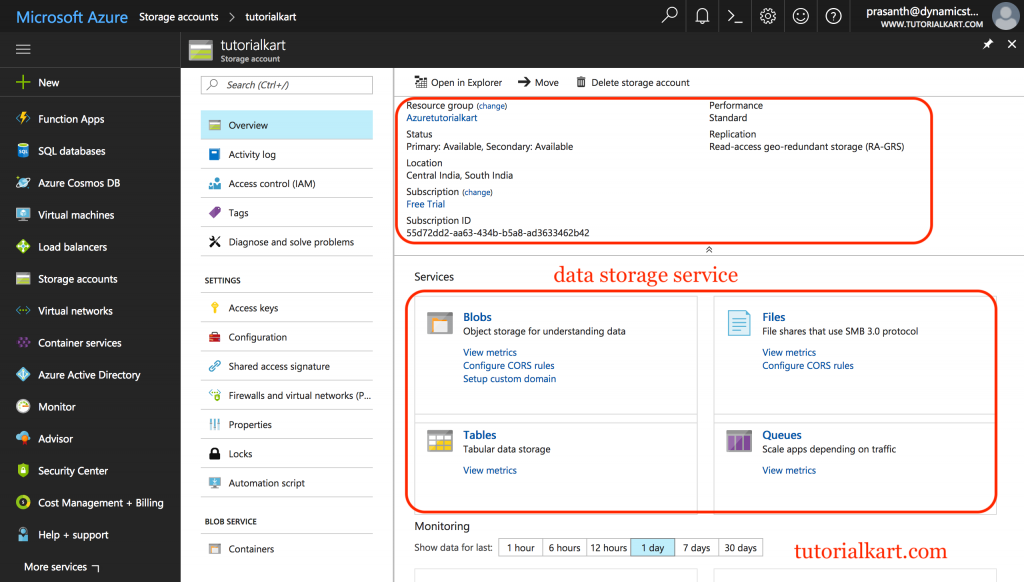
As shown in the screenshot, the storage account displays the available storage services. To work with Azure Blob Storage, click Blobs. The blob service page opens as shown below.
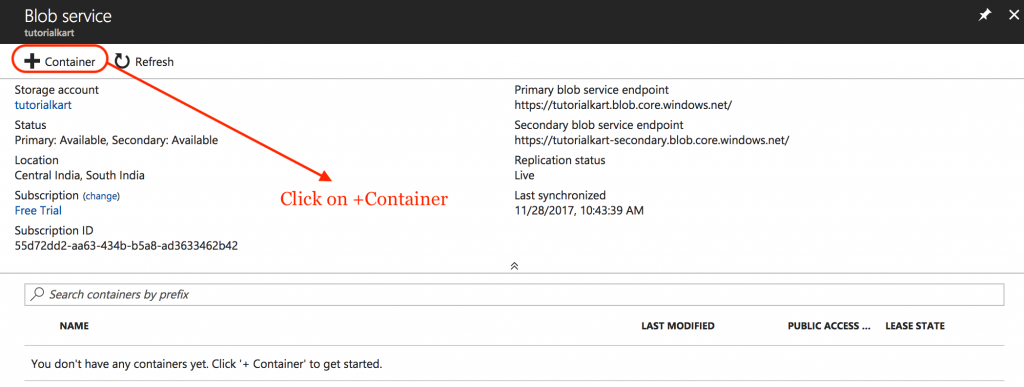
Before uploading a file, create a blob container. The container will hold the blobs that you upload.
- Click + Container to create a new container.
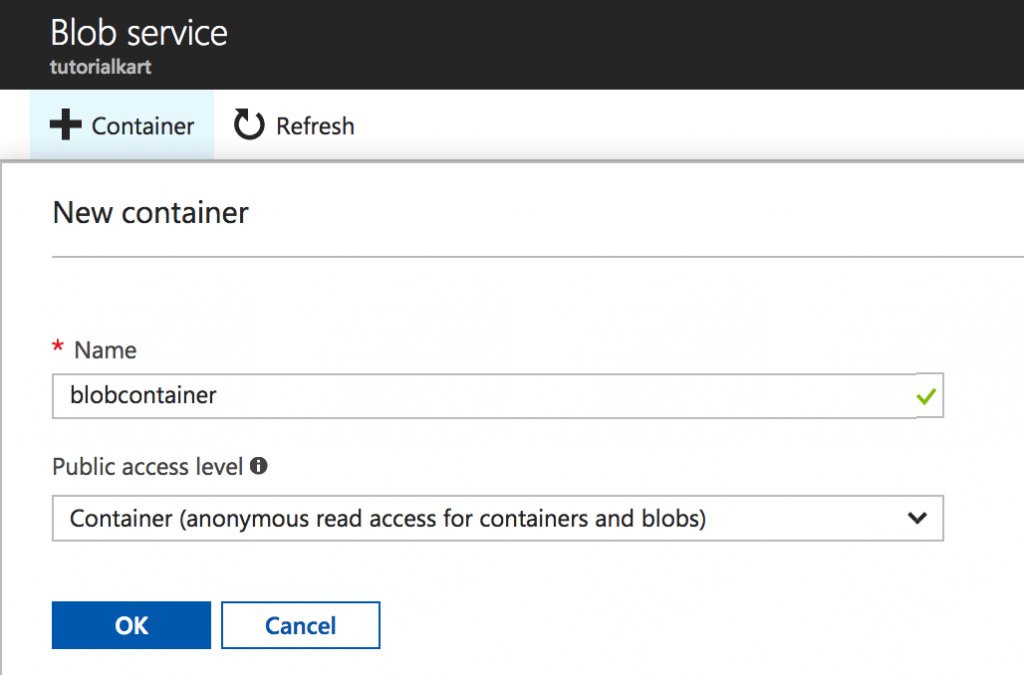
Container name and public access level for Azure Blob Storage
- Enter the blob container name. Container names must use lowercase letters, numbers, and hyphens only.
- Select the public access level from the dropdown.
- Private: No anonymous access. Only authorized users and applications can access the blobs.
- Blob: Anonymous read access is allowed for blobs, but the container itself cannot be listed anonymously.
- Container: Anonymous read access is allowed for blobs, and the container can be listed anonymously.
- Click the OK button to create the blob container.
In most production environments, use Private unless the files are intentionally public. If anonymous public access is disabled at the storage account level, public container options may not be available.
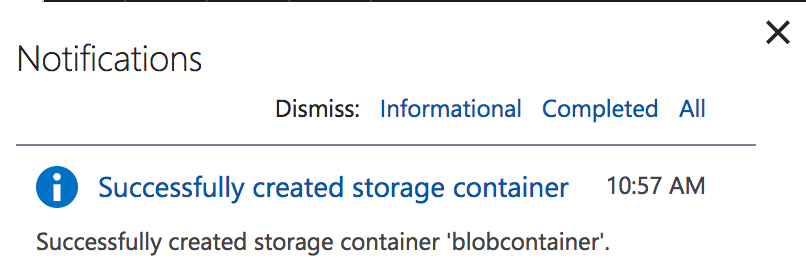
The Azure Blob container has been created successfully as shown above.
Uploading a document or image to Azure Blob Storage
Once the blob container is created, click the container name to open it. You can upload data such as audio files, videos, documents, pictures, backups, and logs. In this example, we upload an image file to Blob Storage.
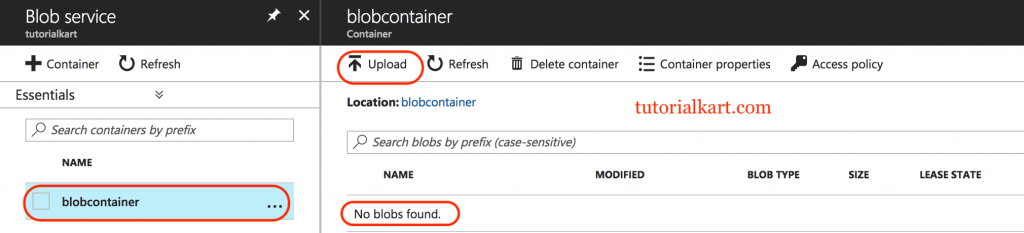
- Click the Upload button.
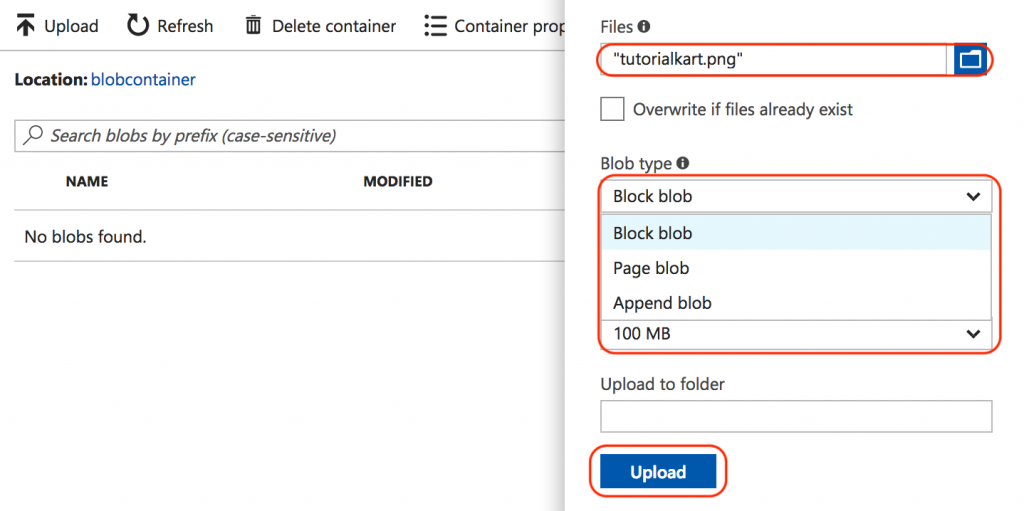
To customize the upload, click Advanced. Depending on the portal version and account configuration, you may see options such as blob type, block size, target folder or virtual directory, and access tier. Select the required options and click the Upload button.
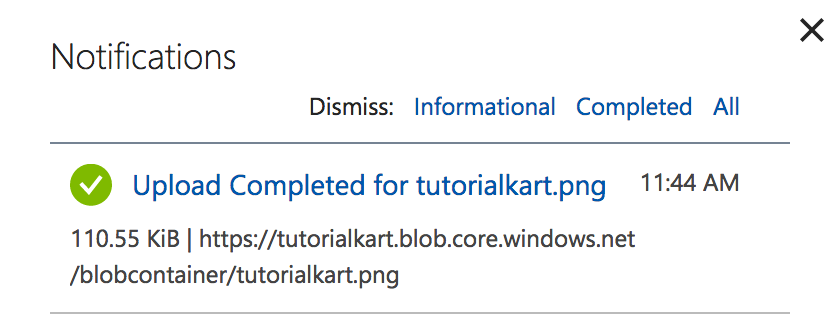
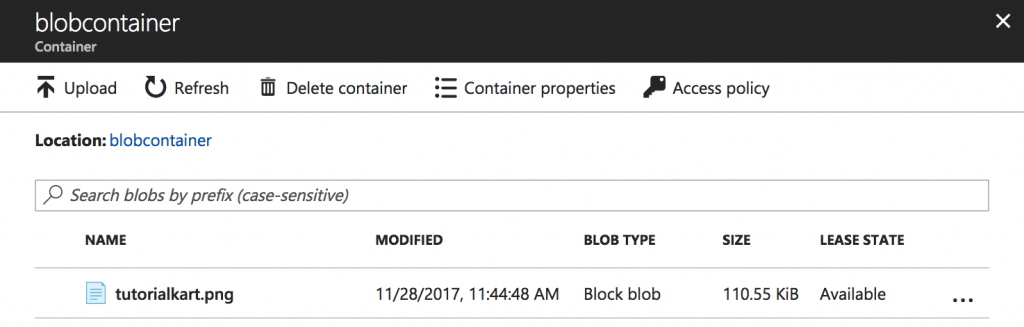
The image has been uploaded successfully to Azure Blob Storage. After upload, you can open the blob properties to copy its URL, check metadata, change the access tier where supported, or generate a shared access signature for controlled access.
You cannot change the blob type after the blob has been created. If you selected the wrong blob type, upload the object again using the correct blob type. Also remember that container names must contain only lowercase letters, numbers, and hyphens.
Create an Azure Blob container with Azure CLI
The Azure portal is useful for learning and small manual tasks. For repeatable setup, you can create a blob container with Azure CLI. Replace the storage account name and container name with your own values.
az storage container create \
  --account-name tutorialkart \
  --name images \
  --auth-mode login
To upload a local file as a block blob, use the following command.
az storage blob upload \
  --account-name tutorialkart \
  --container-name images \
  --name sample-image.png \
  --file ./sample-image.png \
  --auth-mode login
For production automation, prefer Microsoft Entra ID based access where possible instead of copying account keys into scripts.
Azure Blob Storage permissions and secure access
Blob data can be accessed in different ways depending on your application design. Common options include Microsoft Entra ID role-based access control, shared access signatures for time-limited delegated access, and storage account keys for account-level access. For most applications, avoid making containers public unless the files are intended for anonymous users.
- Use Private containers for user files, internal documents, backups, and logs.
- Use short-lived shared access signatures when an application needs to grant temporary access to a specific blob.
- Rotate or protect account keys if they are used by legacy applications.
- Choose the correct redundancy option for your recovery requirements.
- Use lifecycle management policies when old blobs should move to cheaper tiers or be deleted automatically.
Azure Blob Storage troubleshooting notes
- Upload fails because the container name is invalid: use only lowercase letters, numbers, and hyphens.
- Blob URL returns access denied: check whether the container is private, whether the SAS token is expired, and whether public access is disabled.
- Uploaded file is not visible publicly: public access may be blocked at the storage account level, or the container may be private.
- Wrong blob type selected: upload the file again using the required blob type.
- Storage cost is higher than expected: review access tiers, lifecycle rules, transaction volume, and data retrieval patterns.
Azure Blob Storage FAQ
What are the four main Azure Storage services?
The commonly used Azure Storage services are Blob Storage for object data, Azure Files for file shares, Queue Storage for messages, and Table Storage for NoSQL key-value data. Azure Storage also includes other specialized options, but these four are the core services often introduced together.
What is the difference between Azure Storage and Azure Blob Storage?
Azure Storage is the overall cloud storage platform and storage account resource. Azure Blob Storage is one service inside Azure Storage that stores unstructured object data such as files, images, videos, backups, and logs.
How do I create Blob Storage in Azure?
Create or open an Azure Storage account, go to the Blob service, create a container, choose the access level, and upload your files into that container. The storage account is created first; the blob container and blobs are created inside it.
Which Azure Blob type should I choose for normal file uploads?
Use block blobs for normal file uploads such as images, PDFs, videos, documents, and backups. Page blobs are mainly for random read/write scenarios, and append blobs are mainly for append-only logs.
Should an Azure Blob container be public or private?
Use private access by default. Make a container or blob publicly readable only when the files are intentionally meant for anonymous users. For temporary access, use a shared access signature instead of making the whole container public.
Azure Blob Storage editorial QA checklist
- Confirm that the article explains the relationship between storage account, container, and blob.
- Verify that public access levels are described as read access, not write access.
- Check that block blobs, page blobs, and append blobs are mapped to the correct use cases.
- Keep screenshots and existing Azure portal steps consistent with the stored images.
- Review Microsoft Learn links periodically because Azure portal labels and access tier options can change.
Conclusion
In this Azure tutorial, we learned what Azure Blob Storage is, how it fits inside an Azure Storage account, what blob containers are, and how block blobs, page blobs, and append blobs differ. We also created a blob container, uploaded a file to it, and reviewed important access and security points. In the next tutorial, we will learn about Azure Table Storage and how to create Azure Table storage.