 TutorialKart.com
Content Delivery Network (CDN) is a distributed network of edge servers that helps deliver web content closer to users. Microsoft Azure CDN is typically used for serving cacheable static content such as images, videos, style sheets, JavaScript files, documents, downloadable files, and HTML pages with lower latency for users in different locations.
In this Azure tutorial, we are going to learn what Azure Content Delivery Network is, why a CDN profile and CDN endpoint are used, how to create a CDN profile, and how to create an Azure CDN endpoint for an origin such as Azure Storage, Web App, Cloud Service, or a custom origin.
Current Azure note: Microsoft positions Azure Front Door Standard and Premium as the modern CDN platform for many new deployments, while classic Azure CDN offerings may be on a retirement or migration path depending on the SKU. If you are creating a new production architecture, check the current Azure portal options and Microsoft documentation before selecting a CDN SKU. The steps below explain the Azure CDN profile and endpoint flow shown in the screenshots and remain useful for understanding the configuration concepts.
What is Azure Content Delivery Network CDN?
Azure Content Delivery Network CDN stores cached copies of eligible files at edge locations. When a user requests a file, the request can be served from a nearby edge server instead of always going back to the origin server. This helps reduce latency, decreases repeated load on the origin, and improves delivery for users who access the application from different regions.
For example, if a website stores product images in Azure Storage and users access the website from multiple countries, Azure CDN can cache those images at edge locations. The first request may go to the origin, but later requests can be served from the CDN cache until the cached object expires or is purged.
Azure CDN profile and Azure CDN endpoint explained
Before creating Azure CDN, it is important to understand the two main objects used in the configuration: CDN profile and CDN endpoint.
| Azure CDN object | Meaning | Example use |
|---|---|---|
| CDN profile | A container for one or more CDN endpoints. It is created inside a subscription and resource group. | Group endpoints for one website, app, or environment. |
| CDN endpoint | The public edge hostname that users request content from. It is connected to an origin. | <endpointname>.azureedge.net for serving cached files. |
| Origin | The source location from which CDN retrieves content when it is not already cached. | Azure Storage, Azure Web App, Cloud Service, or a publicly reachable custom origin. |
| Pricing tier or SKU | The selected CDN provider and feature set available for the profile. | Choose based on caching, rules, security, and availability requirements. |
When to use Azure CDN for content delivery
- Static website assets: Images, CSS files, JavaScript files, fonts, and downloadable files used by websites or web applications.
- Media files: Videos, audio files, product images, training files, or other high-bandwidth resources.
- Global users: Applications accessed by users from multiple regions where serving from a nearby edge location can reduce latency.
- Origin load reduction: Frequently requested static files can be served from cache instead of repeatedly hitting the origin server.
- Custom domain delivery: Production workloads can use a branded CDN hostname, such as cdn.example.com, instead of only the default edge hostname.
Azure CDN profile creation prerequisites
Before creating an Azure CDN profile and endpoint, keep the following details ready.
- An active Azure subscription with permission to create CDN or Front Door resources.
- A resource group where the CDN profile will be created.
- An origin, such as an Azure Storage account, Azure Web App, Cloud Service, or custom public web server.
- A clear endpoint name because it becomes part of the CDN hostname.
- Planned caching behavior, especially for static files that change often.
- DNS access if you plan to add a custom domain such as cdn.yourdomain.com.
Creating a new Azure CDN profile
Azure CDN profile is a collections of CDN endpoints and each CDN profile contains one or more CDN endpoints. In Microsoft Azure, we can use multiple CDN profiles to organise endpoints by internet domain, web applications or using other criteria. Follow the steps to create Microsoft Azure Content Delivery Network (CDN) profile.
- Login in to your Azure Management Portal using your username and password.
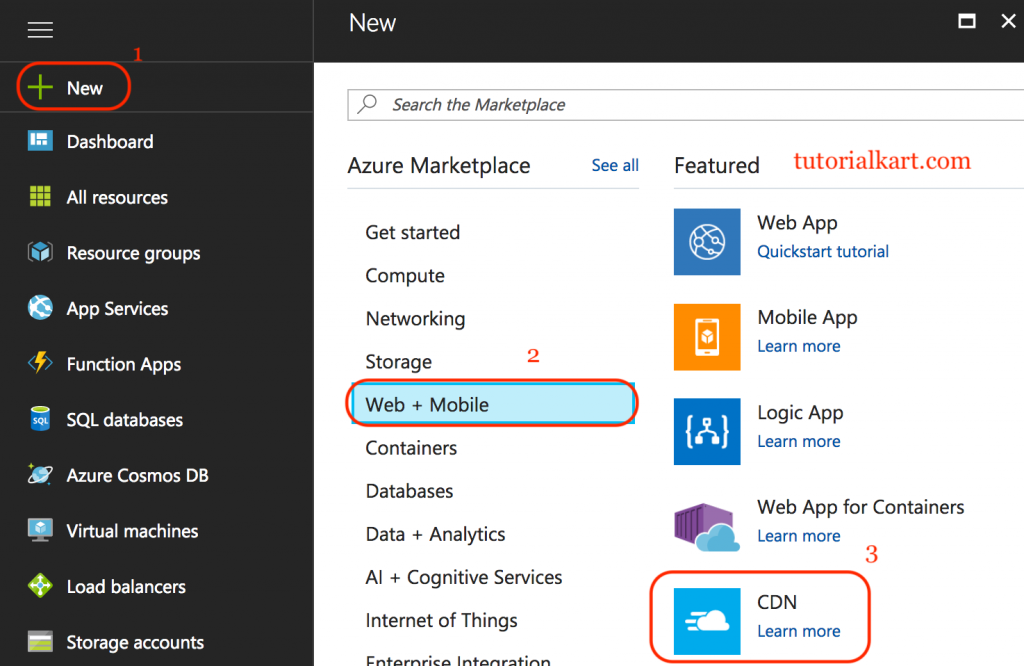
- Now in Azure Portal, navigate to upper left and click on New button.
Now a new CDN profile blade will be appeared. Now enter name for your CDN profile, select location, Resource group and select Pricing tier.
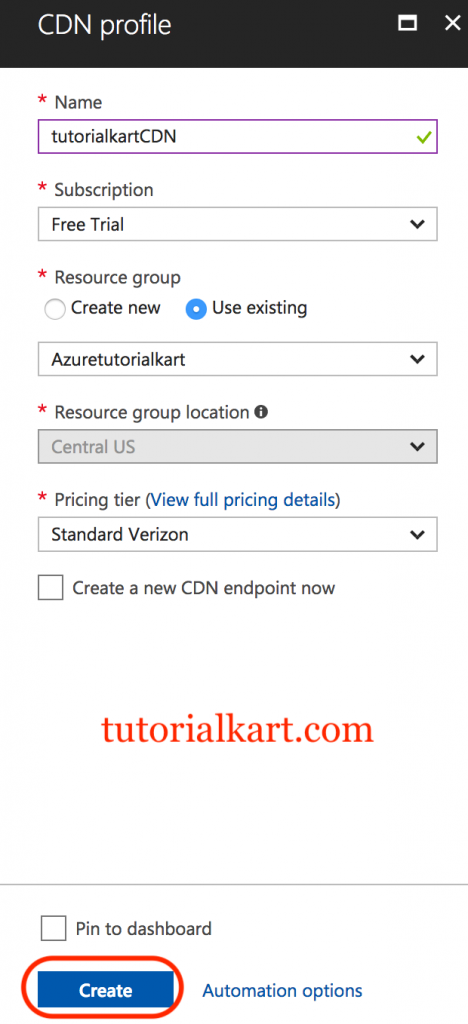
- Enter CDN profile name.
- Select subscription, resource group, pricing tier.
- Click on Create button to create new Azure CDN profile.
Azure CDN profile fields to review before clicking Create
| Field | How to choose the value |
|---|---|
| Profile name | Use a readable name that identifies the application, environment, or website. |
| Subscription | Select the subscription where billing and resource ownership should apply. |
| Resource group | Use an existing resource group for the application or create a new one for CDN resources. |
| Location | The profile resource location is for the Azure resource metadata. CDN content is still delivered through edge locations. |
| Pricing tier | Choose the SKU based on available features, rules support, security requirements, and current Azure availability. |
In newer Azure portal experiences, CDN and Front Door resources may appear together under Front Door and CDN profiles. Select the service and SKU that matches your project requirement. For new internet-facing web applications that need CDN, global routing, TLS, and web application security features together, also evaluate Azure Front Door Standard or Premium.
Creating new Azure CDN endpoint
Before creating CDN endpoint, we must understand why Azure CDN endpoint has to be created? Azure CDN endpoint is a subdomain of azureedge.net, which is used to delivery files using HTTP and HTTPS.
- To create new Azure CDN endpoint, navigate to All resources |CDN profile | +Endpoint.
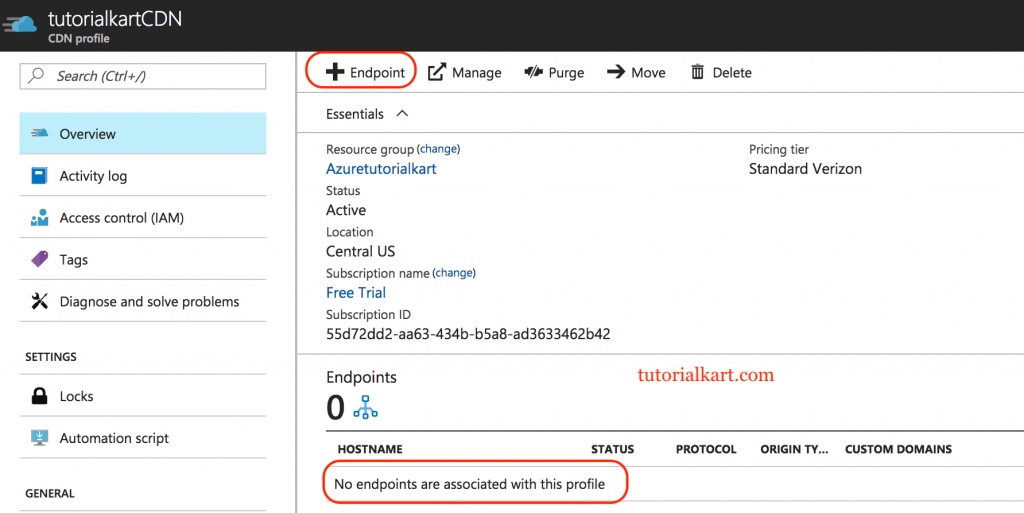
- Click on +Endpoint to create new CDN endpoint.
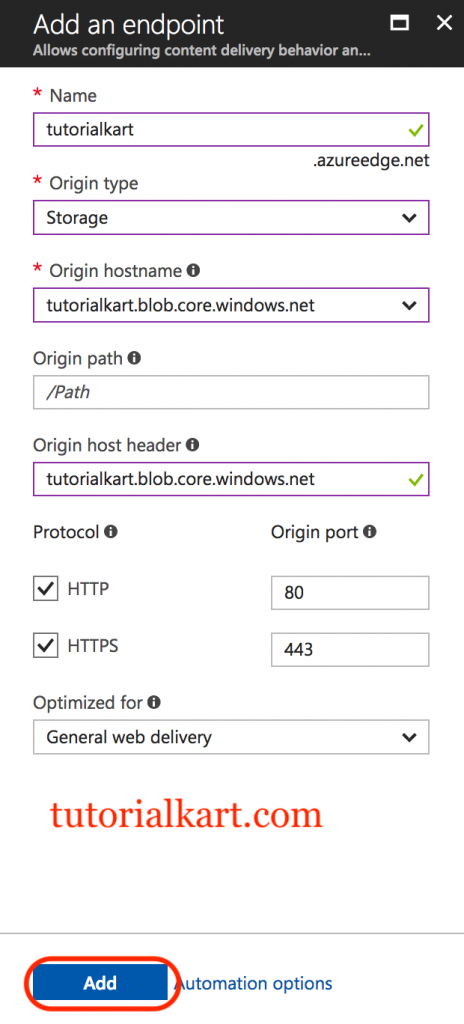
- Enter CDN endpoint name, the endpoint name will be used to access your cached resources at <endpointname>.azureeddge.net. As shown above we have entered endpoint name as tutorialkart.
- In origin type, we have four types : Storage for an Azure Storage account, Cloud Service for an Azure Cloud Service, Web App for an Azure Web App and Custom origin for any public accessible web server origin hosted in Azure. Select any one from the drop down.
- Finally click on Add button to create new Content Delivery Network endpoint.
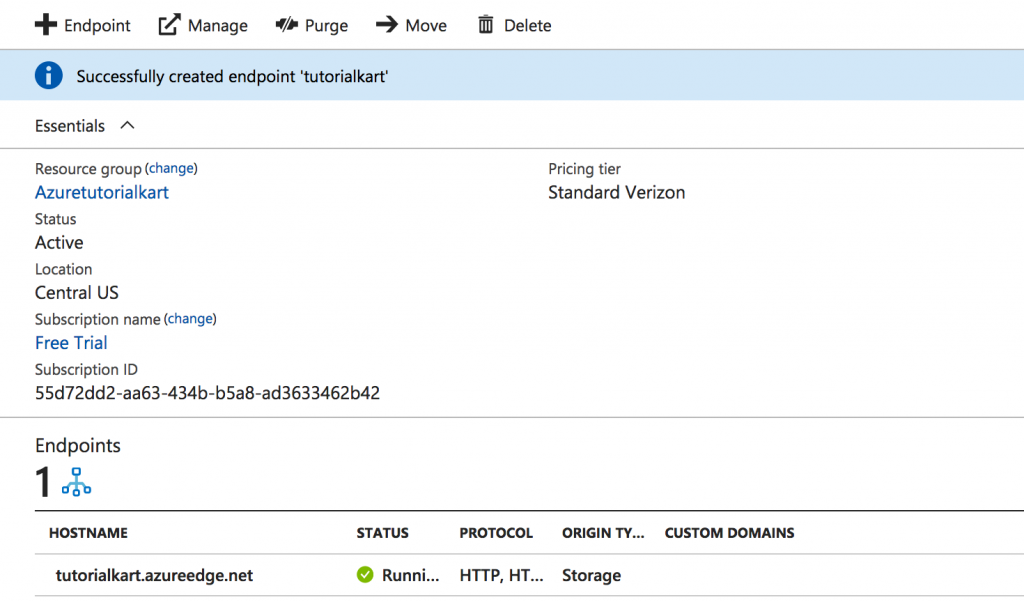
Azure CDN endpoint settings and origin type selection
The endpoint connects the edge hostname to the origin. Choose the origin type carefully because it controls where Azure CDN retrieves the original content from when the requested item is not already available in cache.
| Origin type | Use this when | Typical origin hostname |
|---|---|---|
| Storage | Your files are stored in an Azure Storage account or static website endpoint. | Storage blob or static website hostname. |
| Web App | Your content is served from an Azure App Service web app. | App Service hostname. |
| Cloud Service | Your application uses Azure Cloud Services. | Cloud service hostname. |
| Custom origin | Your origin is any publicly accessible web server, including a non-Azure origin. | Public domain or server hostname. |
After the endpoint is created, Azure provides a CDN hostname. In the screenshots above, the endpoint is created under the CDN profile and can be used to access cached content through the edge domain. In production, many teams add a custom domain and configure HTTPS so users access assets through a branded URL.
How Azure CDN caching works after endpoint creation
When a user requests a file through the Azure CDN endpoint, the CDN checks whether a valid cached copy is available at the edge. If the file is available and not expired, the CDN serves it from cache. If the file is not available or the cached copy has expired, the CDN retrieves it from the origin, serves it to the user, and stores it according to caching rules and origin headers.
- Cache hit: The requested file is served from the CDN edge cache.
- Cache miss: The CDN retrieves the file from the origin before serving it.
- Cache expiration: Cached content is refreshed based on cache-control headers or CDN caching rules.
- Purge: A purge request removes selected cached files from edge locations so updated content can be fetched again.
- Query string behavior: Configure query string caching carefully, especially for assets that use version parameters.
Testing the Azure CDN endpoint after deployment
After the endpoint is created, test it with a real static file from the origin. For example, if your origin contains an image named logo.png, open the CDN endpoint URL with the correct file path. The URL pattern depends on the endpoint hostname and the origin path.
https://<endpointname>.azureedge.net/<path-to-file>If the file does not load, check whether the origin file is publicly reachable, the origin hostname is correct, the path is correct, and HTTPS settings are compatible with your origin. CDN deployment and propagation can also take some time after a new endpoint is created.
Azure CDN custom domain and HTTPS planning
The default Azure CDN endpoint hostname is useful for testing, but production websites commonly use a custom domain such as cdn.example.com. This normally requires a DNS CNAME record that points the custom domain to the CDN endpoint hostname. After the custom domain is validated, configure HTTPS using the certificate option supported by the selected CDN or Front Door SKU.
- Use a clear subdomain such as cdn, static, or assets.
- Configure DNS only after confirming the endpoint hostname.
- Enable HTTPS for production delivery to avoid mixed-content and security issues.
- Plan cache invalidation when replacing files with the same filename.
- Use versioned filenames for CSS, JavaScript, and images that change frequently.
Azure CDN best practices for static content delivery
- Cache only suitable content: Azure CDN is best for static and cacheable files. Avoid caching private or user-specific content unless the configuration is designed for it.
- Use long cache duration with versioned files: For files such as app.2026.css or hashed JavaScript bundles, longer cache duration is safer because filename changes can publish a new version.
- Keep origin paths organized: Store assets under predictable folders such as /images/, /css/, and /js/.
- Review query string caching: Query strings can affect cache behavior. Use a consistent rule for version parameters and dynamic URLs.
- Purge only when needed: Purging too often reduces cache efficiency. Prefer versioned files for routine deployments.
- Monitor origin and CDN metrics: Review traffic, errors, cache hit ratio, and bandwidth usage to confirm the CDN is working as expected.
Common Azure CDN profile and endpoint issues
| Issue | Likely reason | What to check |
|---|---|---|
| CDN endpoint does not load the file | Wrong file path, private origin file, or incorrect origin hostname. | Open the origin URL directly and confirm the same path works. |
| Old file still appears | The edge cache still has the earlier version. | Purge the file or publish with a versioned filename. |
| Custom domain is not validated | DNS CNAME is missing or has not propagated. | Verify the DNS record and wait for DNS propagation. |
| HTTPS warning appears | Certificate or protocol settings are incomplete. | Check custom domain HTTPS configuration and origin TLS settings. |
| Cannot create profile | Missing permissions, unsupported SKU, resource provider issue, or current service availability changes. | Check subscription permissions, Microsoft.Cdn resource provider registration, and current Azure portal options. |
Azure CDN and Azure Front Door selection note
Azure CDN and Azure Front Door are related content delivery services, but they are not always selected for the same requirement. Azure CDN is commonly discussed for static content acceleration through CDN endpoints. Azure Front Door Standard and Premium add a broader global entry point for applications, including modern CDN delivery, routing, TLS, WAF integration depending on tier, and origin management features.
For a simple learning scenario, creating a CDN profile and endpoint helps you understand how edge delivery works. For new production workloads, especially those that need global routing and web application protection, review Azure Front Door Standard or Premium along with the current Azure CDN retirement and migration guidance.
Azure CDN official references
- Azure Content Delivery Network product page
- Azure CDN best practices from Microsoft Learn
- Microsoft Learn comparison between Azure Front Door and Azure CDN
Azure CDN profile and endpoint FAQs
What is Azure Content Delivery Network CDN?
Azure Content Delivery Network CDN is a Microsoft Azure service used to deliver cacheable web content from edge locations closer to users. It is commonly used for images, videos, CSS, JavaScript, documents, and other static files.
What is an Azure CDN profile?
An Azure CDN profile is a container for CDN endpoints. A profile is created inside an Azure subscription and resource group, and it can hold one or more endpoints depending on how you organize applications, domains, or environments.
What is an Azure CDN endpoint?
An Azure CDN endpoint is the public CDN hostname that serves cached content. It connects to an origin such as Azure Storage, Azure Web App, Cloud Service, or a custom public web server.
Which origin type should I select for an Azure CDN endpoint?
Select Storage when files are in Azure Storage, Web App when the origin is Azure App Service, Cloud Service for Azure Cloud Services, and Custom origin for any publicly reachable web server or domain that is not covered by the other options.
Should I use Azure CDN or Azure Front Door for a new deployment?
For new production deployments, review the current Azure portal options and Microsoft guidance. Azure Front Door Standard and Premium are often the modern choice when you need CDN delivery along with global routing, TLS, origin management, and web application security features.
QA checklist for Microsoft Azure CDN tutorial review
- Confirm that the tutorial explains the difference between Azure CDN profile, endpoint, and origin.
- Check that the existing Azure portal screenshots and image links remain unchanged.
- Verify that the endpoint hostname example is clearly shown as <endpointname>.azureedge.net.
- Confirm that Storage, Cloud Service, Web App, and Custom origin are described with practical selection guidance.
- Review the current Azure service availability, SKU options, and Azure Front Door migration guidance before using the steps for a new production deployment.