 TutorialKart.com
What is Azure File Storage?
Azure File Storage, commonly called Azure Files, is a managed cloud file share service in Microsoft Azure. It lets you create file shares that can be mounted by applications and operating systems by using standard file sharing protocols such as Server Message Block (SMB). Azure Files also supports NFS for supported file share configurations, while SMB remains the common choice for Windows-style file shares.
Azure File Storage provides shared storage using Server Message Block (SMB) and Common Internet File System(CIFS) protocols. This allows clients, such as Windows Explorer, to connect and browse File storage. In Windows file share , clients can add directory structures and files to the share and Azure File shares can be mounted to different Operating systems like Windows, Linux and MacOs.
Azure Files is part of an Azure Storage account. A storage account can contain several Azure Storage services, including Blob storage, File shares, Queue storage, and Table storage. Use Azure File Storage when you need a shared folder experience in the cloud rather than object storage for individual blobs.
- Main purpose of Azure File Storage
- Create Azure File Storage in the Azure portal
- Upload files to an Azure file share
- Map an Azure file share to Windows or Linux
- Azure Files vs Azure Blob Storage
- Azure File Storage FAQs
Main purpose of Azure File Storage
The main purpose of Azure File Storage is to provide a shared file system that multiple users, virtual machines, containers, or applications can access. It is useful when an application expects a normal file path, shared directory, drive letter, or network share instead of a blob URL or object storage API.
- Lift-and-shift applications: move applications that already use file shares without redesigning them for object storage.
- Shared configuration and logs: store files that need to be read or written by more than one application instance.
- Hybrid file shares: use Azure File Sync to keep files available on Windows Server while centralizing data in Azure Files.
- Container storage: provide a persistent shared file system for workloads that need files to remain available across container restarts.
- Simple file access: browse, upload, download, and organize files with folders similar to a traditional file server.
For Microsoft reference material, see the Azure Files introduction at learn.microsoft.com/en-us/azure/storage/files/storage-files-introduction.
Creating Azure File Storage in the Azure portal
In our previous Azure tutorials, we have learned about How to create Azure Blob Storage and Azure Table storage. In this Azure tutorial, we are going to learn about Creating Azure file storage. Follow the steps given below.
The Azure portal interface may change over time, but the basic workflow is the same: open a storage account, go to the file shares area, create a new file share, set the share name and quota, and then upload or mount the share.
- Navigate to Storage account and click on Files as shown below.
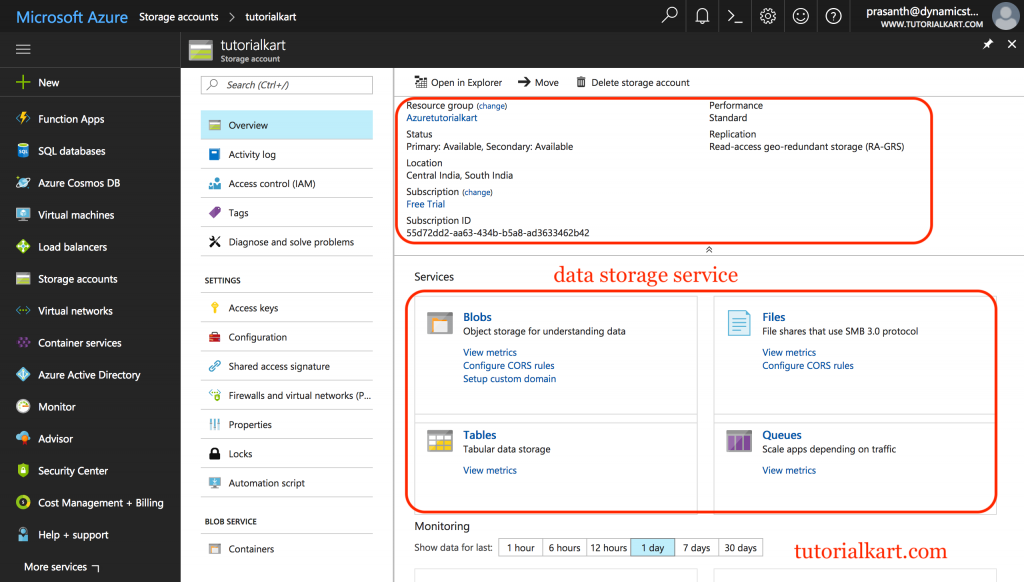
As shown above, list of all storage service that are available in Azure will be displayed as shown above. To create Azure File Storage, click on +File share button.
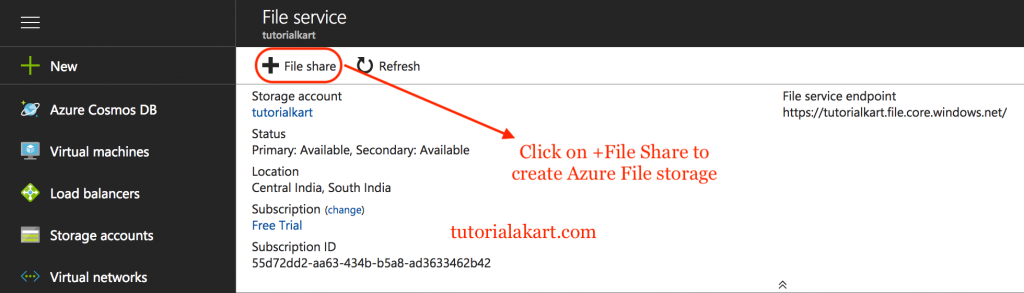
- Now enter File share Name and it’s Quote (Data in GB).
Choose a file share name that uses lowercase letters, numbers, and hyphens. Keep the name simple because it becomes part of the share path that users and applications connect to. Set the quota based on the amount of data you expect to store. Quota and performance limits vary by account type, redundancy option, and file share tier, so check the current Azure Files scale targets before using the share for production workloads.
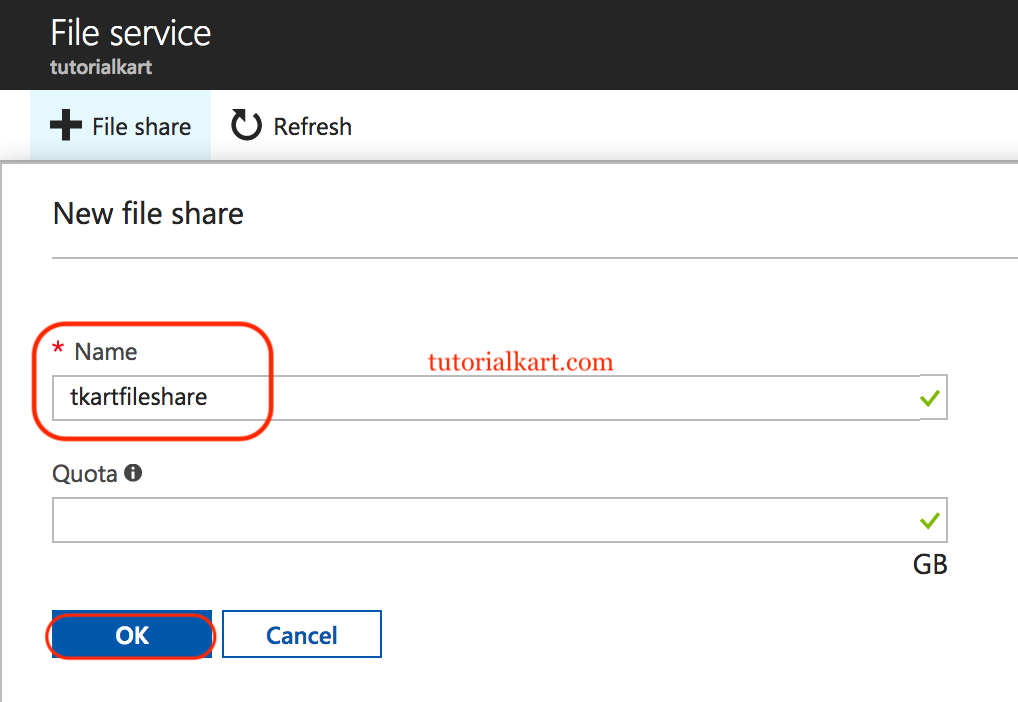
- Click on Ok button. Once done, we can map the file share to your Windows machine or Linux machine, adding directories within the file share, uploading data to it, and so on, if you opened it after creation.
If you prefer Azure CLI for repeatable setup, you can create a file share with a command similar to the following. Replace the resource group, storage account, share name, and quota with your own values.
az storage share-rm create \
  --resource-group myResourceGroup \
  --storage-account myStorageAccount \
  --name reports-share \
  --quota 100
Upload files and folders to an Azure file share
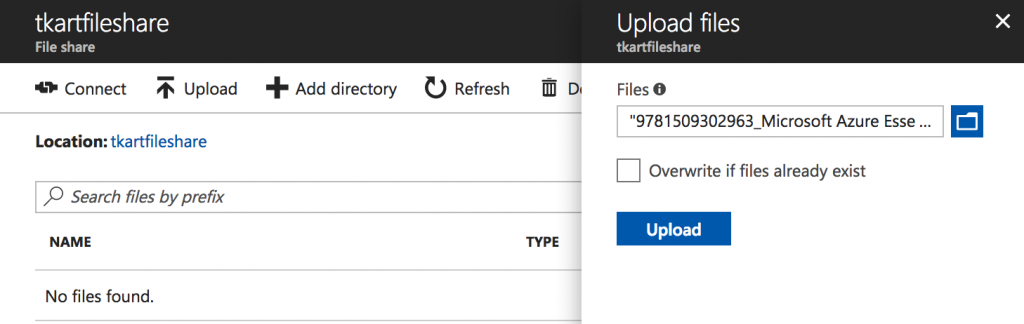
- Select your file and click on Upload button.
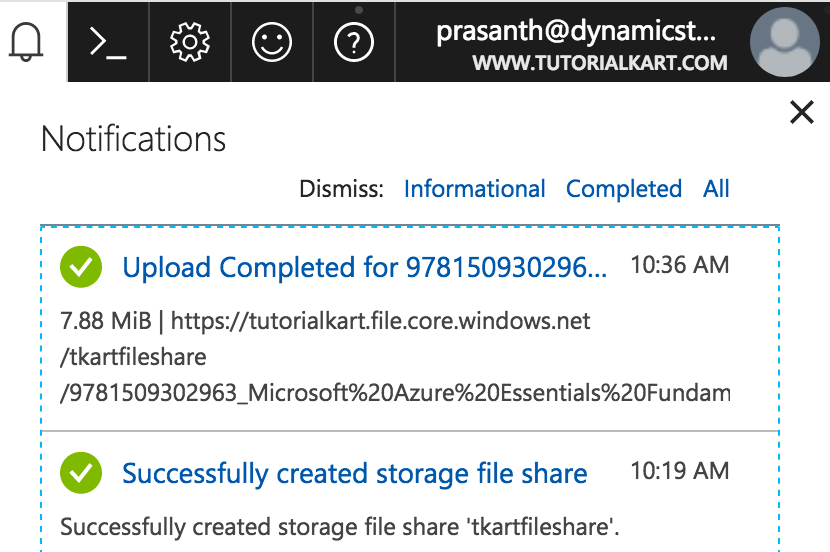
Our file has been uploaded successfully. Now we have to map the file share as a drive on your Windows machine or Linux machine.
For small test files, the Azure portal upload option is convenient. For larger migrations or repeated transfers, use tools such as AzCopy, Azure Storage Explorer, Robocopy with a mounted SMB share, or Azure File Sync depending on the source location and the migration pattern. AzCopy is designed for Azure Storage data movement, while Robocopy is commonly used for copying files across Windows file shares.
Map Azure File Storage as a drive on Windows or Linux
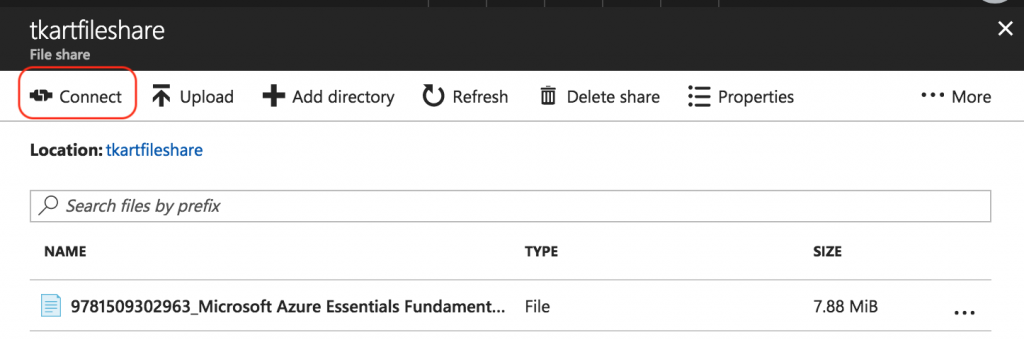
Click on Connect and it displays commands that are required to map.
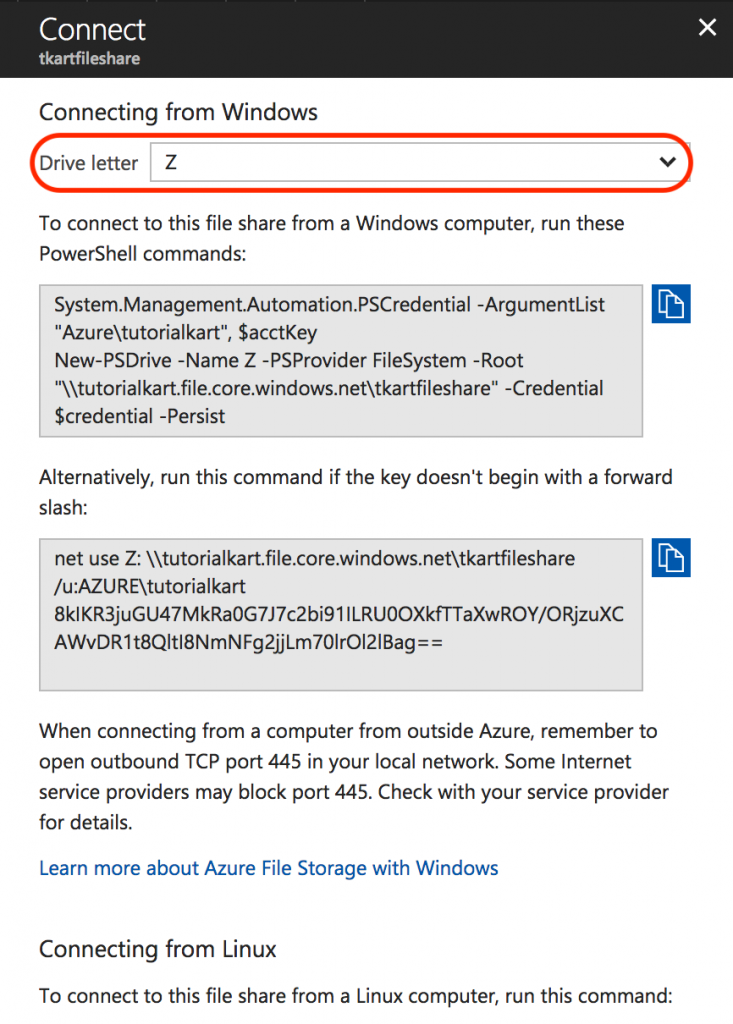
When you click Connect, Azure shows operating-system-specific commands for mounting the file share. For Windows, the command usually maps the file share to a drive letter by using the storage account name and access key. For Linux, Azure provides mount commands based on the selected protocol and distribution.
For SMB file shares, make sure outbound port 445 is allowed from the client network. Some organizations and internet service providers block this port, which can prevent direct mounting from outside Azure. In that case, use a supported network path such as VPN, ExpressRoute, private endpoints, or run the workload inside Azure. Microsoft documents networking considerations for Azure Files at learn.microsoft.com/en-us/azure/storage/files/storage-files-networking-overview.
Azure File Storage vs Azure Blob Storage
Azure Files and Azure Blob Storage are both part of Azure Storage, but they solve different storage problems. Choose Azure Files when the workload needs a shared file system. Choose Blob Storage when the workload stores objects such as images, backups, videos, logs, documents, or application-generated files that are accessed through APIs or URLs.
| Requirement | Use Azure File Storage | Use Azure Blob Storage |
|---|---|---|
| Access style | SMB or NFS file share mounted by clients | Object storage accessed through REST APIs, SDKs, or URLs |
| Folder and file share experience | Yes, similar to a network file share | Blob containers and virtual folder paths |
| Lift-and-shift legacy apps | Good fit when the app expects a file path | Requires app changes if it expects a mounted file system |
| Common use cases | Shared folders, app configuration, hybrid file shares, container volumes | Media files, backups, data lakes, static content, object archives |
Azure File Storage features and practical limits
- The maximum size of a file share is 5 TB, considering that a file in the file share cannot exceed 1 TB.
- Every Azure File share supports up to 1000 IOPS, and 60 MB/s throughput.
- File share names can contain only lowercase letters, numbers, and hyphens, and must begin and end with a letter or number. The name cannot contain two consecutive hyphens
The older limits above were common in earlier Azure Files documentation and portal examples. Current Azure Files capacity, IOPS, throughput, and share size targets can differ by file share type, provisioned size, redundancy, protocol, and region. For current planning, use Microsoft Learn scale target documentation at learn.microsoft.com/en-us/azure/storage/files/storage-files-scale-targets instead of relying on a fixed number from an old screenshot.
- Managed file shares: Azure manages the file service infrastructure, so you do not manage disks or file server operating systems.
- SMB and NFS options: select the protocol that fits the operating system and workload requirements.
- Mount from multiple clients: Windows, Linux, and macOS clients can connect when networking and authentication are configured correctly.
- Azure portal and tooling support: create and manage shares using Azure portal, Azure CLI, PowerShell, REST APIs, SDKs, or Azure Storage Explorer.
- Security controls: use storage account access controls, identity-based access where supported, encryption, private endpoints, firewall rules, and least-privilege permissions.
Security checks before using Azure File Storage in production
Before using an Azure file share for a real workload, review access, network, and backup settings. A file share is easy to create, but production use needs a clear security and recovery plan.
- Use a storage account naming and access strategy that fits your environment.
- Restrict public network access when the share should be reachable only through private networking.
- Check whether the workload needs SMB or NFS before creating the share.
- Use identity-based authentication for SMB shares where it is supported and suitable.
- Protect important shares with backup, snapshots, or an approved recovery process.
- Monitor capacity, transactions, latency, and throttling for active workloads.
Azure File Storage FAQs
What is the main purpose of Azure File Storage?
The main purpose of Azure File Storage is to provide managed cloud file shares that applications and users can access like network file shares. It is useful when a workload needs shared folders, mounted paths, or compatibility with existing file-based applications.
Is Azure Files part of an Azure Storage account?
Yes. Azure Files is one of the services available inside an Azure Storage account. A storage account can also include services such as Blob storage, Queue storage, and Table storage depending on the account type and configuration.
What are the four common Azure Storage services?
The four commonly referenced Azure Storage services are Blob storage, Azure Files, Queue storage, and Table storage. Blob storage is for object data, Azure Files is for managed file shares, Queue storage is for messages, and Table storage is for NoSQL key-value data.
When should I use Azure File Storage instead of Blob Storage?
Use Azure File Storage when you need a shared file system that can be mounted by clients. Use Blob Storage when you need object storage accessed through APIs, SDKs, or URLs.
Is AzCopy faster than Robocopy for Azure file migration?
AzCopy is optimized for moving data to and from Azure Storage, while Robocopy is a Windows file copy tool often used with mounted SMB shares. The faster option depends on file count, file size, network path, protocol, and migration design. Test with a sample workload before choosing a migration approach.
Editorial QA checklist for this Azure File Storage tutorial
- Does the page explain that Azure File Storage means managed Azure file shares?
- Does the tutorial show the portal workflow from storage account to file share creation?
- Are existing Azure portal screenshots preserved while clarifying that the portal UI may change?
- Does the page distinguish Azure Files from Azure Blob Storage for searchers comparing both services?
- Does the feature section avoid relying only on old 5 TB and 1000 IOPS limits and point readers to current Microsoft scale targets?
- Does the FAQ answer the common questions about purpose, storage account relationship, storage service types, Blob comparison, and AzCopy versus Robocopy?
Summary of creating Azure File Storage
Azure File Storage is used to create managed cloud file shares that can be mounted and used by applications or operating systems. To create a share, open the storage account in the Azure portal, select the file shares area, create a new file share, set the name and quota, upload files if needed, and use the Connect option to mount the share from Windows, Linux, or another supported client.