 TutorialKart.com
Delete a Column from a MySQL Table
Use the ALTER TABLE ... DROP COLUMN statement to permanently remove a column and its stored values from an existing MySQL table. Dropping a column changes the table schema; it does not delete any rows from the table.
Before running the statement on a production table, verify the column name, review dependent indexes and constraints, check application queries, and take a tested backup. An ALTER TABLE operation can cause an implicit commit, so do not assume that a later ROLLBACK will restore the dropped column.
MySQL DROP COLUMN Syntax
The syntax of MySQL DROP COLUMN is:
  ALTER TABLE table_name
  DROP COLUMN column_name;
In this statement:
table_nameis the table whose structure you want to change.column_nameis the column to remove.- The
COLUMNkeyword is optional in MySQL, but including it makes the statement easier to read.
The same syntax, shown as a reusable template, is:
ALTER TABLE table_name
DROP COLUMN column_name;
Check the MySQL Table Before Dropping a Column
Confirm that you are connected to the intended database and inspect the current table definition before making the change.
SELECT DATABASE();
DESCRIBE students;
SHOW CREATE TABLE students;
If you also need to confirm the server version, run:
SELECT VERSION();Check whether the column is used by a primary key, foreign key, generated column, index, view, trigger, stored procedure, event, report, or application query. Update or remove those dependencies in the correct order before dropping the column.
Example: Drop the id Column from the students Table
Consider the following table students.
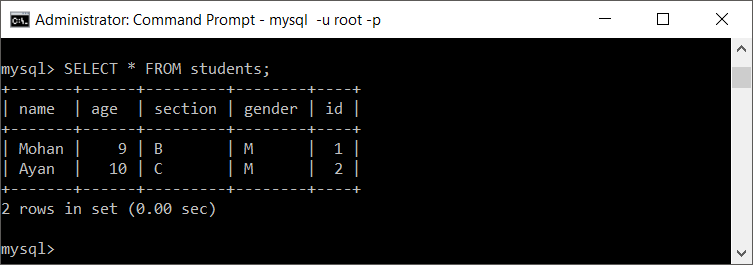
The legacy code block below uses DELETE COLUMN, which is not valid MySQL syntax. It is retained unchanged for reference. Use the corrected DROP COLUMN statement shown immediately after it.
ALTER TABLE students
DELETE COLUMN id;
Run this corrected query to remove the id column:
ALTER TABLE students
DROP COLUMN id;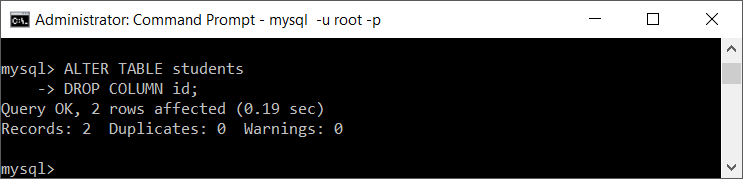
After the statement completes, the id definition and all values stored in that column are removed. The rows themselves remain in the table. A client such as MySQL Workbench may display an affected-row or copied-row count depending on the storage engine and the algorithm used for the table alteration.
Verify the updated table structure and data:
DESCRIBE students;
SELECT * FROM students;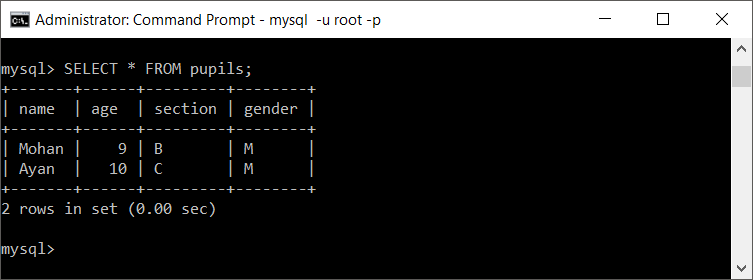
Drop Multiple Columns in One MySQL ALTER TABLE Statement
MySQL allows multiple column changes in one ALTER TABLE statement. Separate each DROP COLUMN clause with a comma.
ALTER TABLE students
DROP COLUMN middle_name,
DROP COLUMN temporary_code;
Combining related changes can avoid running several separate table alterations, but review the complete statement carefully because all listed columns are removed.
Check Whether a MySQL Column Exists Before Dropping It
The documented MySQL 8.4 ALTER TABLE syntax does not include IF EXISTS for DROP COLUMN. For version-aware migration scripts, query INFORMATION_SCHEMA.COLUMNS first and execute the ALTER TABLE statement only when the column exists.
SELECT COUNT(*) AS column_exists
FROM INFORMATION_SCHEMA.COLUMNS
WHERE TABLE_SCHEMA = DATABASE()
  AND TABLE_NAME = 'students'
  AND COLUMN_NAME = 'id';
A result of 1 means that the column exists in the selected database. A result of 0 means that the column is already absent. Check the MySQL ALTER TABLE reference for the syntax supported by your server version.
DROP COLUMN Versus DELETE in MySQL
DROP COLUMN and DELETE perform different operations:
| Operation | Purpose | Result |
|---|---|---|
ALTER TABLE ... DROP COLUMN | Changes the table structure | Removes one column and all values stored in it |
DELETE FROM ... | Changes table data | Removes matching rows while keeping the table columns |
TRUNCATE TABLE | Clears table data | Removes all rows while keeping the table structure |
Use DELETE when you need to remove rows. Use DROP COLUMN only when the column should no longer be part of the table schema.
Dependencies Affected by Dropping a MySQL Column
A dropped column can affect database objects and application code that refer to it. Review the following dependencies before applying the schema change:
- Indexes and keys: Check primary keys, unique indexes, ordinary indexes, and foreign-key constraints that include the column.
- Generated columns: Verify that no generated-column expression references the column being removed.
- Views: A view that selects or calculates from the dropped column can become invalid or fail when queried.
- Triggers and stored programs: Review triggers, stored procedures, functions, and scheduled events for references to the column.
- Application code: Update queries, ORM mappings, imports, exports, reports, API responses, and tests that expect the column.
Effect of Dropping a Column on MySQL Triggers
A trigger that reads from or writes to the removed column must be updated or dropped before the schema change can be considered complete. Inspect trigger definitions with SHOW TRIGGERS and SHOW CREATE TRIGGER.
Effect of Dropping a Column on Stored Procedures and Views
Stored procedures, functions, and views may contain SQL that names the deleted column. MySQL does not automatically rewrite those definitions. Test each dependent object after the alteration and deploy compatible application code with the database change.
MySQL DROP COLUMN QA Checklist
- Confirm the selected database, table name, and exact column name.
- Save a tested backup or snapshot before removing production data.
- Use
SHOW CREATE TABLEandSHOW INDEXto review keys, indexes, and constraints. - Search views, triggers, stored programs, migrations, reports, and application code for the column name.
- Test the
ALTER TABLE ... DROP COLUMNstatement on a staging copy with representative data. - Verify the table structure, important queries, and application behavior after deployment.
Frequently Asked Questions About MySQL DROP COLUMN
Which command deletes a column from a MySQL table?
Use ALTER TABLE table_name DROP COLUMN column_name;. The DELETE statement removes rows, not columns.
Does dropping a MySQL column delete table rows?
No. It removes the column definition and the values stored in that column, while the remaining rows and columns stay in the table.
Can MySQL drop multiple columns in one query?
Yes. Add multiple DROP COLUMN clauses to the same ALTER TABLE statement and separate them with commas.
Can a dropped MySQL column be rolled back?
Do not rely on transaction rollback for this operation. MySQL DDL statements such as ALTER TABLE can cause an implicit commit. Restore the column definition and data from a backup if recovery is required.
Why does MySQL refuse to drop a column?
Common causes include an incorrect table or column name, insufficient privileges, or a dependency such as an index, key, generated-column expression, or database object that still references the column. Read the complete error message and resolve the dependency before retrying.
MySQL DROP COLUMN Summary
To delete a column from a MySQL table, use ALTER TABLE with DROP COLUMN. Inspect the schema first, account for dependencies, back up important data, run the alteration, and then verify both the table structure and the applications that use it.
In this MySQL Tutorial, we have learnt how to delete column of MySQL table and the effects of doing so on other elements of the database.