 TutorialKart.com
What is SAP Cost Element Accounting in SAP CO?
Cost Element Accounting in SAP CO is the part of Controlling that classifies costs and revenues so they can be recorded, allocated, analyzed, and reported by management accounting objects. Cost elements answer the question: what type of cost or revenue is this? Examples include raw material consumption, salary expense, utility expense, sales revenue, overhead allocation, and internal activity allocation.
In classic SAP ERP and SAP R/3, cost element accounting (CO-OM-CEL) deals with the collection of costs and summarizes costs within controlling and posts to reconciliation ledger account. For every profit & loss type G/L account type, corresponding cost elements are to be created in SAP R/3 system.
In SAP S/4HANA, cost elements are integrated with G/L accounts. This means the cost element information is maintained as part of the G/L account master data, and the cost element category decides how the account behaves in Controlling. This is an important difference when you compare older SAP ECC steps with current SAP S/4HANA configuration.
What are cost elements in SAP Controlling?
Cost element is an item in the chart of accounts, which is used in controlling area to record the values assigned consumption of production factors like raw material, utilities, wages, freight, repairs, and internal services. Cost elements are divided in to two types i.e.
- Primary Cost / Revenue Elements
- Secondary Cost Elements
A cost element is not the same as a cost center. A cost element identifies the nature of the cost, while a cost center identifies where the cost is collected or who is responsible for it. For example, “electricity expense” can be a cost element, and “Plant Maintenance Department” can be a cost center.
| SAP CO object | Meaning | Simple example |
|---|---|---|
| Cost element | Classifies the type of cost or revenue | Raw material consumption, rent, salaries, sales revenue |
| Cost center | Collects cost by department, location, or responsibility area | Production department, HR department, warehouse |
| Internal order | Collects cost for a specific job, event, or temporary activity | Trade fair, machine repair project, marketing campaign |
| Profit center | Supports profitability responsibility reporting | Product division, regional business unit |
Primary cost elements in SAP CO and their link with G/L accounts
Primary Cost Elements: –
Primary cost elements describe the costs that occur outside of controlling and enter SAP CO through business transactions that also affect Financial Accounting. It links to SAP financial accounting (FI) expenses account (corresponding to G/L account required for costs). When you are creating new primary cost elements, the SAP check if a corresponding accounts are available in SAP Financial accounting.
Common examples of primary cost elements are salary expense, raw material consumption, travel expense, electricity expense, rent expense, depreciation expense, and cost-reducing revenue accounts. These values usually originate from FI, Materials Management, Sales and Distribution, Asset Accounting, or other integrated postings.
Cost Element Categories: – You need to assign a particular cost element category when you are implementing cost element accounting in SAP.
- 01 – Primary costs / cost reducing revenues
- 11 – Revenues
- 12 – Sales deductions
The cost element category controls how the account can be used in Controlling. For example, an expense account used for cost postings is not treated the same way as a revenue account or a sales deduction account. Assigning the correct category is therefore part of both SAP CO design and financial master data governance.
Secondary cost elements in SAP CO for internal allocations
Secondary Cost Elements
It describes the costs flows that occurs only within controlling like allocations, overhead cost calculations, assessments, settlements, and internal activity allocation. In classic SAP ERP, secondary cost elements do not link to external FI expense accounts in the same way as primary cost elements because they represent internal CO value flows.
Secondary Cost element category: – Similarly you need to assign a cost element category when you are creating secondary cost elements. Some of the important secondary cost element category are
- 21 – Internal settlement
- 31 – Order / Project results analysis
- 41 – Overhead rates
- 42 – Assessment
- 43 – Internal activity allocation
Secondary cost elements are useful when the organization wants to move costs inside Controlling without creating an external vendor invoice or customer invoice. For example, an internal service department may allocate its service cost to production cost centers using secondary cost elements.
Primary cost element vs secondary cost element in SAP CO
| Comparison point | Primary cost element | Secondary cost element |
|---|---|---|
| Source of posting | External or integrated postings that also affect FI | Internal CO postings only |
| Typical use | Record actual business costs and revenues | Allocate, assess, settle, or distribute internal costs |
| G/L account relationship | Linked to a G/L account used in Financial Accounting | Used for internal Controlling value flows |
| Examples | Salary expense, raw material consumption, rent, revenue | Assessment cost, overhead allocation, internal activity allocation |
| Main question answered | What external cost or revenue was posted? | How was cost moved or allocated inside CO? |
G/L account and cost element difference in SAP
A G/L account belongs to the chart of accounts and is used for financial accounting, balance sheet, and profit and loss reporting. A cost element is the Controlling view of a cost or revenue account that allows the same value to be analyzed in CO. In older SAP ERP systems, a cost element was created separately for the relevant P&L G/L account. In SAP S/4HANA, the G/L account and cost element are maintained together in the G/L account master.
This distinction matters during configuration and migration. If an expense G/L account is expected to post to a cost center, internal order, WBS element, or profitability segment, the controlling-related account settings must support that CO posting. Otherwise, users may face posting errors when they enter cost objects during business transactions.
SAP Cost Element Accounting (CO-CEL) Configuration
The primary configuration of cost element accounting in SAP involve maintenance of cost element master data, cost element groups, and information system. In SAP ECC, separate transactions are commonly used to create or display cost elements. In SAP S/4HANA, cost element attributes are handled through G/L account master data and related apps or transactions.
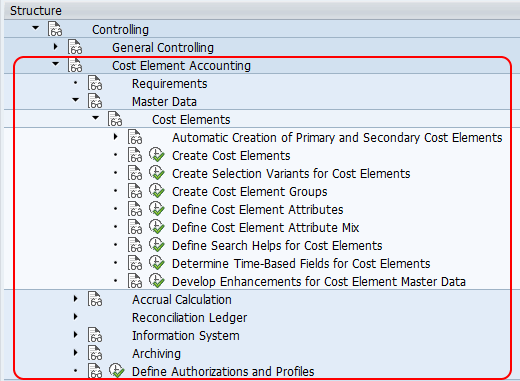
The important configuration steps of SAP CO-CEL are
- Creation of primary cost elements
- Creation of secondary cost elements
- Creation of cost element group
- SAP CO/FI reconciliation in company code currency
- Cost element master data reports.
SAP Cost Element Accounting configuration steps in practice
The exact menu path and transaction depend on whether the system is SAP ECC or SAP S/4HANA. Still, the design sequence is similar: decide which cost and revenue accounts are relevant for Controlling, assign the correct cost element category, group cost elements for reporting, and test postings to cost objects.
- Review the chart of accounts and identify P&L accounts that should be visible in Controlling.
- Confirm the controlling area and company code assignment before testing postings.
- Create or maintain the G/L account and cost element category based on system release.
- Assign the correct primary or secondary cost element category.
- Create cost element groups for reports, planning, assessment cycles, and allocations.
- Post a test transaction to a cost center, internal order, or other cost object.
- Review CO line items and reports to confirm that the cost element appears correctly.
For SAP ECC learning systems, transaction codes such as KA01, KA02, KA03, KA06, and KAH1 may appear in training materials. For SAP S/4HANA systems, check the G/L account master data process used in your implementation, because cost element handling is integrated into the account master.
Cost element groups in SAP CO reporting and allocation
Cost element groups collect related cost elements under one node so they can be used in reports, planning layouts, allocations, and assessment cycles. For example, an organization may create a “Personnel Costs” group that includes salaries, bonus, employer contributions, and training expenses.
Good cost element grouping makes SAP CO reports easier to read. It also reduces maintenance effort because the same group can be reused in multiple reports or allocation cycles. However, groups should be reviewed when new G/L accounts or cost elements are created, otherwise reports may miss new cost categories.
Example SAP CO posting flow using cost element and cost center
Consider a utility expense invoice posted in SAP. The G/L account identifies the expense account in FI. The cost element lets the same expense flow into Controlling. The cost center identifies the department or responsibility area that consumed the utility service.
| Posting detail | Example value | Purpose in SAP |
|---|---|---|
| G/L account | Electricity Expense | Financial accounting and P&L reporting |
| Cost element | Electricity Expense cost element | CO classification of the expense |
| Cost center | Production Department | Where the cost is collected |
| Report result | Production electricity cost | Management accounting analysis |
Common SAP cost element accounting mistakes to avoid
- Using the wrong cost element category: this can affect posting behavior, allocation, and reporting.
- Confusing cost element with cost center: the cost element tells what the cost is; the cost center tells where the cost is collected.
- Creating accounts without CO requirements: expense accounts that need CO postings should be reviewed with controlling requirements in mind.
- Ignoring cost element groups: reports and allocations may be incomplete if new cost elements are not added to the correct groups.
- Following ECC-only steps in S/4HANA: in SAP S/4HANA, cost element information is integrated with G/L account master data, so the maintenance approach is different.
Editorial QA checklist for SAP Cost Element Accounting tutorial
- The article explains that cost elements classify cost and revenue values for SAP Controlling.
- The difference between primary cost elements and secondary cost elements is clear.
- The SAP ECC and SAP S/4HANA difference is stated without mixing configuration steps.
- The article separates cost element, G/L account, and cost center with examples.
- Cost element categories are listed only as examples and should be validated against the project system.
- Internal links to SAP CO primary cost elements, secondary cost elements, and cost center accounting are present.
- The configuration section reminds readers to check controlling area, chart of accounts, and reporting groups.
Official SAP references for cost elements and SAP CO configuration
For release-specific behavior, refer to SAP Help for cost elements in SAP S/4HANA, SAP support content on cost element accounting, and SAP support content on SAP Controlling master data. Always verify transaction codes, menu paths, and category availability in the target SAP release.
SAP Cost Element Accounting FAQs
What is cost element accounting in SAP CO?
Cost element accounting in SAP CO classifies costs and revenues for Controlling. It helps SAP record what type of cost or revenue was posted and supports cost center accounting, internal orders, allocations, planning, and management reporting.
What is the difference between cost element and cost center in SAP?
A cost element identifies the nature of a cost or revenue, such as salary expense or electricity expense. A cost center identifies where the cost is collected, such as a production department, HR department, or warehouse.
What is the difference between G/L account and cost element in SAP?
A G/L account is used in Financial Accounting for ledger and financial statement reporting. A cost element is the Controlling view of a cost or revenue account. In SAP S/4HANA, cost element data is integrated into the G/L account master.
What are primary cost elements in SAP?
Primary cost elements represent costs and revenues that originate outside Controlling and are posted through FI or integrated business transactions. Examples include material consumption, salaries, rent, travel expense, and revenue accounts.
What are secondary cost elements in SAP?
Secondary cost elements represent internal value flows inside Controlling, such as assessment, overhead allocation, internal activity allocation, and settlement. They are used when costs are moved or allocated within CO.
Also read: what is cost center accounting in SAP.