 TutorialKart.com
What is SAP ABAP?
SAP ABAP stands for Advanced Business Application Programming. It is SAP’s programming language for building, extending, and customizing business applications that run on the ABAP application server. ABAP was earlier known widely as ABAP/4, where the term pointed to its fourth-generation language style. Modern SAP ABAP supports both procedural programming and object-oriented programming through ABAP Objects.
In simple terms, SAP ABAP is used when a standard SAP application must be adapted to a company’s business process. ABAP developers create reports, forms, interfaces, enhancements, conversions, workflows, and custom applications that work with SAP business data.
SAP ABAP/4 meaning and how modern ABAP is used
The name SAP ABAP/4 is still common in older tutorials and project documents, but current SAP development generally refers to the language as ABAP. The older ABAP/4 style focused mainly on business reports and transaction processing. Modern ABAP also includes classes, interfaces, exception handling, database access with Open SQL, service development, and tools for building applications on SAP systems.
| SAP ABAP term | Meaning for a beginner |
|---|---|
| ABAP | Programming language used to develop and enhance SAP applications. |
| ABAP/4 | Older name commonly used for the fourth-generation ABAP programming language. |
| ABAP Objects | Object-oriented part of ABAP, including classes, objects, methods, and interfaces. |
| AS ABAP | ABAP application server where ABAP programs are executed. |
| ABAP Workbench | Set of SAP tools used to create programs, dictionary objects, screens, forms, and related development objects. |
Is SAP ABAP a programming language?
Yes. SAP ABAP is a programming language. It is designed mainly for business application development inside SAP environments. A general-purpose language such as Java or Python can be used for many kinds of software, while ABAP is specialized for SAP business processes, SAP database tables, SAP screens, SAP reports, and SAP application logic.
ABAP programs normally run inside an SAP system rather than as separate desktop programs. This is why ABAP learning should include the language syntax as well as SAP concepts such as clients, tables, transactions, authorizations, packages, transports, and the ABAP Dictionary.
Why SAP ABAP is used in SAP projects
SAP software provides many standard business processes, but most organizations still need controlled customization. ABAP is used to create those custom objects without disturbing the standard SAP design more than necessary. Typical SAP ABAP work includes reading business data, validating entries, printing documents, connecting systems, adding user exits or enhancements, and building reports for business users.
- Custom reports: Display sales, purchase, inventory, finance, HR, or production information based on user selection criteria.
- Data conversions: Load legacy data into SAP during implementation or migration activities.
- Forms and outputs: Generate invoices, purchase orders, delivery notes, payslips, and other business documents.
- Enhancements: Add project-specific logic to standard SAP processes using supported enhancement techniques.
- Interfaces: Exchange data between SAP and non-SAP systems using suitable integration methods.
- Workflow and automation: Support approvals, notifications, and process-driven tasks.
Important concepts of SAP ABAP module
The SAP ABAP module covers more than language syntax. A beginner should understand how ABAP programs, database objects, screens, and SAP tools work together inside an SAP system.
ABAP Transactions: ABAP transactions are used to start SAP programs, screens, and business processes. A transaction code gives users a direct way to open a standard SAP application or a custom application created for an organization.
BDC (Batch Data Conversion): Batch data conversion helps transfer data from legacy or non-SAP systems into SAP using transaction-based processing. BDC is commonly discussed in data migration, but newer projects may also use tools such as BAPIs, IDocs, APIs, or migration cockpit options depending on the SAP landscape.
SAP Scripts : SAP scripts and smart forms maintain communication with business partners by formatting business documents such as invoices, order confirmations, delivery notes, and letters.
ABAP Reports: ABAP reports are used to design and generate reports in SAP. With help of reports, an organization can check daily sales and turn over.
ABAP Workbench: SAP ABAP workbench is a set of tools that can generate components of SAP applications. The important components of workbench are
- ABAP Editor
- ABAP Dictionary
- Screen Painter
- Menu Painter
- Function builder
- Form painter
- Message class builder
ABAP tools : SAP ABAP Tools are used to design and process business requirements such as BDC, LSMW, Scripts, Forms, Screen painter, business workflow, BAPI, ALE and WebDynpro.
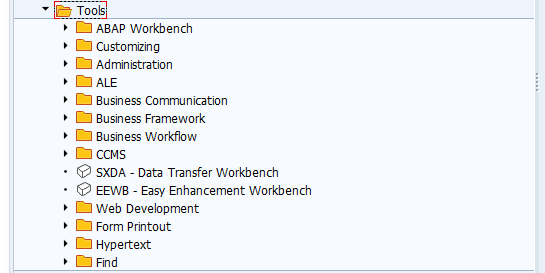
SAP ABAP tools used by developers
SAP ABAP developers work with development objects rather than only writing code in a text editor. These tools help define data, write programs, design screens, create reusable logic, and move changes safely from development to testing and production systems.
| ABAP tool or object | Purpose in SAP ABAP development |
|---|---|
| ABAP Editor | Used to create and maintain ABAP programs, includes, reports, and executable code. |
| ABAP Dictionary | Defines database tables, views, data elements, domains, structures, and table types. |
| Function Builder | Creates function modules that can be reused across programs. |
| Class Builder | Creates ABAP Objects classes, methods, attributes, and interfaces. |
| Screen Painter | Designs screens for classic dialog programming. |
| Form tools | Used for printed or PDF-style business outputs such as invoices and purchase orders. |
| Transport Organizer | Groups development changes and moves them through the SAP landscape. |
Simple SAP ABAP program example
A basic ABAP report begins with a report name and then contains statements that the ABAP runtime executes. The following example prints a short text on the output screen.
REPORT zhello_abap.

WRITE: 'Hello SAP ABAP'.
In this example, REPORT declares the ABAP report program and WRITE sends text to the classic list output. Real project programs usually include selection screens, database reads, validations, internal tables, modularization, and authorization checks.
SAP ABAP architecture in an SAP R/3 system
SAP Architecture
SAP architecture is designed based on client-server architecture. It is a three tier client server system and called as SAP R/3 system.
- Presentation Layer
- Application Layer
- Database Layer;
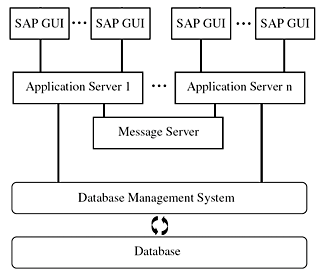
The presentation layer is the user interface used to access SAP screens. The application layer processes ABAP logic and business rules. The database layer stores application data, customizing data, and repository objects. Understanding this three-tier structure helps beginners see where ABAP code runs and how it reads or changes SAP data.
SAP ABAP reports, transactions, forms, and enhancements
Most beginner-level SAP ABAP training introduces a few development object types repeatedly. Each object solves a different kind of business requirement.
| Requirement | Common SAP ABAP development object |
|---|---|
| Show a list of business data | Executable report or ALV report |
| Capture user input through screens | Dialog program, transaction code, and screen objects |
| Print a business document | SAPscript, Smart Forms, or Adobe Forms depending on the system |
| Reuse business logic | Function module, class method, include, or subroutine |
| Load data into SAP | BDC, BAPI, IDoc, LSMW, or migration tool depending on the project |
| Add custom logic to standard SAP | User exit, customer exit, BAdI, enhancement spot, or extension technique supported by the system |
Roles of SAP ABAP consultant
Roles of SAP ABAP Consultant
SAP ABAP consultants are mainly responsible for developing SAP R/3 application using standard programming language ABAP. The main roles and responsibilities of ABAP consultants are
- Plays a major role in implementation of SAP software – Modifications and Enchancements
- ABAP language is used for developing the entire ERP SAP software, so ABAP consultants works in every SAP module
- Develop new application using the components of existing application.
In a real project, an SAP ABAP consultant usually works with functional consultants and business users. The functional consultant explains the process requirement, while the ABAP consultant converts it into a technical solution that follows SAP standards and project rules.
- Prepare technical specifications after understanding the functional requirement.
- Create and test reports, interfaces, conversions, enhancements, forms, and workflows.
- Use the ABAP Dictionary correctly for tables, views, domains, data elements, and structures.
- Debug standard and custom programs to identify errors and performance issues.
- Apply authorization checks, input validations, and error handling where required.
- Coordinate transports from development to quality and production systems.
- Support production issues without making unsafe direct changes in live systems.
Difference between SAP and SAP ABAP
SAP is the enterprise software platform and business application ecosystem. SAP ABAP is the programming language used to develop and extend many SAP applications. The difference is similar to the difference between a business application platform and the language used to customize parts of that platform.
| Point | SAP | SAP ABAP |
|---|---|---|
| Meaning | Enterprise software used for business processes such as finance, sales, materials, HR, and production. | Programming language and development environment used in SAP systems. |
| User type | Business users, functional consultants, administrators, and technical teams. | Mainly developers and technical consultants. |
| Work focus | Configuring and running business processes. | Writing code, creating development objects, debugging, and enhancing SAP applications. |
| Example activity | Create a sales order or post an invoice. | Create a custom sales report or add validation logic to a process. |
How difficult is SAP ABAP coding for beginners?
SAP ABAP coding is manageable for beginners who learn it in the right order. The syntax is readable, but the challenge is that ABAP is closely connected to SAP business data and system tools. A beginner should not learn only keywords and statements; they should also practise with tables, selection screens, internal tables, modularization, debugging, and simple database reads.
If you already know any programming language, ABAP syntax will be easier to understand. If you are new to programming, start with variables, data types, conditions, loops, internal tables, and simple reports before moving to forms, interfaces, enhancements, and object-oriented ABAP.
How to learn SAP ABAP step by step
How to learn SAP ABAP?
We have designed ABAP tutorials from basics to advanced concepts, so every ABAP beginner can easily learn ABAP/4 programming language for free of cost.
- Understand what SAP ABAP is and where ABAP programs run in the SAP architecture.
- Learn basic ABAP syntax: data declarations, constants, operators, conditions, loops, and string handling.
- Practise internal tables, work areas, field symbols, and structures because they are used in most ABAP programs.
- Learn the ABAP Dictionary: tables, data elements, domains, views, lock objects, and search helps.
- Create simple executable reports and selection screens.
- Practise Open SQL carefully, including filtering data correctly and avoiding unnecessary database reads.
- Use the debugger to understand program flow and correct errors.
- Move to modularization with subroutines, function modules, classes, and methods.
- Study forms, BDC, BAPI, IDoc, ALE, workflow, and enhancement techniques after you are comfortable with reports.
- Write small end-to-end examples instead of only reading syntax notes.
SAP ABAP beginner learning path
| Learning stage | What to practise | Expected result |
|---|---|---|
| Foundation | ABAP syntax, variables, IF, CASE, DO, LOOP, WRITE | You can read and write small programs. |
| Data handling | Internal tables, work areas, structures, field symbols | You can process records inside an ABAP program. |
| SAP data model | ABAP Dictionary, transparent tables, views, data elements | You can understand how SAP data is defined. |
| Reporting | Selection screens, Open SQL, ALV reports | You can build useful display reports. |
| Project objects | Forms, BDC, BAPIs, enhancements, debugging | You can understand common implementation tasks. |
| Modern ABAP | Classes, methods, exceptions, clean coding practices | You can work with object-oriented ABAP and maintainable code. |
SAP ABAP examples of real project requirements
The following examples show how ABAP knowledge is applied in SAP projects. These examples are general and the exact object type can change based on the SAP version, module, and project standard.
- Sales report: A sales manager wants a report that filters sales orders by date, customer, sales organization, and material.
- Invoice output: A company wants a custom invoice layout with tax details, company logo, payment terms, and customer address.
- Data migration: A project team wants to upload thousands of customer master records from a legacy system into SAP.
- Validation enhancement: A business rule requires an error message when users save incomplete document data.
- Interface program: A non-SAP system must send or receive order, inventory, or finance data from SAP.
SAP ABAP editorial QA checklist
Use this topic-specific checklist when reviewing a SAP ABAP tutorial, example, or interview preparation note.
- Does the page clearly explain that SAP ABAP is a programming language used for SAP business applications?
- Does it distinguish older SAP ABAP/4 terminology from modern ABAP and ABAP Objects?
- Are ABAP Workbench, ABAP Dictionary, reports, forms, enhancements, and data conversion explained with practical purpose?
- Are examples written as SAP project scenarios rather than generic programming examples only?
- Does any added code block use the correct PrismJS language class and avoid unsupported copied output?
- Are claims about SAP versions, tools, or architecture stated generally unless an official source is available?
SAP ABAP FAQs
Is SAP ABAP a programming language?
Yes. SAP ABAP is a programming language used to develop and customize applications in SAP systems. It is especially used for reports, forms, interfaces, conversions, enhancements, and business application logic.
What is SAP ABAP/4?
SAP ABAP/4 is the older name commonly used for ABAP as a fourth-generation programming language. Many older project documents and tutorials still use the term ABAP/4, while modern SAP development usually says ABAP or ABAP Objects.
Is SAP ABAP coding difficult?
SAP ABAP coding is not difficult to start, but it needs regular practice inside an SAP environment. Beginners should learn basic syntax first and then practise internal tables, Open SQL, ABAP Dictionary objects, debugging, reports, and enhancements.
What is the difference between SAP and SAP ABAP?
SAP refers to enterprise business software and related platforms. SAP ABAP is the programming language used to develop, customize, and extend many SAP applications. A functional user may work with SAP screens, while an ABAP developer writes and maintains technical objects behind those processes.
What should I learn before SAP ABAP?
Before SAP ABAP, it is helpful to know basic programming concepts such as variables, conditions, loops, arrays or tables, and debugging. Basic understanding of business processes such as sales, purchasing, finance, or inventory also helps because ABAP programs usually solve business requirements.