 TutorialKart.com
R packages add functions, datasets, documentation, and other tools to a base R installation. Most packages are installed from the Comprehensive R Archive Network, commonly called CRAN, while packages for bioinformatics and related fields are often distributed through Bioconductor.
Steps to Install an R Package from CRAN
R programming language consists of a huge collection of packages at the cran and bioconductor repositories. This is also one of the reason for R language to become so popular.
Use the install.packages() function to download and install a package from CRAN. You normally need to install a package only once for each R library and R version.
- Open the R console, RGui, RStudio console, VS Code terminal, or another terminal where R is available.
- Run
install.packages("package_name"), replacingpackage_namewith the package you need. - If R asks you to select a CRAN mirror, choose a nearby mirror or use the default cloud mirror.
- Wait until R reports that the package was successfully installed.
- Load the installed package with
library(package_name).
install.packages("package_name")The package name must be enclosed in quotation marks during installation. For example, the following command installs the jsonlite package.
install.packages("jsonlite")Selecting a CRAN mirror during R package installation
Older R setups may display a window asking you to select a CRAN mirror. Choose a geographically close mirror and click OK. You can avoid the prompt by specifying the CRAN repository directly.
install.packages("jsonlite", repos = "https://cloud.r-project.org")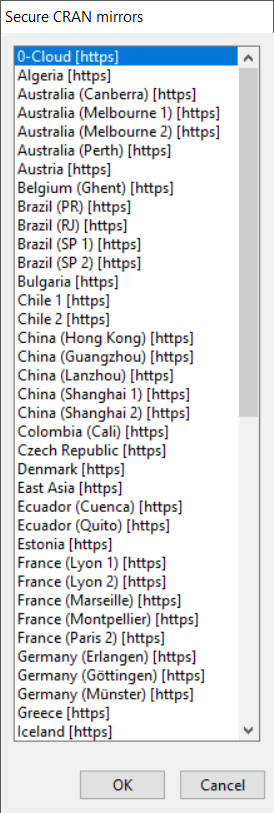
Example: Install the compare Package in R
The following console session installs a package named compare. The exact folder paths, package version, download size, and messages may differ on your computer.
> install.packages("compare")
Installing package into ‘C:/Users/TutorialKart/Documents/R/win-library/3.5’
(as ‘lib’ is unspecified)
--- Please select a CRAN mirror for use in this session ---
trying URL 'https://cloud.r-project.org/bin/windows/contrib/3.5/compare_0.2-6.zip'
Content type 'application/zip' length 510919 bytes (498 KB)
downloaded 498 KB

package ‘compare’ successfully unpacked and MD5 sums checked

The downloaded binary packages are in
        C:\Users\TutorialKart\AppData\Local\Temp\RtmpSW6t9I\downloaded_packages
>
After installation, load the package into the current R session with library().
library(compare)If library(compare) runs without an error, R found the installed package and attached it to the current session. You must run library() again in each new R session where you want to use the package.
Install an R Package Only If It Is Missing
A script can check whether a package is already installed before attempting another installation. This is useful in setup scripts and reproducible projects.
package_name <- "jsonlite"

if (!requireNamespace(package_name, quietly = TRUE)) {
  install.packages(package_name, repos = "https://cloud.r-project.org")
}

library(jsonlite)
requireNamespace() checks whether R can find the package without attaching it. The package is installed only when that check returns FALSE.
Install Multiple R Packages with One Command
Pass a character vector to install.packages() when a project requires several packages.
install.packages(
  c("dplyr", "ggplot2", "readr"),
  repos = "https://cloud.r-project.org"
)
R installs the requested packages and any required dependencies that are available from the selected repository.
Install an R Package from the Command Line
You can install a CRAN package without opening an interactive R console by running an R expression from a terminal. This requires the R or Rscript executable to be available in your system path.
Rscript -e 'install.packages("jsonlite", repos="https://cloud.r-project.org")'On Windows Command Prompt, use double quotation marks around the full R expression and escape the package-name quotation marks.
Rscript -e "install.packages(\"jsonlite\", repos=\"https://cloud.r-project.org\")"Install an R Package from a Local File or Folder
Use a local package archive when the computer is offline or when you have downloaded a package file manually. Set repos = NULL so R treats the path as a local package rather than a repository name.
Install a local binary package on Windows
install.packages(
  "C:/Downloads/package-name.zip",
  repos = NULL,
  type = "win.binary"
)
Install a local R package from source
install.packages(
  "/home/user/Downloads/package-name.tar.gz",
  repos = NULL,
  type = "source"
)
Installing from source may require development tools and external system libraries. On Windows, some source packages require a compatible Rtools installation. On Linux, a compiler and development headers may be required.
Download R Packages for Offline Installation
For an offline computer, download the package archive and its required dependencies on a computer with internet access. Copy the files to the offline system, then install each local archive with repos = NULL.
install.packages(
  "C:/OfflinePackages/jsonlite_1.8.9.zip",
  repos = NULL,
  type = "win.binary"
)
The archive type must match the operating system and R version. A Windows binary package cannot normally be installed as a Linux binary, and a binary built for an incompatible R version may fail to load.
Install a Bioconductor Package in R
Bioconductor packages are generally installed through the BiocManager package rather than by calling install.packages() directly for the target package.
if (!requireNamespace("BiocManager", quietly = TRUE)) {
  install.packages("BiocManager")
}

BiocManager::install("Biostrings")
This approach lets Bioconductor select package versions that are compatible with the installed R and Bioconductor releases.
Choose a Custom R Package Library
R installs packages into a library directory. If you do not have permission to write to the system library, create a personal library and pass its path through the lib argument.
personal_library <- "~/R/library"
dir.create(personal_library, recursive = TRUE, showWarnings = FALSE)

install.packages(
  "jsonlite",
  lib = personal_library,
  repos = "https://cloud.r-project.org"
)

library(jsonlite, lib.loc = personal_library)
Use .libPaths() to see the library directories that R currently searches.
.libPaths()Update Installed R Packages
Use update.packages() to check installed packages against versions available in the configured repositories.
update.packages(
  ask = FALSE,
  repos = "https://cloud.r-project.org"
)
Review project compatibility before updating all packages in an important or reproducible analysis. A newer package version can introduce changed behavior or dependency requirements.
Uninstall an R Package
Use remove.packages() to remove an installed package from a library.
remove.packages("compare")If the package is installed in a non-default library, specify that directory.
remove.packages("compare", lib = "~/R/library")Why an R Package Installation Fails
An installation error usually points to a repository, permission, dependency, network, library-lock, compiler, or version-compatibility problem. Read the first error message in the console rather than relying only on the final warning.
- Package is not available: Check the package spelling, configured repository, and whether the package supports your R version.
- Permission denied: Install into a personal library that your user account can modify.
- Cannot open URL: Check the internet connection, proxy settings, firewall, repository URL, and TLS support.
- Non-zero exit status: Look earlier in the output for a missing dependency, compiler error, or system-library error.
- Package lock error: Close other R sessions and remove the stale
00LOCKdirectory only after confirming no installation is still running. - Compilation tools are missing: Install the required compiler toolchain, such as Rtools on Windows, when a source package must be compiled.
- Dependency is unavailable: Install the missing R dependency or the required operating-system development library.
Check the installed R version and package libraries
R.version.string
.libPaths()
getOption("repos")
These commands help confirm which R version is running, where packages are being installed, and which repository R is using.
Test installation outside RStudio
If package installation fails inside RStudio, try the same command in the standard R console or through Rscript. This helps determine whether the problem is related to R itself, the selected library, or the development environment.
Frequently Asked Questions About Installing R Packages
Why can I not install packages in R?
Common causes include an unsupported R version, an incorrect package name, a repository or network problem, insufficient write permission, a missing dependency, or unavailable compilation tools. Inspect the earliest error in the installation output for the specific cause.
Do I need to install an R package every time?
No. Install a package once into an R library, then use library(packageName) in each new R session. You may need to reinstall packages after changing R versions, library locations, computers, or project environments.
What is the difference between install.packages() and library()?
install.packages() downloads and installs package files into a library. library() loads an already installed package into the current R session.
How do I install an R package in VS Code?
Open an R terminal or an integrated terminal in VS Code, start R, and run install.packages("packageName"). You can also run the installation through Rscript -e when Rscript is available in the system path.
How do I know whether an R package is installed?
Use requireNamespace("packageName", quietly = TRUE). It returns TRUE when the package is available in the active library paths and FALSE when R cannot find it.
Editorial QA Checklist for R Package Installation Instructions
- Verify that every CRAN example encloses the package name in quotation marks.
- Confirm that installation and loading are explained as separate operations.
- Check Windows, macOS, and Linux path examples for correct slash and quotation-mark usage.
- Confirm that local package examples use
repos = NULLand the appropriate package type. - Test troubleshooting advice against the exact installation error before recommending deletion of a lock directory or installation of build tools.