 TutorialKart.com
In our previous Informatica tutorial, we learned about Configuring Informatica Client and Domain. In this Informatica PowerCenter tutorial, we will learn how to create users and folders in Informatica PowerCenter, assign the required privileges, and verify the folder from Designer, Workflow Manager, and Workflow Monitor.
User creation is done from Informatica Administrator, while folder creation is done from PowerCenter Repository Manager. Both are required before a developer can start building sources, targets, mappings, sessions, and workflows in a controlled repository workspace.
Why an Informatica PowerCenter user is required
An Informatica PowerCenter user is required to log in to PowerCenter client tools and perform repository activities based on assigned roles and privileges. A user may need access to create mappings in Informatica Designer, create sessions and workflows in Workflow Manager, monitor workflow runs, manage repository folders, or administer services depending on the project role.
In a development environment, a user is usually created for each developer, tester, administrator, or support engineer. The exact privileges should match the responsibility of the person rather than assigning all permissions to every user.
Before creating Informatica PowerCenter users and folders
Before starting the steps, make sure the Informatica domain, Repository Service, and PowerCenter client tools are already configured. You should also have an administrator account or a user account with permission to manage users, roles, privileges, and repository folders.
- Informatica Administrator URL, domain name, host, and port details should be available.
- The PowerCenter Repository Service should be running.
- PowerCenter Repository Manager should be installed on the client machine.
- You should know the naming convention for users and folders used in your project.
- You should know whether the folder must be private, shared, or restricted to selected users or groups.
How to create users and folders in Informatica PowerCenter
To create users and folders in Informatica PowerCenter, first log in to Informatica Administrator with your username and password. Use the Security tab to create the Informatica user. After that, use PowerCenter Repository Manager to create the repository folder where mappings, sessions, workflows, and related repository objects will be stored.
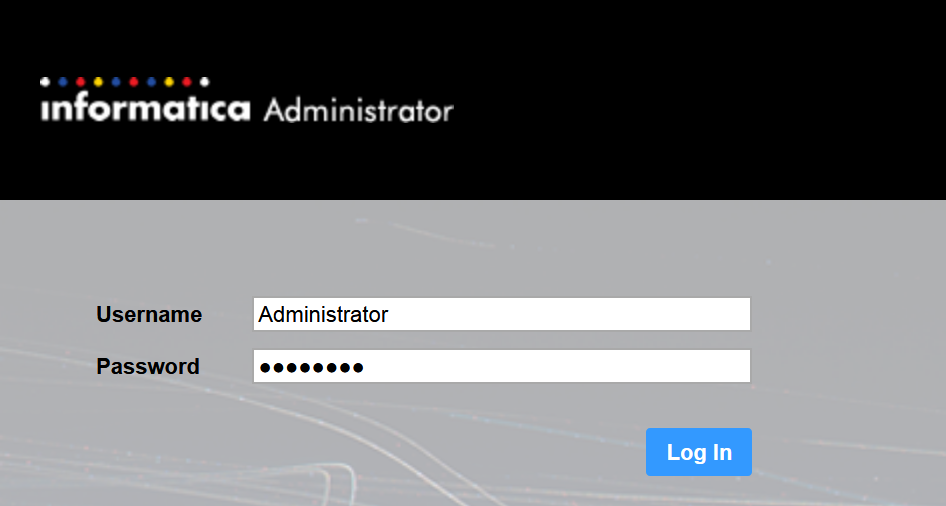
Creating a new user in Informatica Administrator
Informatica users are created in Informatica Administrator. These users can later be given access to the domain, Repository Service, and repository folders according to the required job function.
- Go to the Security tab.
- Select Users.
- Go to Actions and choose the option to create a new user.
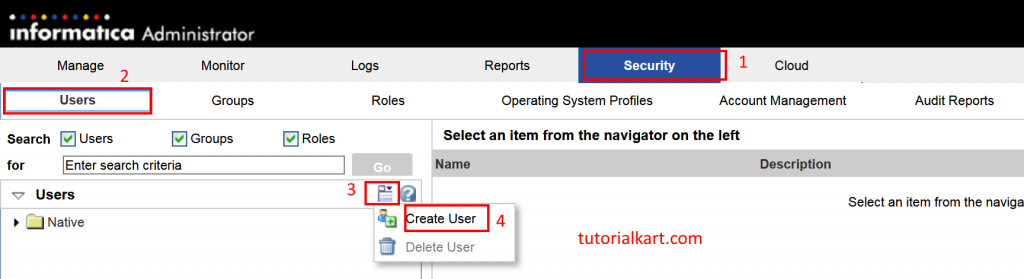
- Enter the desired login user name.
- Enter the password and confirm the password.
- Enter the full name of the Informatica user.
- Review the user details before saving.
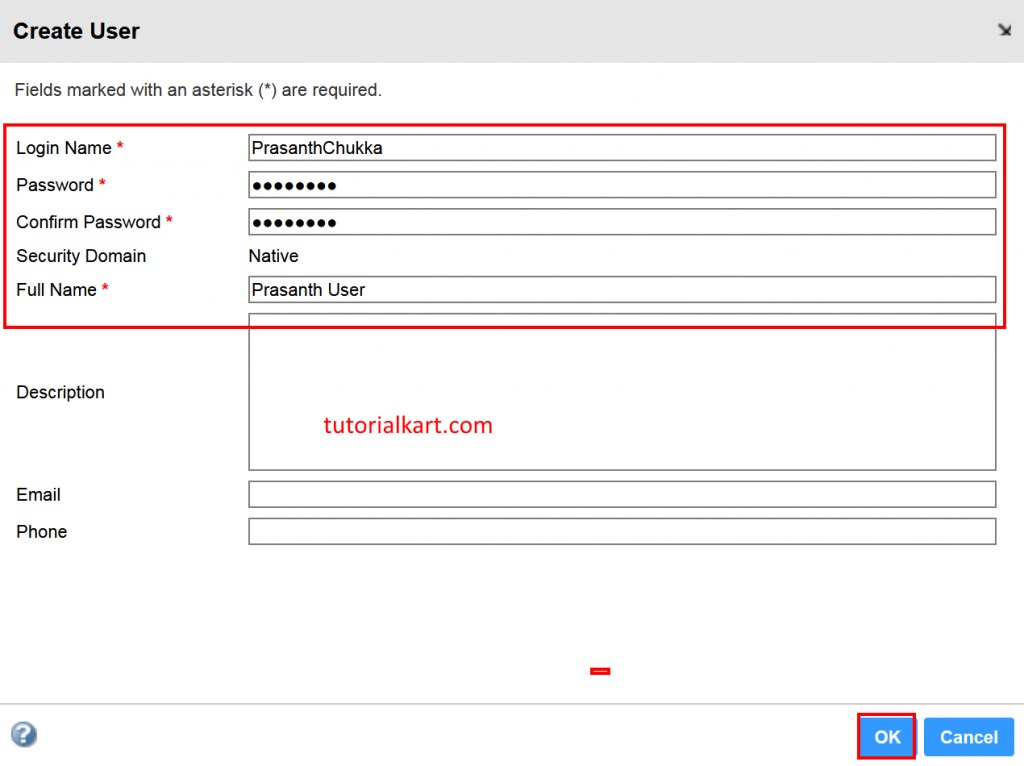
- Click on the OK button to create the user.
After the user is created, the account exists in the Informatica domain, but the user may still not be able to perform repository operations until the required roles, privileges, and folder permissions are assigned.
Assigning Informatica PowerCenter roles and privileges to the user
After successfully creating the Informatica user, select the domain or service to view the assigned privileges. To assign privileges, go to User (Prasanthchukka) | Privileges | Edit.
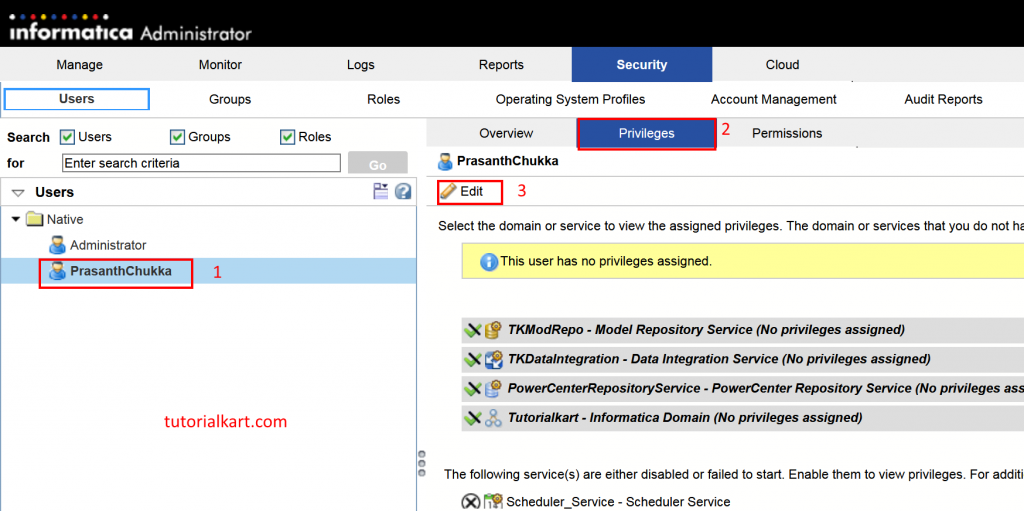
Privileges decide what the user can do after logging in. For example, a developer may need permission to connect to the Repository Service and work with repository objects, while an administrator may need additional privileges to manage services, users, groups, or repository-level settings.
- Select the required service or domain area.
- Click Edit under privileges.
- Select the check boxes for the roles and privileges that are required for this user.
- Avoid assigning administrator-level privileges unless the user actually needs administration access.
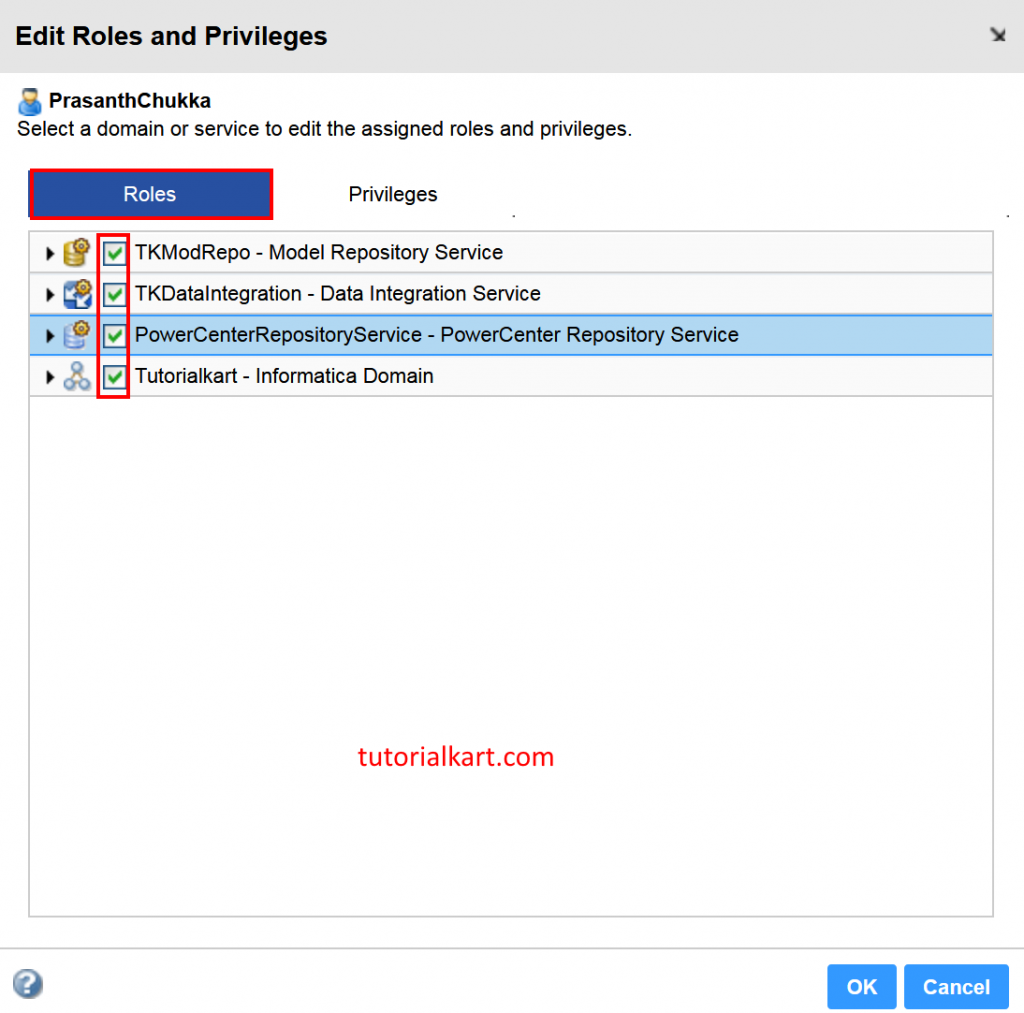
- Click on the OK button to save the assigned privileges.
If the user can log in but cannot open a repository folder, check both service-level privileges and folder-level permissions. In many setups, the user needs access at more than one level.
PowerCenter user access planning for developers, testers, and administrators
| User type | Typical access requirement | Practical note |
|---|---|---|
| Developer | Create and edit sources, targets, mappings, mapplets, sessions, and workflows in assigned folders. | Give access only to development folders unless cross-project access is needed. |
| Tester | View mappings and workflows, run or monitor jobs if testing requires execution. | Separate edit access from execution access where possible. |
| Production support | Monitor workflows, review session logs, and restart jobs if allowed by process. | Production folder permissions should be controlled carefully. |
| Administrator | Manage users, groups, services, repository settings, and security. | Administrator privileges should be assigned only to trusted admin users. |
How to create and edit folders in Informatica PowerCenter Repository Manager
What is a folder in Informatica PowerCenter?
A folder in Informatica PowerCenter is a repository container used to organize development objects. Sources, targets, mappings, mapplets, reusable transformations, sessions, workflows, and worklets are stored under folders. In real projects, folders are often created by project, application, environment, or release.
For example, a project may use separate folders for development, testing, and production repositories, or it may use project-specific folders such as SALES_ETL_DEV, FINANCE_ETL_TEST, and HR_ETL_PROD. The naming pattern depends on the repository standards followed by the organization.
Creating a repository folder in PowerCenter Repository Manager
To create a folder, open Informatica PowerCenter Repository Manager and log in with your username and password. Navigate to the Folder menu at the top and click Create as shown below.
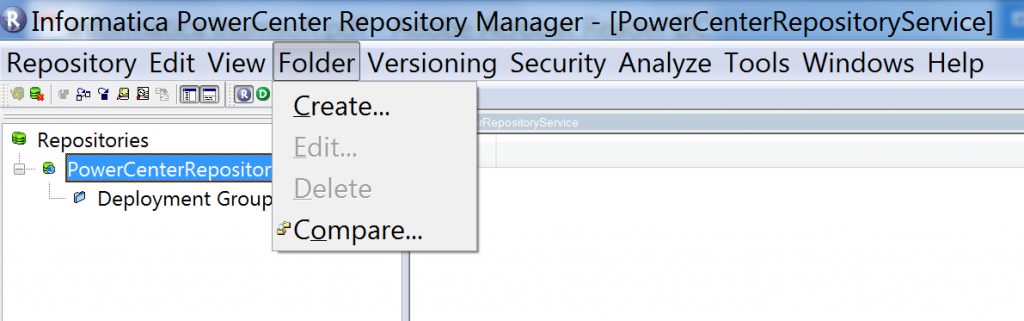
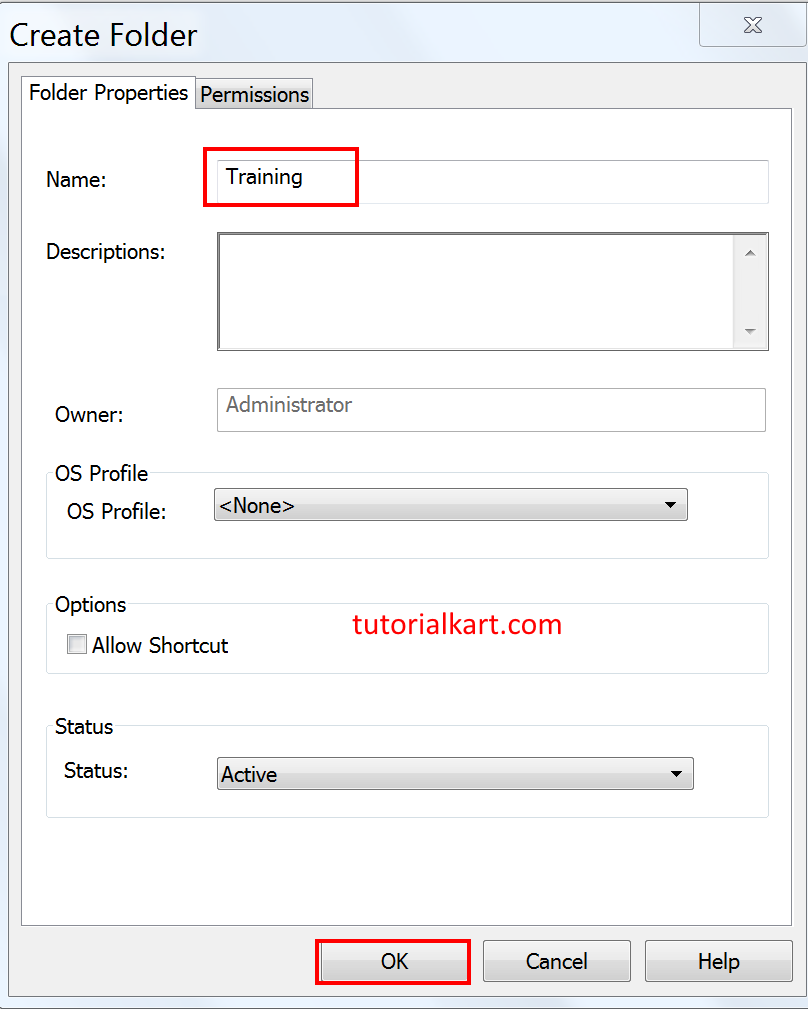
- Enter the folder name.
- Use a clear folder name that identifies the project, application, or environment.
- Click on the OK button to create the folder.
- A pop-up window will be displayed showing that the folder has been successfully created.
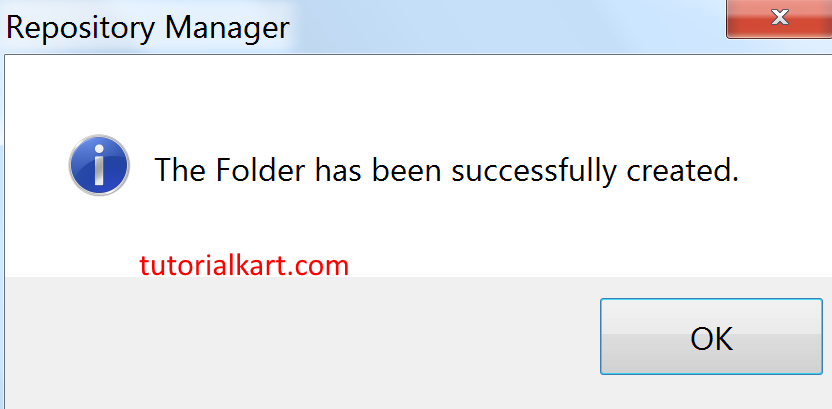
- Click on the OK button.
Editing Informatica PowerCenter folder properties and permissions
After creating the folder, review the folder properties and permissions. Folder access controls who can read, write, execute, or manage objects inside that folder. If the user was created successfully but cannot work in the folder, folder permissions are one of the first areas to check.
- Open Repository Manager and connect to the repository.
- Select the required folder.
- Open the folder properties or permissions window.
- Add the required user or group.
- Assign the required permissions based on the role of the user.
- Save the changes and ask the user to reconnect from the PowerCenter client tool.
For team development, it is usually better to assign folder permissions through groups instead of adding each user individually. This makes future maintenance easier when team members are added or removed.
Opening the new Informatica folder in PowerCenter Designer
Open Informatica PowerCenter Designer. Using PowerCenter Designer, we can access repository-level development objects by connecting to the Repository Service with the required domain, host, port, repository, username, and password details.
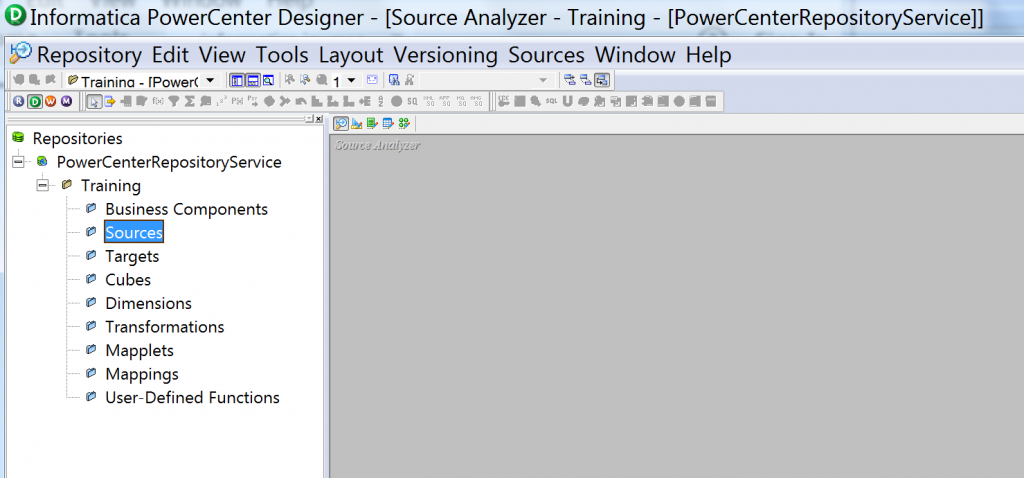
To open an Informatica folder, double-click the folder that was created earlier in PowerCenter Designer. As shown above, we can observe five main components that are nested under the Informatica folder.
Source Analyzer: Importing and creating source definitions can be done using Source Analyzer. These source definitions are used for data extraction.
Target Designer: Importing and creating target definitions can be done using Target Designer. These target definitions are used for data load.
Transformation Developer: Creating reusable transformations can be done in the Transformation Developer component. These transformations are used for reusable data transformation logic.
Mapplet Designer: We can create mapplets in the Mapplet Designer. A mapplet contains a reusable set of transformations that can be used inside mappings.
Mapping Designer: A mapping is a graphical representation of data flow from source to target. Creating a mapping with source definitions, target definitions, transformations, mapplets, mapping parameters, and mapping variables is done in the Mapping Designer workspace.
All these folder components are Designer-level components. To move from one PowerCenter client tool to another client tool, or from one component to another component within a client, use the Tools menu at the top.
Creating sessions and workflows from the Informatica PowerCenter folder
- PowerCenter Workflow Manager is used to create tasks such as sessions in Task Developer.
- A session is a task that helps execute a mapping.
- Worklets can be created in Worklet Designer.
- Workflows can be created in Workflow Designer.
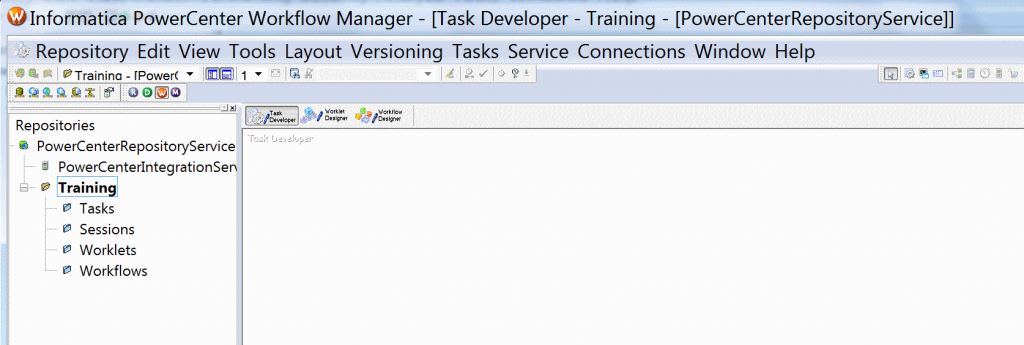
After creating mappings in Designer, the next step is usually to create a session and then include that session in a workflow. The session defines how the mapping runs, while the workflow controls the execution sequence, dependencies, scheduling behavior, and task flow.
Monitoring Informatica workflows after user and folder setup
Informatica PowerCenter Workflow Monitor is responsible for viewing the status of workflows, sessions, and tasks that start execution from Workflow Manager.
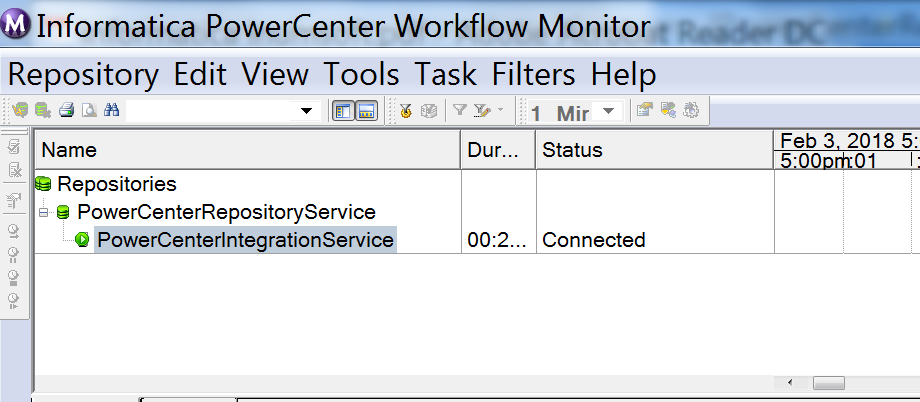
Using Informatica PowerCenter Workflow Monitor, we can view workflow runs, session status, session logs, workflow logs, start time, end time, run duration, and failure details. If a user is expected to monitor jobs, make sure the required monitoring privileges are assigned.
Common issues while creating Informatica users and folders
| Issue | Likely reason | What to check |
|---|---|---|
| User cannot log in | Incorrect credentials, inactive account, or domain connection issue. | Check username, password, domain, host, port, and user status. |
| User can log in but cannot open a folder | Folder permission is missing. | Check folder permissions in Repository Manager. |
| User can open the folder but cannot edit objects | Read-only access or insufficient repository privilege. | Review role, privilege, and folder write permissions. |
| Folder is not visible in Designer | User does not have permission, or the client is connected to a different repository. | Confirm repository connection and folder access. |
| Workflow cannot be monitored | Monitoring privilege is not assigned. | Review Workflow Monitor and Repository Service privileges. |
Best practices for Informatica PowerCenter user and folder administration
- Create separate user accounts instead of sharing one common login among multiple developers.
- Use groups for team-based access whenever possible.
- Assign only the required privileges for the user role.
- Follow a consistent folder naming convention for project, application, and environment folders.
- Keep development, testing, and production access separate.
- Review user and folder permissions regularly, especially when team members move out of a project.
- Ask users to reconnect to the client tool after permission changes if the old session does not reflect the updated access.
Informatica PowerCenter user and folder setup QA checklist
- The Informatica user is created in the correct domain.
- The username follows the project or organization naming standard.
- The user has the required Repository Service privileges.
- Folder-level permissions are assigned to the user or group.
- The newly created folder opens in PowerCenter Designer.
- The user can create or view mappings based on the assigned access level.
- The user can create sessions and workflows only if that access is required.
- Workflow Monitor access is tested for users who need job monitoring rights.
FAQs on creating users and folders in Informatica PowerCenter
How do you create a folder in Informatica PowerCenter?
To create a folder in Informatica PowerCenter, open Repository Manager, connect to the repository, go to the Folder menu, click Create, enter the folder name, and save it. After creating the folder, assign the required folder permissions to users or groups.
Where are Informatica PowerCenter project folders created?
Informatica PowerCenter project folders are created in PowerCenter Repository Manager. These folders are stored inside the repository and are visible from client tools such as Designer and Workflow Manager if the user has the required permissions.
How do you create a user in the Informatica Administrator console?
To create a user in the Informatica Administrator console, log in to Informatica Administrator, open the Security tab, select Users, create a new user, enter the login name, password, and full name, and save the user. Then assign the required privileges.
Why is a newly created Informatica user unable to access a folder?
A newly created Informatica user may be unable to access a folder if the user has not been assigned the required folder permissions or Repository Service privileges. Check both user privileges in Informatica Administrator and folder permissions in Repository Manager.
Should every Informatica PowerCenter user get administrator privileges?
No. Administrator privileges should be given only to users who manage domain, service, repository, or security settings. Developers and testers should usually receive only the privileges needed for their assigned folders and tasks.
Summary of creating Informatica PowerCenter users and folders
In this Informatica PowerCenter tutorial, we created a user from Informatica Administrator, assigned privileges, created a repository folder from PowerCenter Repository Manager, and reviewed how that folder is used in Designer, Workflow Manager, and Workflow Monitor. A correct setup requires both user-level privileges and folder-level permissions. Once both are assigned properly, users can begin developing mappings, creating sessions and workflows, and monitoring workflow execution based on their project role.