 TutorialKart.com
Informatica Source Analyzer – Import a Source from a Database
Source Analyzer is a workspace in Informatica PowerCenter Designer used to create and manage source definitions. When you import a database table, PowerCenter reads its structure and creates a source definition containing metadata such as the table name, column names, data types, key information, and other available constraints. It does not copy the table’s rows into the repository.
This Informatica tutorial explains how to open Source Analyzer, connect to a database through an ODBC data source, import a table, save its definition, and verify the imported metadata.
What Source Analyzer Imports from a Database
A source definition describes the structure that PowerCenter expects to read from a source system. Depending on the database, driver, and permissions, an imported definition can include:
- Database table or view name
- Column names and their order
- Native database data types, precision, and scale
- Nullable-column information
- Primary-key and other available constraint metadata
- The database owner or schema associated with the object
The definition is stored as repository metadata and can later be added to a mapping. Reading the actual records requires a mapping, session, workflow, and a valid runtime connection.
Requirements for Importing a Database Source
Before starting the import, confirm that the PowerCenter repository is available and that the required database connectivity has been configured on the Designer machine.
- Access to PowerCenter Designer and the required repository folder
- A configured ODBC data source for the source database
- A compatible database client and ODBC driver
- A database account permitted to view the required schema, tables, views, and metadata
- The database owner or schema name, when required
If an ODBC data source has not yet been configured, follow the guide on how to create an ODBC Connection before continuing.
How to Open Source Analyzer in Informatica PowerCenter
PowerCenter Designer includes several workspaces for different development tasks. Source Analyzer manages source definitions; Target Designer manages target definitions; Mapplet Designer creates mapplets; Transformation Developer creates reusable transformations; and Mapping Designer is used to create Mapping in Informatica.
Open PowerCenter Designer and connect to the PowerCenter Repository as shown below.
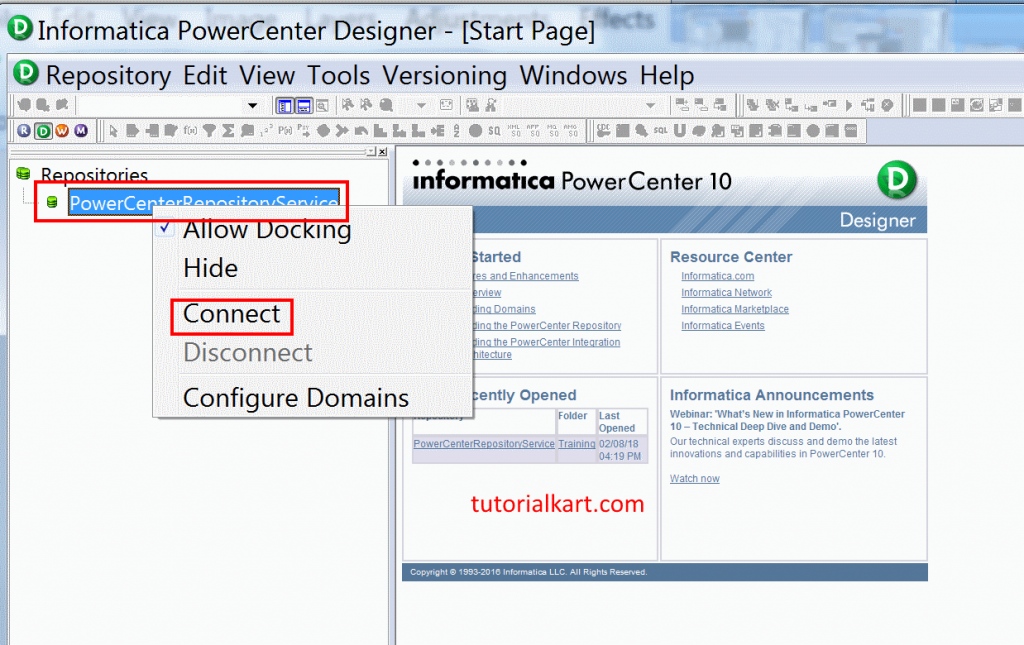
- Open PowerCenter Designer.
- In the Navigator, double-click the required repository service. In this example, the service is named PowerCenterRepository.
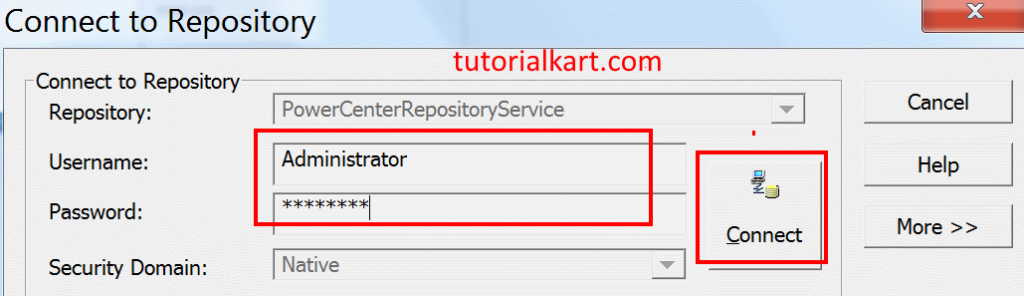
- Enter the repository username and password. The screenshot uses Administrator and password as training-environment values; use the credentials assigned to your environment.
- Click Connect.
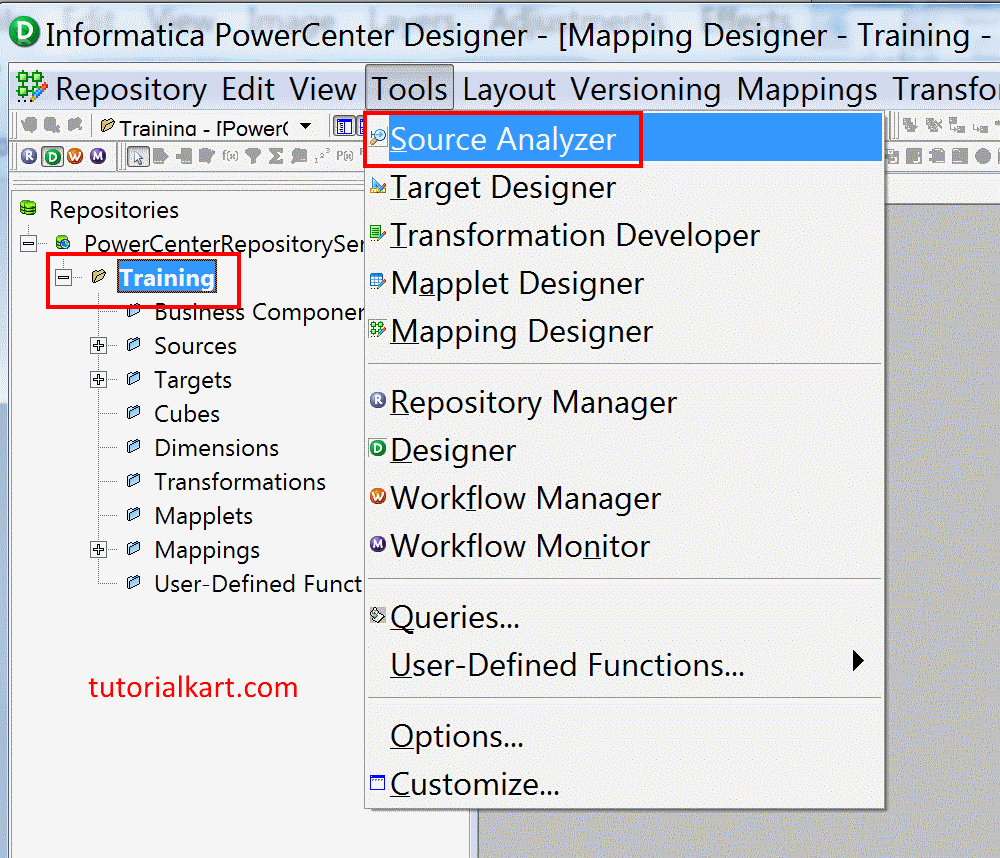
- Select the repository folder in which the source definition should be stored. This example uses the Training folder.
- From the Tools menu, select Source Analyzer.
How to Import a Source Definition from a Database
After opening Source Analyzer, use the database import dialog to connect to the source system and select the required table or view.
- In Source Analyzer, open the Sources menu.
- Select Import from Database.
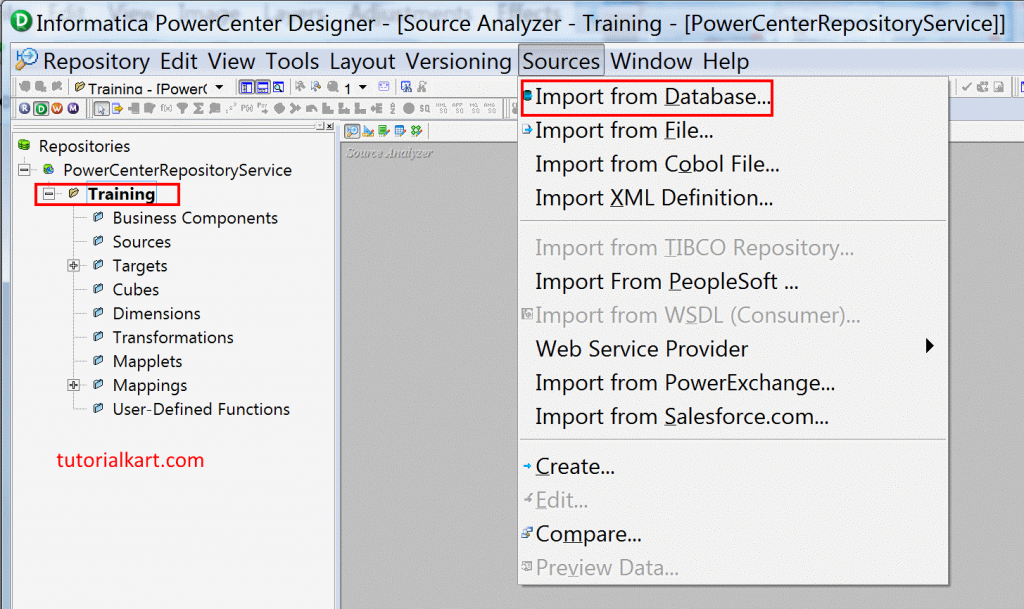
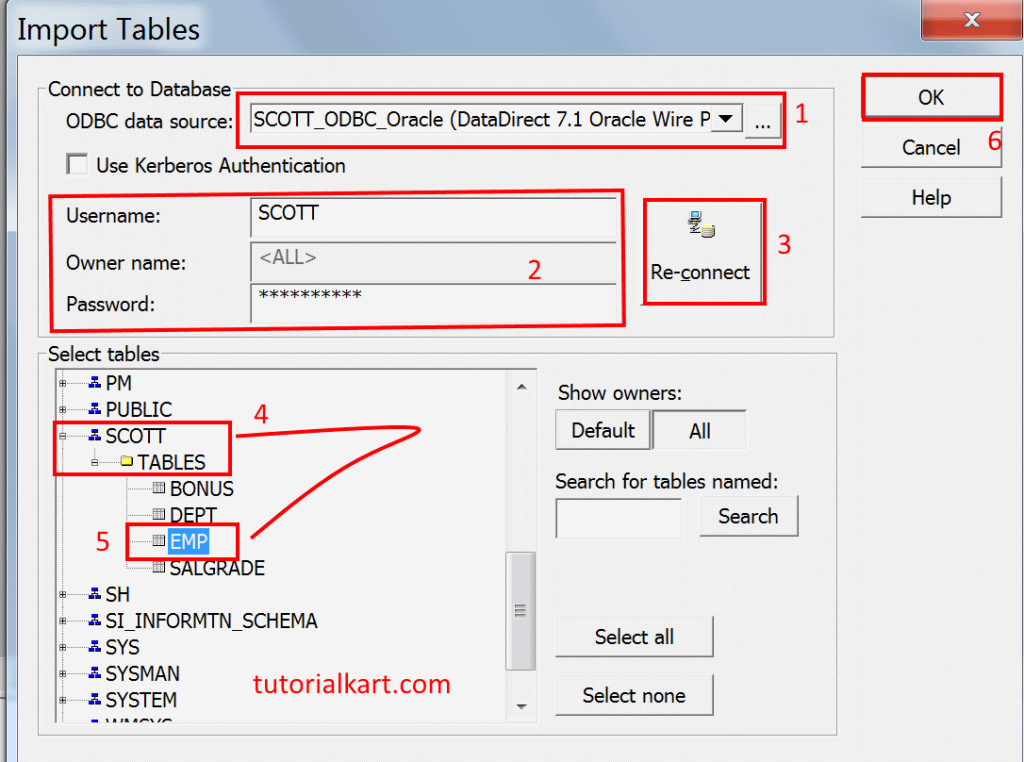
In the connection dialog, select the ODBC data source and enter the database login details. The values below belong to the tutorial’s sample Oracle environment and should be replaced with the values configured for your database.
- ODBC data source: Scott_ODBC_Oracle
- Username: SCOTT
- Owner name: SCOTT
- Password: Admin12345
Do not use these sample credentials in a production system. Use a suitably restricted database account and follow your organization’s credential-management requirements.
- Click Connect.
- Expand the required owner or schema in the object tree.
- Expand Tables or Views, as appropriate.
- For this example, navigate to SCOTT | Tables | EMP.
- Select the EMP table. You can select additional objects if they are needed in the same repository folder.
- Click OK to import the selected definition.
- Review the source definition displayed in the Designer workspace.
- Choose Repository | Save, or use the Save command, to store the imported definition in the repository.
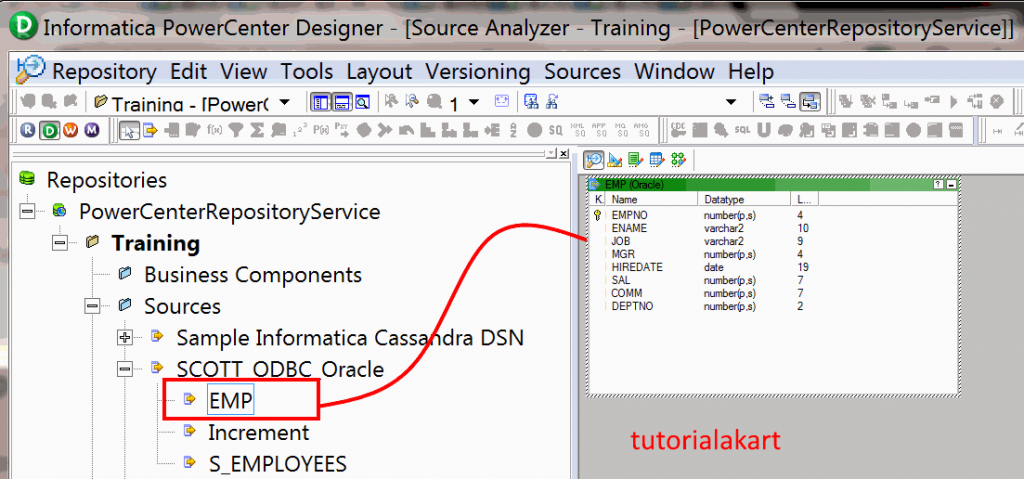
Verify the Imported Source Definition
Before using the definition in a mapping, compare it with the current database object. This helps identify driver-related type conversions, missing key metadata, or changes made to the source table after an earlier import.
- Confirm that the source name and database owner are correct.
- Check that every required column is present and in the expected order.
- Review data types, lengths, precision, and scale.
- Check nullable settings and key information where available.
- Save the repository folder and confirm that the source appears in the Navigator.
If the database table later changes, the repository definition does not necessarily update by itself. Review the source definition and re-import or update its metadata through a controlled change process before running dependent mappings.
Troubleshooting Database Source Imports
The ODBC data source is not listed
Verify that the correct ODBC driver is installed and that the data source is configured where PowerCenter Designer can access it. Also confirm that the driver and Designer use compatible system architecture.
The database connection fails
Check the database host, port, service name, network access, username, and password. Test the ODBC connection outside PowerCenter when the driver provides a connection-test option.
The required table or schema is missing
Confirm the owner name and verify that the database account has permission to view the required object and its metadata. In some environments, objects owned by another schema are not visible without additional privileges or synonyms.
Imported column types differ from database types
PowerCenter represents database-native types through the selected driver and its supported type mappings. Review precision, scale, length, and date or timestamp handling before using the source in a mapping.
Database Sources and Flat-File Sources in Source Analyzer
Source Analyzer can also create definitions for delimited and fixed-width flat files. Database sources are imported through a configured database connection, whereas flat-file definitions require file-format information such as delimiters, field widths, column names, and data types. In both cases, the result is source metadata that can be used in a mapping.
Informatica Source Analyzer FAQs
What is Source Analyzer in Informatica PowerCenter?
Source Analyzer is the PowerCenter Designer workspace used to import, create, inspect, and manage source definitions for database tables, views, flat files, and other supported source types.
Does importing a database source copy its data into Informatica?
No. The import creates a metadata definition in the repository. Records are read only when a session runs a mapping that uses the source and a valid runtime connection.
Why is an ODBC connection required for the source import?
PowerCenter Designer uses the configured ODBC data source and database driver to connect to the database, browse accessible objects, and retrieve their metadata.
Can Source Analyzer import database views?
Yes, accessible views can be imported as source definitions when they are exposed by the database driver and the connected account has sufficient permissions. Review their column and key metadata because views may expose less constraint information than tables.
What should be done when the database table structure changes?
Compare the repository definition with the revised table, update or re-import the metadata as appropriate, and review affected mappings and transformations before running workflows against the changed structure.
Source Import Editorial QA Checklist
- The tutorial distinguishes a source definition from the source table’s actual records.
- The repository service, repository folder, and Source Analyzer navigation are identified correctly.
- ODBC, driver, database permission, and owner or schema requirements are explained.
- Sample credentials are clearly identified as training values rather than reusable production credentials.
- The import procedure includes selecting the table, confirming the import, saving the repository, and checking the resulting metadata.
- Troubleshooting covers missing ODBC sources, connection failures, object visibility, and data-type differences.
- The FAQ answers are specific to importing database definitions through Informatica Source Analyzer.