 TutorialKart.com
What Is Mapping in Informatica PowerCenter?
A mapping in Informatica PowerCenter is a design that defines how data moves from one or more sources to one or more targets. It connects source definitions, target definitions, and transformations in a visual data flow.
The mapping specifies where the data comes from, which fields are used, what transformations are applied, and where the resulting data is written. A mapping stores this design metadata in the repository; it does not run independently.
This tutorial creates a direct source-to-target mapping named m_flat_mapping. It reads rows from the Oracle EMP table and maps them to the T_EMPLOYEE target table.
Components Used in an Informatica Mapping
An Informatica PowerCenter mapping can contain the following components:
- Source definition: Describes the structure of the source table, file, or supported source object.
- Source Qualifier: Represents the rows that PowerCenter reads from a relational source. It is created automatically when a relational source is added to a mapping.
- Transformations: Apply operations such as filtering, expression evaluation, lookup, aggregation, routing, or sorting.
- Target definition: Describes the structure of the table, file, or other supported destination that receives the mapped data.
- Links: Connect output ports to compatible input ports and define the direction in which row data moves.
Mapping, Session, and Workflow in Informatica
A mapping, session, and workflow serve different purposes in PowerCenter:
| PowerCenter object | Purpose |
|---|---|
| Mapping | Defines the source-to-target data flow and transformation logic. |
| Session | Provides the runtime configuration for executing a mapping, including source and target connections. |
| Workflow | Controls the execution of the session and any other workflow tasks. |
The mapping is created in PowerCenter Designer. The related session and workflow are created in Workflow Manager.
Requirements for Creating the EMP-to-T_EMPLOYEE Mapping
Before creating the example mapping, confirm that the following objects and permissions are available:
- Access to the required PowerCenter repository and folder.
- An imported source definition for the EMP table.
- An imported or manually created target definition for T_EMPLOYEE.
- Compatible source and target fields for the direct field mappings.
- Repository permission to create and save mappings in the selected folder.
How to Create a Mapping in Informatica PowerCenter
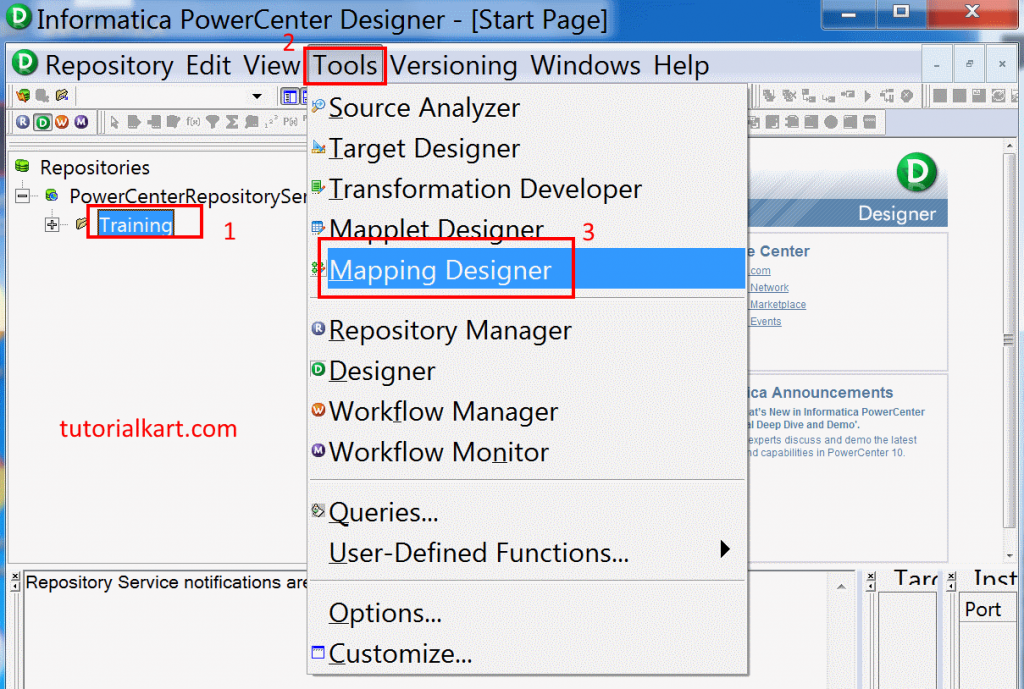
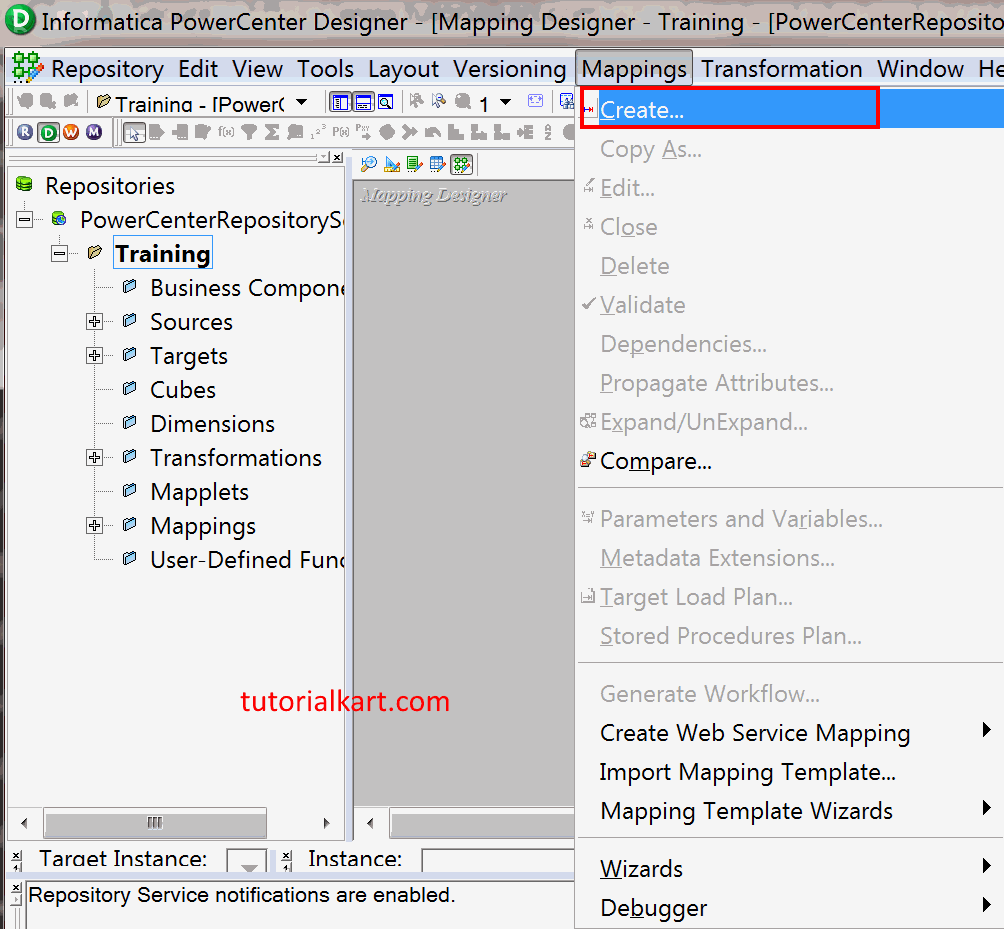
Open Informatica PowerCenter Designer, connect to the repository, and open the folder in which the mapping must be stored. Select Tools | Mapping Designer, and then select Mappings | Create.
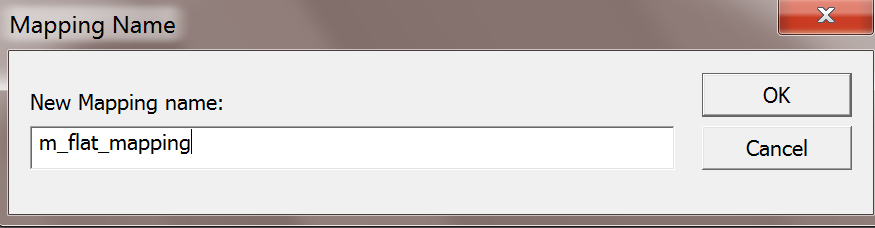
Name the Informatica Mapping m_flat_mapping
Enter m_flat_mapping in the mapping name dialog box and click OK. A clear naming convention makes mappings easier to identify in the repository and Workflow Manager.
Add the EMP Source Definition to Mapping Designer
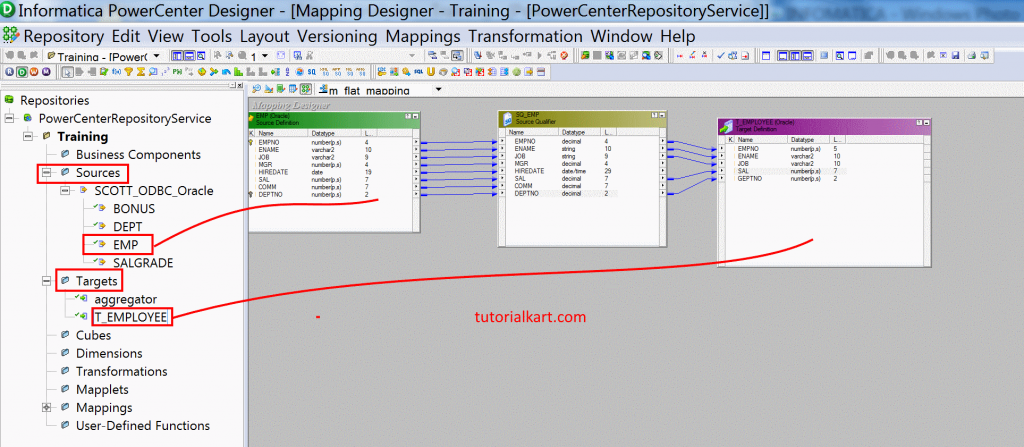
Locate the EMP source definition in the Navigator and drag it into the Mapping Designer workspace. When a relational source is added, PowerCenter also creates the associated Source Qualifier transformation, shown in this example as SQ_EMP.
The source definition represents the database table metadata. The Source Qualifier represents the rows that the Integration Service reads from that relational source during execution.
Add the T_EMPLOYEE Target Definition
Locate the T_EMPLOYEE target definition in the Navigator and drag it into the same workspace. Placing both definitions in the mapping does not copy data; it creates the design objects required to define the source-to-target flow.
Connect SQ_EMP Fields to T_EMPLOYEE Fields
Connect the required output ports in SQ_EMP to the corresponding input ports in T_EMPLOYEE. Drag each source field to the target field that represents the same business value.
Do not rely only on field position. Compare the field names, data types, precision, scale, and intended meaning before creating each link. If the source and target structures differ, add the appropriate transformations instead of connecting incompatible fields directly.
Note: If a field is linked incorrectly, select the link and press the Delete key. Deleting the link does not delete the source or target field.
How to Validate and Save the Informatica Mapping
After connecting the fields, review the complete data flow and validate the mapping. Validation checks the mapping design for issues such as unconnected required ports, invalid transformation expressions, and incompatible connections.
- Confirm that the mapping contains the intended EMP source and T_EMPLOYEE target.
- Check that every required target field receives data from the correct source or transformation port.
- Select the mapping validation option available in PowerCenter Designer.
- Review and correct any reported mapping errors.
- Save the repository changes after the mapping becomes valid.
A valid mapping means that the design passes PowerCenter’s validation checks. It does not confirm that database connections, permissions, target constraints, or production data will succeed at runtime.
How to Execute the m_flat_mapping Mapping
A PowerCenter mapping cannot be executed directly from Mapping Designer. To run m_flat_mapping, create a session that references it and place that session in a workflow.
- Open Workflow Manager and connect to the same repository folder.
- Create a session for m_flat_mapping.
- Configure the required source and target database connections.
- Review target load properties and other session settings.
- Create a workflow and add the session task to it.
- Validate and start the workflow.
- Use Workflow Monitor to review the execution status and session log.
When the workflow runs, the Integration Service reads the source rows, applies the mapping logic, and attempts to write the resulting rows to the configured target. The actual result depends on the session configuration, connections, permissions, target constraints, and input data.
Common Informatica Mapping Problems
The EMP or T_EMPLOYEE Definition Is Missing
Confirm that the source and target definitions were imported or created in the same repository folder. Also verify that the correct folder is open in PowerCenter Designer.
SQ_EMP Is Not Created Automatically
Check that EMP was imported as a relational source definition and added from the Sources node. The automatic Source Qualifier behavior applies when a relational source is added to the mapping.
Source and Target Ports Cannot Be Linked
Review the port direction and data types. A connection must run from an output-capable port to an input-capable port. When the data types or formats differ, use a suitable transformation to convert or derive the value.
The Mapping Is Valid but the Workflow Fails
Mapping validation does not test every runtime dependency. Check the session log for connection failures, SQL errors, rejected rows, permission problems, target constraints, or other execution details.
EMP-to-T_EMPLOYEE Mapping QA Checklist
- Confirm that the mapping is named m_flat_mapping and is saved in the intended repository folder.
- Verify that EMP is the source definition and T_EMPLOYEE is the target definition.
- Confirm that SQ_EMP is connected to the correct target fields.
- Compare the source and target field names, data types, precision, scale, and business meaning.
- Check that all required target fields receive valid input.
- Validate the mapping and resolve every reported design error.
- Verify the session’s source and target connections before running the workflow.
- Review Workflow Monitor and the session log after execution.
Informatica Mapping FAQs
What is an Informatica mapping?
An Informatica PowerCenter mapping is a repository object that defines how data moves from source definitions to target definitions through connected transformations. It describes the data flow and transformation rules but requires a session and workflow for execution.
How do I create a mapping in Informatica PowerCenter?
Open Mapping Designer, select Mappings | Create, enter a mapping name, add the required source and target definitions, connect their fields through any necessary transformations, validate the design, and save the repository.
What is mapping in an ETL process?
In an ETL process, mapping defines how source data corresponds to target data and what rules are applied between extraction and loading. These rules can include filtering, conversion, calculation, lookup, aggregation, and field-to-field assignment.
Can an Informatica mapping run without a session?
No. In PowerCenter, a mapping contains the data-flow design, while a session provides the runtime instructions required to execute that mapping. The session is normally run as part of a workflow.
What is a flat mapping in Informatica?
The term commonly refers to a simple mapping with a direct or minimally transformed source-to-target flow. In this example, fields from SQ_EMP are connected directly to corresponding fields in T_EMPLOYEE. It is a descriptive term rather than a separate PowerCenter mapping object type.