 TutorialKart.com
What is Informatica PowerCenter Designer?
Informatica PowerCenter Designer is the graphical design client used to create and manage PowerCenter repository objects such as sources, targets, transformations, mapplets, and mappings. In an ETL project, Designer is where you define how data should move from source systems to target systems and what transformations should happen between them.
PowerCenter Designer does not execute the ETL job by itself. It stores metadata and design logic in the repository. The actual session and workflow execution is handled later through PowerCenter workflow tools and the Integration Service. This difference is important for beginners: Designer is for building the mapping logic; workflow tools are for running, scheduling, and monitoring that logic.
A Mapping in PowerCenter Designer is usually created by importing or defining source metadata, defining target metadata, adding transformations, and connecting ports in the Mapping Designer workspace. To understand the Informatica PowerCenter Designer interface, open Informatica PowerCenter Designer, right-click the Repository service, click Connect, and enter the required username and password credentials.
Where PowerCenter Designer fits in an Informatica ETL project
Informatica PowerCenter Designer is used during the development stage of an ETL project. A developer uses it to define source structures, target structures, reusable transformation logic, and mappings. After a mapping is valid and saved in the repository, it can be used in sessions and workflows for execution.
A simple PowerCenter development flow is shown below.
- Connect to the PowerCenter repository from Designer.
- Open the required repository folder for the project.
- Import or create source definitions in Source Analyzer.
- Import or create target definitions in Target Designer.
- Create transformations, mapplets, or reusable objects when needed.
- Build the mapping by linking source, transformation, and target ports.
- Validate the mapping and fix errors shown in the Output window.
- Save the mapping so it is available for session and workflow creation.
Informatica PowerCenter Designer interface components
Informatica PowerCenter Designer is loaded with different interface components that help developers build and maintain ETL mappings. The Designer screen is divided into five main areas.
- Navigator.
- Workspace.
- Toolbar.
- Output/control panel.
- Status bar.
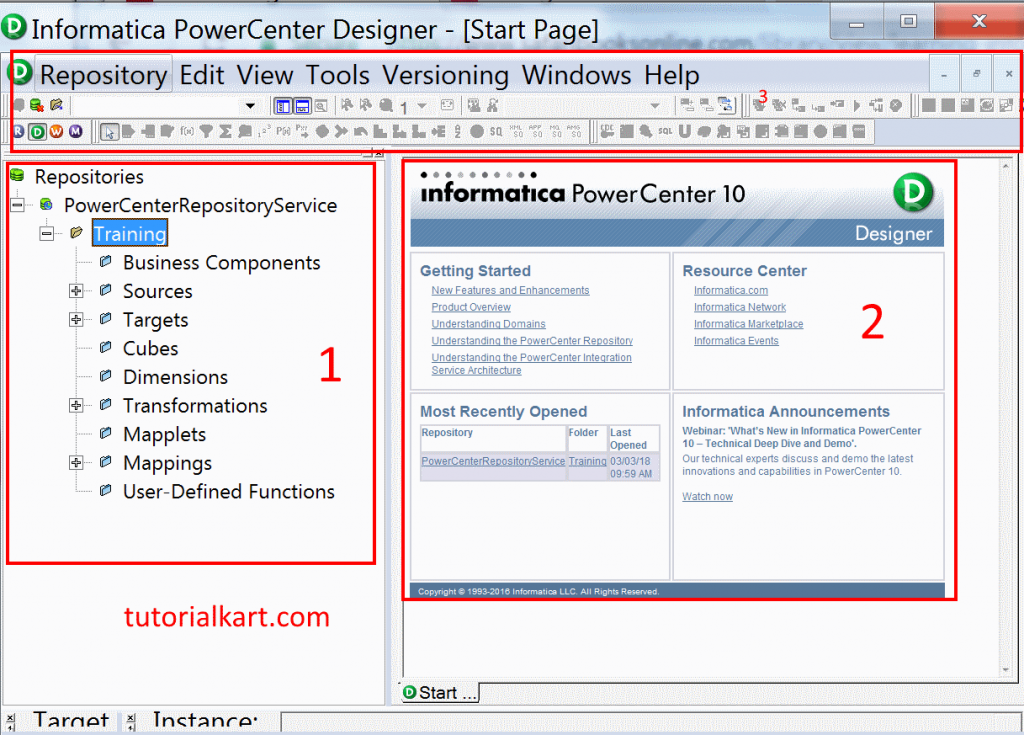
Navigator in Informatica PowerCenter Designer is used to connect with the Repository service, open folders, copy objects, create shortcuts, and browse repository objects. Using Navigator, developers can reuse existing components such as sources, targets, mappings, mapplets, and reusable transformations.
Workspace is the main design area where repository objects are opened, edited, and connected. In the Designer workspace, you can create and modify sources, targets, transformations, mapplets, and mappings. This is where most mapping design work is done.
Toolbar provides menus and shortcuts for repository actions, editing, tools, versioning, windows, and help. The available toolbar options can change depending on the Designer tool that is currently active.
Output/control panel displays messages about the task performed in PowerCenter Designer. It helps you confirm whether a mapping is valid, whether an object is saved, and which errors must be corrected before the mapping can be used safely.
Status bar displays the status of the current operation, such as connection state, validation progress, or object activity in the current workspace.
PowerCenter Designer tools used to build mappings
Informatica PowerCenter Designer is used to create and edit PowerCenter objects like sources, targets, mapplets, transformations, and mappings. The main Designer tools are explained below.
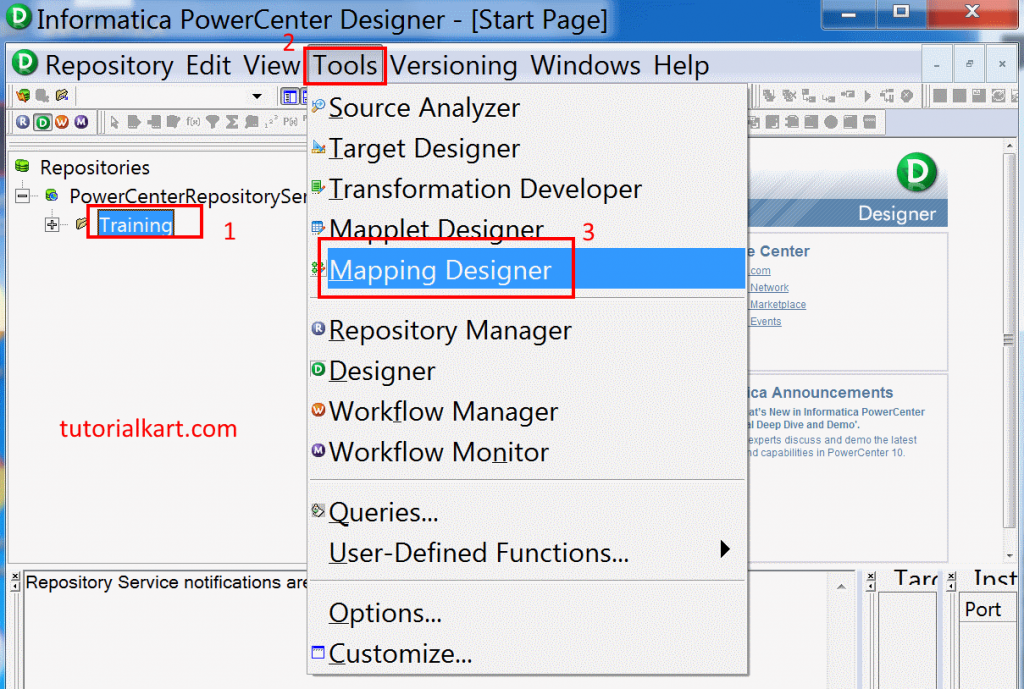
- Source Analyzer: A source in ETL is the system or object from which records are extracted. Source Analyzer allows developers to create, compare, and import source definitions from databases, flat files, COBOL files, XML definitions, PeopleSoft, web service providers, Salesforce, and other supported systems.
- Target Designer: A target in ETL is the destination structure where transformed data is loaded. Target Designer allows developers to create and modify target definitions by importing from databases, flat files, XML, Salesforce, PeopleSoft, and other supported systems. Target metadata includes column names, data types, precision, scale, and key properties.
- Transformation Developer: Transformation Developer is used to create reusable transformations. Reusable transformations are helpful when the same business rule or data conversion must be used in more than one mapping.
- Mapplet Designer: A mapplet is a reusable group of transformations. Using Mapplet Designer, developers can create a common transformation flow once and reuse it inside multiple mappings.
- Mapping Designer: Mapping Designer is where source definitions, transformations, mapplets, and target definitions are connected to form the complete ETL logic. This is the tool most developers use when they build the actual data flow.
Source Analyzer in Informatica PowerCenter Designer
Source Analyzer is used to bring source metadata into the repository. When you import a database table, flat file, or XML definition, PowerCenter stores the structure as a source definition. The source definition represents metadata; it is not the actual source data.
After importing source definitions, check the column names, data types, key fields, and precision values. If the source structure changes later, compare or refresh the source definition carefully so existing mappings do not break unexpectedly.
Target Designer in Informatica PowerCenter Designer
Target Designer is used to define the structure of the target system. A target definition can represent a database table, file, XML target, or another supported destination. The mapping uses this target definition to understand which fields must be loaded and what data types are expected.
For accurate mapping design, verify that target column names, nullable settings, data types, and key fields match the real target object. Many mapping validation issues come from mismatched ports, missing target fields, or incompatible data types between transformation output and target input.
Transformation Developer, Mapplet Designer, and Mapping Designer difference
Beginners often confuse Transformation Developer, Mapplet Designer, and Mapping Designer because all three are used while building ETL logic. Their purpose is different.
| Designer tool | Main purpose | When to use it |
|---|---|---|
| Transformation Developer | Create reusable transformation objects | Use it when a single reusable transformation is needed in many mappings |
| Mapplet Designer | Create a reusable group of transformations | Use it when the same set of connected transformation steps is repeated |
| Mapping Designer | Create the complete source-to-target data flow | Use it when building the actual ETL mapping |
For example, a reusable Expression transformation can be created in Transformation Developer. A standard customer cleansing flow can be created as a mapplet. The final mapping can then use source definitions, the mapplet, additional transformations, and target definitions together.
Common PowerCenter Designer validation issues
PowerCenter Designer validation checks whether a mapping is structurally correct. A valid mapping is still not a guarantee that the business result is correct, but it confirms that the mapping can be saved and used for later execution steps.
- Unconnected required ports: A target or transformation port that must receive data is not connected.
- Data type mismatch: A port sends a value that does not match the expected data type or precision.
- Invalid expression logic: An Expression, Filter, Router, or Aggregator transformation contains incorrect syntax or incompatible functions.
- Missing source or target metadata: A definition has been deleted, changed, or not imported correctly.
- Reusable object dependency issues: A mapping depends on a reusable transformation or mapplet that has been changed without validating the dependent mappings.
Always review the Output/control panel after validation. It usually gives the first useful clue about which object, port, or expression needs correction.
How to learn Informatica PowerCenter Designer safely
If you are learning PowerCenter Designer, start with the basic flow of source definition, target definition, mapping, transformation, validation, and save. Do not begin with complex workflows before you understand how mappings are built in Designer.
For software availability, documentation, and installation packages, use official Informatica sources such as the Informatica download page and official PowerCenter documentation. Availability can depend on product version, licensing, and your organization’s Informatica account, so avoid downloading installers from unofficial websites.
PowerCenter Designer QA checklist before saving a mapping
- Confirm that source definitions match the current source tables, files, or service structures.
- Confirm that target definitions match the target table or file structure expected by the load process.
- Check every connected port for correct data type, precision, and scale.
- Review transformation expressions, filters, lookups, aggregations, and router conditions for business correctness.
- Validate the mapping and read the Output/control panel messages before saving the final version.
- Check whether reusable transformations and mapplets are used intentionally and are not changed in a way that affects other mappings.
PowerCenter Designer FAQs
What is PowerCenter Designer in Informatica?
PowerCenter Designer is the graphical client used to create and manage source definitions, target definitions, transformations, mapplets, and mappings in Informatica PowerCenter. It is mainly used during ETL development.
What is Informatica PowerCenter used for?
Informatica PowerCenter is used for data integration and ETL processes. It helps extract data from source systems, transform it according to business rules, and load it into target systems such as data warehouses, databases, or files.
How can I download Informatica PowerCenter to learn Designer?
Use Informatica’s official download and documentation channels. Access can depend on the version, license, and account permissions. Avoid unofficial installer sources, especially for enterprise ETL software.
Is Informatica PowerCenter Designer the same as PowerDesigner?
No. PowerCenter Designer is a design tool inside Informatica PowerCenter for creating ETL mappings. PowerDesigner generally refers to a separate data modeling product, so the names should not be treated as the same tool.
Is Informatica PowerCenter discontinued?
Do not rely on old tutorials or forum comments to decide product status. Check current Informatica product documentation, download access, and your organization’s licensing details. The Designer concepts are still useful when maintaining or learning existing PowerCenter environments.
In summary, Informatica PowerCenter Designer is the main development interface for building PowerCenter mapping logic. Once you understand Navigator, Workspace, Source Analyzer, Target Designer, Transformation Developer, Mapplet Designer, and Mapping Designer, the rest of the PowerCenter development process becomes easier to follow.