 TutorialKart.com
Informatica PowerCenter Repository Backup & Restore
In this Informatica tutorial, we are going to learn how to take an Informatica PowerCenter Repository backup and restore it step by step in Informatica 10.0.1. An Informatica PowerCenter Repository backup can be taken from the Administrator tool, also called the Admin Console, or by using the pmrep command.
The PowerCenter repository stores metadata such as folders, mappings, mapplets, workflows, sessions, sources, targets, reusable transformations, and related repository objects. A repository backup is therefore a key administrative task before upgrades, migrations, major deployments, or maintenance activities.
Before taking an Informatica PowerCenter Repository backup
Before starting the backup, make sure that you have the required repository privileges and that the Repository Service is available in the domain. It is also a good practice to plan the backup during a low-usage window so that active development and workflow execution do not interfere with the operation.
- Confirm the Repository Service name and domain name.
- Check that you can log in to the Informatica Administrator tool.
- Use a repository administrator or a user with the required repository permissions.
- Choose a clear backup file name that includes the repository name and date.
- Decide whether workflow and session logs must be included in the backup.
- Store the backup file in a protected location after the backup is created.
The backup file created by PowerCenter is a repository backup file, not a plain database export. Do not edit the backup file manually.
Repository Backup using Admin console
In Informatica, Administrator regulated repository backup to prevent data loose due to some software and hardware failures. Informatica PowerCenter repository backup is stored as binary files. Logon to Informatica Admin console using login username and password.
Step 1 : Select Repository Service.
Informatica Repository service is the centralized database that stores metadata generated in the client tools. Select repository service present in the domain navigator as shown below.
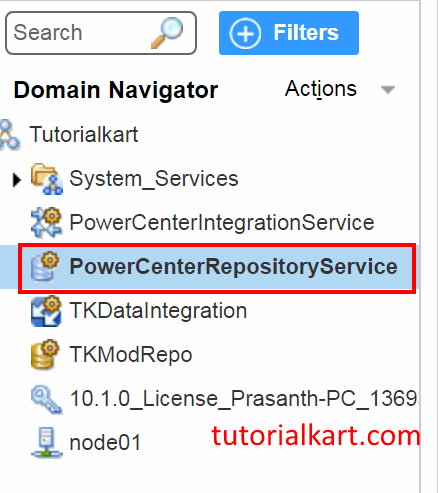
After selecting the Repository Service, check that you are working on the correct repository. In domains with multiple Repository Services, selecting the wrong service can create confusion when backup files are reviewed later.
Step 2 : Select backup contents under actions menu to take backup.
To select backup content, navigate to Actions at the right top of the page and select repository contents | Backup as shown below.
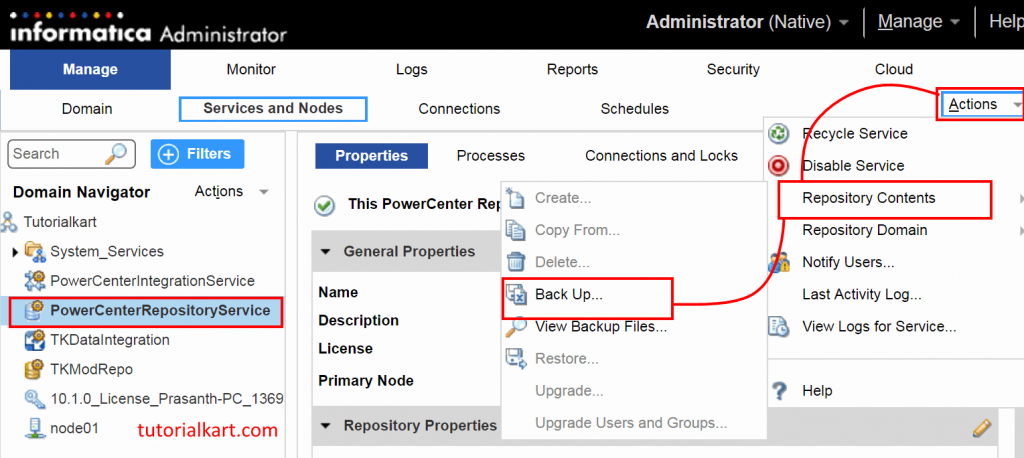
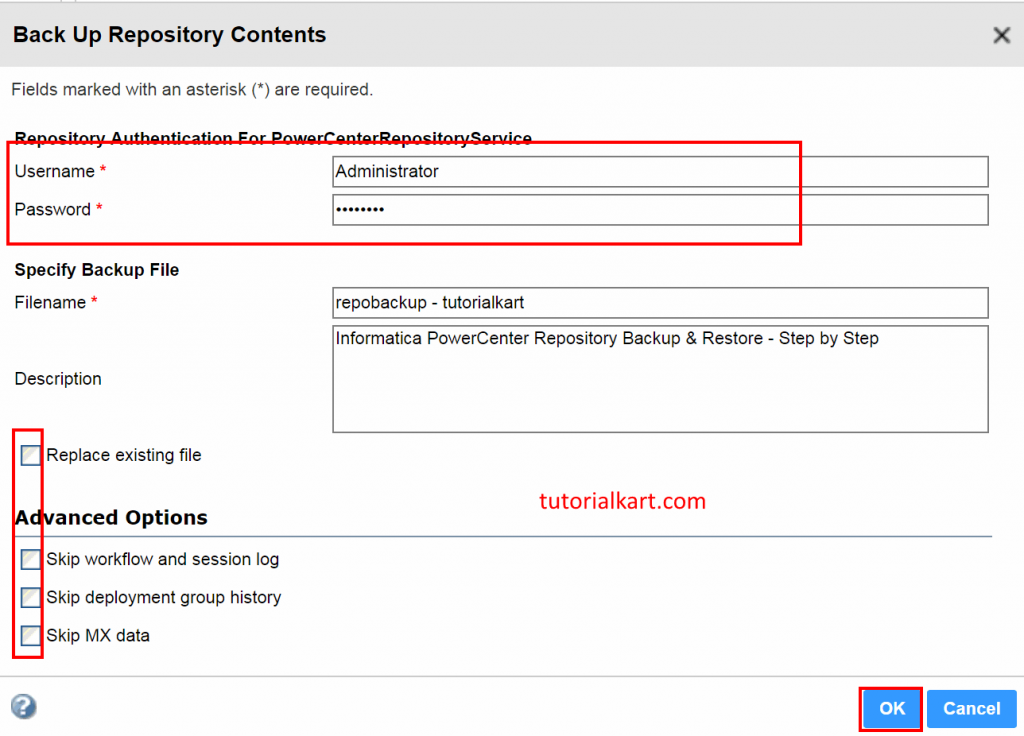
Enter Username, password, Backup filename and description details to take Informatica PowerCenter repository backup. Based on the backup requirement select advances options shown below.
- Click on Ok button.
Use a meaningful description for the backup file. For example, mention whether the backup was taken before an upgrade, before importing a large deployment, or before repository maintenance. This helps the administrator identify the correct backup file during restore.
What to include in a PowerCenter Repository backup
While taking a repository backup, the main decision is whether to include only repository metadata or also include additional history and log information. For a small repository, including more content may be acceptable. For large production repositories, logs and history can increase the backup size.
| Backup choice | When to use it |
|---|---|
| Repository metadata backup | Use this for normal backup, migration, and recovery of mappings, workflows, sessions, and other repository objects. |
| Include workflow and session logs | Use this when historical execution details are required for audit or troubleshooting. |
| Skip logs or history options | Use this when the backup must be smaller and only repository design metadata is required. |
| Detailed backup description | Use this to identify the purpose of the backup during restore. |
If the backup is intended for disaster recovery, keep a copy outside the Informatica server and verify that the file can be accessed by the required administrators.
View Informatica PowerCenter Repository Backup
To view PowerCenter repository Backup, navigate repository service | Actions |repository content | View Backup files
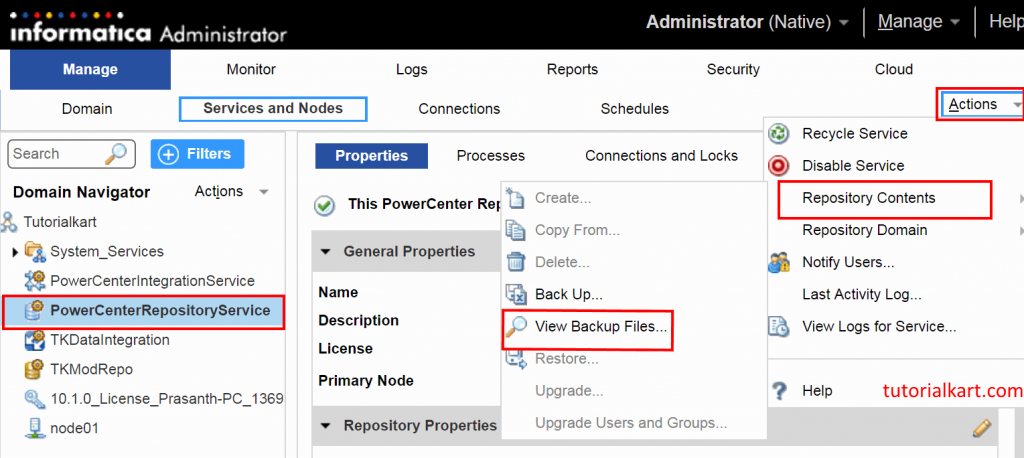
Now a popup window will be appeared on your screen which displays list of backed up files with file name, version, Skip options and description as shown below.

Review the file name, version, skip options, and description before choosing a file for restore. If several backup files exist, do not select a file only by its position in the list. Match the date, description, and repository version carefully.
Step 3 : Restore contents under actions menu to restore.
To restore contents in the repository service, we must have backed up the informatica repository. Click on Restore link as shown above.
Repository restore replaces the repository contents with the contents from the selected backup file. Before restoring, take a fresh backup of the current repository if it contains any useful work. Inform users not to connect to the repository during the restore activity.
Restore Informatica PowerCenter Repository backup safely
Follow these checks before restoring a PowerCenter repository backup from the Admin Console.
- Confirm that the selected backup file belongs to the same repository or to the repository that you intentionally want to restore.
- Check the Informatica version and repository compatibility before restoring a backup from another environment.
- Take a current backup of the target repository before restore.
- Stop or pause dependent activity so that users and workflows do not update repository metadata during restore.
- Restore the selected backup file from the Repository Contents menu.
- After restore, validate folders, mappings, workflows, sessions, connections, and permissions.
After restore, open PowerCenter Repository Manager, Designer, Workflow Manager, and Workflow Monitor as needed to confirm that repository objects are available and usable.
Informatica PowerCenter repository backup using pmrep command
The pmrep command-line program is useful when repository backup must be automated through scripts. The general flow is to connect to the repository and then run the repository backup command. The exact options can vary by PowerCenter version and environment, so verify the command syntax in your installed Informatica command reference before using it in production.
pmrep connect -r RepositoryServiceName -d DomainName -n Administrator -x Password
pmrep backup -o /backup/RepositoryServiceName_2026_06_29.rep
For scheduled backups, store credentials securely instead of hard-coding passwords in plain text scripts. Also write script output to a log file so that failures can be reviewed later.
#!/bin/bash

BACKUP_DIR="/backup/informatica"
REPOSITORY="RepositoryServiceName"
DOMAIN="DomainName"
BACKUP_FILE="$BACKUP_DIR/${REPOSITORY}_$(date +%Y%m%d).rep"

mkdir -p "$BACKUP_DIR"

pmrep connect -r "$REPOSITORY" -d "$DOMAIN" -n "$INFA_USER" -x "$INFA_PASSWORD"
pmrep backup -o "$BACKUP_FILE"
In the sample script, INFA_USER and INFA_PASSWORD are expected to be supplied through a secure operating system mechanism or scheduler configuration. Adjust the repository name, domain name, and backup directory for your environment.
Informatica PowerCenter repository restore using pmrep command
A repository restore can also be performed using pmrep. Use this method only after confirming the target repository and backup file. Restoring the wrong backup can overwrite the current repository content.
pmrep connect -r RepositoryServiceName -d DomainName -n Administrator -x Password
pmrep restore -i /backup/RepositoryServiceName_2026_06_29.rep
After a command-line restore, review the command output and logs. Then connect with PowerCenter client tools and validate the restored objects before allowing users to resume work.
Repository backup file naming and storage practice
A clear naming convention reduces mistakes during restore. Include the repository service name, environment, and date in the file name.
RepositoryServiceName_ENV_YYYYMMDD.repExample file names:
PCREP_DEV_20260629.repPCREP_TEST_20260629.repPCREP_PROD_before_upgrade_20260629.rep
Keep backup files in a directory with restricted access. For production repositories, follow the organization backup retention policy and keep at least one copy outside the application server.
Common errors during PowerCenter Repository backup and restore
| Issue | Likely cause | What to check |
|---|---|---|
| Backup option is not available | User does not have required privileges or wrong service is selected | Check repository permissions and selected Repository Service |
| Backup fails immediately | Repository Service is not available or login details are wrong | Check service status, username, password, and domain |
| Backup file is too large | Logs and history are included | Review advanced backup options and retention needs |
| Restore selected wrong file | Backup descriptions are unclear | Use consistent file names and descriptions |
| Objects missing after restore | Wrong backup file or environment was restored | Validate backup date, version, and source repository |
Admin Console backup versus pmrep backup in Informatica
Both Admin Console and pmrep can be used for PowerCenter repository backup. Choose the method based on whether the task is manual or automated.
| Backup method | Best use case | Notes |
|---|---|---|
| Admin Console backup | Manual backup before a planned change | Easy to use and suitable for administrators who prefer the web interface |
| pmrep backup | Scheduled or scripted repository backup | Useful for automation, but scripts must handle credentials and logging safely |
| Admin Console restore | Controlled restore from visible backup list | Useful when the administrator wants to review available backup files in the console |
| pmrep restore | Command-line restore in controlled environments | Requires careful validation of repository name and input backup file |
FAQs on Informatica PowerCenter Repository backup and restore
What is an Informatica PowerCenter Repository backup?
An Informatica PowerCenter Repository backup is a backup of repository metadata such as mappings, workflows, sessions, folders, sources, targets, transformations, and related repository objects. It is used for recovery, migration, and maintenance activities.
Can I take a PowerCenter Repository backup from Admin Console?
Yes. Select the Repository Service in the Informatica Administrator tool, go to the Actions menu, and use the Repository Contents backup option. Enter the required login and backup file details to create the backup.
Can I automate Informatica repository backup?
Yes. Repository backup can be automated with the pmrep command-line utility. In a production script, store credentials securely and capture command output in a log file.
Does restoring a repository backup overwrite existing PowerCenter repository contents?
Yes. A restore operation replaces the target repository contents with the contents from the selected backup file. Always take a current backup and verify the selected file before restoring.
What should I check after restoring a PowerCenter Repository backup?
After restore, verify folders, mappings, workflows, sessions, connection objects, repository permissions, and workflow execution behavior. Also review restore logs for warnings or errors.
Editorial QA checklist for this PowerCenter Repository backup tutorial
- Confirm that every restore instruction clearly warns that repository contents can be overwritten.
- Check that Admin Console navigation uses Repository Service and Repository Contents terminology consistently.
- Verify that
pmrepexamples are treated as templates and not copied blindly into production. - Ensure backup file naming examples identify repository, environment, and date.
- Confirm that the article separates PowerCenter Repository backup from Model Repository Service backup.
Conclusion: Informatica PowerCenter Repository backup and restore
In this tutorial, we learned how to take an Informatica PowerCenter Repository backup from the Admin Console, how to view backup files, and how to restore repository contents. We also reviewed the pmrep command-line approach for backup and restore. The main rule is to verify the repository name, backup file, version, and environment before any restore operation, because restore replaces the current repository contents with the selected backup.