 TutorialKart.com
What is an Infotype in SAP HR?
In SAP HR, an infotype is a structured group of related HR data fields used to store employee, applicant, payroll, time, or organizational information. For example, personal data, address details, bank details, qualifications, and organizational assignment are maintained in separate infotypes so that each type of HR information can be stored, displayed, changed, and reported in a consistent way.
Technically, an infotype is linked to SAP HR master data tables and screens. Most Personnel Administration infotypes are identified by a four-digit number, such as 0000 for Actions, 0001 for Organizational Assignment, 0002 for Personal Data, and 0006 for Addresses. The employee data is maintained with validity dates, which helps SAP keep a time-dependent history instead of simply overwriting old information.
Why SAP HR Uses Infotypes for Employee Master Data
Standard SAP R/3 and SAP HCM systems deliver various infotypes to maintain different categories of employee information separately. This structure makes HR data easier to validate, process, audit, and use in payroll, time management, personnel administration, and reporting.
- Logical grouping: Related fields are kept together, such as street, city, postal code, and country in the address infotype.
- Time dependency: Records can be stored with start and end dates, so SAP can show what data was valid at a particular point in time.
- Standard processing: SAP programs, reports, payroll functions, and HR transactions can read infotype data in a predictable format.
- Country and payroll support: Some infotypes are country-specific and are used for statutory, tax, or payroll-related requirements.
- Customization option: Projects can create customer-specific infotypes when standard SAP infotypes do not cover a business requirement.
Characteristics of Infotype
- Info type stores the data in a table for a specific period of time, means when you create a object with the dates from 01.04.2010 to 31.03.2020, you can view the object up to 31st March, 2017.
- The data will not be deleted and you can view the objects by changing the date.
- Every infotype is defined with four character numerical key with long text.
SAP HR Infotype Number, Screen, and Table Relationship
Each SAP HR infotype is usually represented by a four-digit number. In Personnel Administration, the corresponding transparent table commonly follows the pattern PA plus the infotype number. For example, Infotype 0002 is commonly stored in table PA0002. In Personnel Planning and Organizational Management, infotype tables commonly follow the HRP pattern, such as HRP1001 for Relationships.
| Infotype | Common Use in SAP HR | Typical Table Pattern |
|---|---|---|
| 0000 – Actions | Hiring, transfer, promotion, termination, and other personnel actions | PA0000 |
| 0001 – Organizational Assignment | Company code, personnel area, position, job, and organizational unit assignment | PA0001 |
| 0002 – Personal Data | Name, date of birth, gender, marital status, and personal details | PA0002 |
| 0006 – Addresses | Permanent address, temporary address, and other address records | PA0006 |
| 0008 – Basic Pay | Pay scale, wage types, and basic salary information | PA0008 |
| 0024 – Qualifications | Skills, qualifications, and related profile information | PA0024 |
| 1001 – Relationships | Relationships between organizational objects such as positions, jobs, users, and organizational units | HRP1001 |
The exact fields and processing logic depend on the infotype, country version, and configuration used in the SAP HR system. Functional consultants usually maintain infotypes through SAP HR transactions, while ABAP consultants may refer to the underlying tables, structures, and enhancement options for reports or custom developments.
Infotype Validity Periods
Validity period of time is used to denote the time period for information stored in infotype. Every infotype would have a start date and end date. In some cases infinity date is used for infotypes wherever end data can not be predetermined.
For example, if an employee changes address, SAP HR can keep the old address record with its earlier validity period and create a new address record from the effective change date. This is useful for payroll, statutory reporting, audit checks, and historical HR reports.
Time Constraint Concept in SAP HR Infotypes
Infotypes are controlled by time constraints. A time constraint defines how many records of a particular infotype can exist for the same employee during the same period. This is one of the key reasons SAP HR can control whether data should be mandatory, unique, overlapping, or optional for a given date range.
| Time Constraint | Meaning in SAP HR Infotypes | Simple Example |
|---|---|---|
| Time Constraint 1 | Exactly one valid record must exist at any time, and gaps are usually not allowed. | Organizational Assignment for an active employee |
| Time Constraint 2 | Only one record can exist at a time, but a record may not be mandatory for every period. | Certain optional employee details |
| Time Constraint 3 | Multiple records can exist for the same period, depending on the infotype design. | Multiple communication or address-related records |
When a user creates, changes, copies, or delimits an infotype record, SAP checks the time constraint rules and adjusts the records according to the permitted validity logic.
Infotype Subtypes
Some infotypes can have a sub types, which is used to denote sub infotype. Subtype refers as the further classification of an infotype in SAP.
For example, the Addresses infotype can use subtypes to distinguish permanent residence, temporary address, or emergency address. Subtypes make it possible to store different categories of data under the same main infotype number without creating a separate infotype for every variation.
Types of Infotypes in SAP HR
The different types of infotypes area
- SAP Standard infotype
- Customer Specific infotype
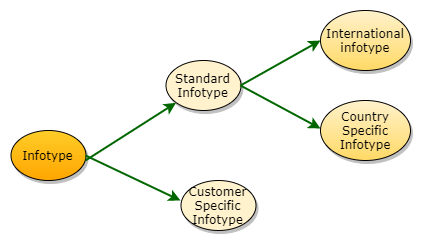
SAP standard Infotype : – Standard SAP infotypes are the infotypes which are delivered by standard SAP system. Standard infotypes comes with predefined settings which are used to maintain employees information. Standard infotypes can be divided into two categories
- International infotypes : – This international infotypes can be used for all countries.
- Country Specific infotypes : -This types of infotypes are only used in specific countries, this infotypes are used in payroll process.
Customer Specific Info type : – You can create custom infotype as per requirements of project. This infortypes are used by SAP HR – ABAP consultants.
Standard SAP HR Infotypes and Customer-Specific Infotypes
Standard SAP HR infotypes are delivered by SAP and are used for common HR business processes. These infotypes already have standard screens, fields, database tables, and processing logic. They can be configured according to business rules, country requirements, and payroll needs.
Customer-specific infotypes are created when a project needs to store HR data that is not covered by standard SAP. These custom infotypes are generally designed carefully because they may require custom screens, validation, authorization checks, reporting logic, and upgrade-safe development practices.
| Infotype Category | Purpose | Example Usage |
|---|---|---|
| International standard infotypes | Used across countries for common HR information | Personal Data, Organizational Assignment, Addresses |
| Country-specific standard infotypes | Used for local statutory, tax, benefits, or payroll processing | Country payroll and legal reporting data |
| Customer-specific infotypes | Created for project-specific HR data requirements | Internal employee attributes not available in standard SAP |
How SAP HR Infotypes Are Maintained in Daily Work
In SAP HR Personnel Administration, infotype records are commonly maintained for an employee personnel number. Users can create, change, display, copy, delimit, or delete records depending on their authorization and the transaction being used.
- Create: Adds a new infotype record for a validity period.
- Change: Updates an existing record when correction is required.
- Copy: Creates a new record based on an existing record.
- Delimit: Ends the validity of a record on a specific date.
- Display: Shows the infotype data without allowing changes.
Common SAP HR transactions such as PA20 and PA30 are used to display and maintain personnel master data. The exact transaction access depends on the organization’s SAP role and authorization design.
Infotype 0024 and Infotype 1001 in SAP HR
Infotype 0024 is commonly associated with qualifications or profile-related employee information. It is used when an organization wants to maintain skill, qualification, or capability details for employees as part of HR master data or personnel development processes.
Infotype 1001 is used in Organizational Management to define relationships between objects. For example, it can represent relationships between an organizational unit and a position, a position and a holder, or a user and an employee-related object. This infotype is important in OM because the organizational structure is built from objects and relationships.
These two examples show that infotypes are not limited to basic employee personal data. They are also used for qualifications, organizational structures, relationships, and other HR business objects.
Common Mistakes When Understanding SAP HR Infotypes
- Thinking an infotype is only a database table: An infotype includes business meaning, screen layout, validation, time validity, and related processing logic.
- Ignoring validity dates: SAP HR data is often time-dependent, so the correct date range is essential when displaying or reporting infotype records.
- Confusing infotypes and subtypes: An infotype is the main data category; a subtype is a further classification inside selected infotypes.
- Assuming every infotype is global: Some infotypes are international, while others are country-specific or used only for certain HR processes.
- Creating custom infotypes too quickly: A standard infotype, configuration option, or enhancement may already meet the requirement.
SAP HR Infotype FAQ
What is an infotype in SAP HR?
An infotype in SAP HR is a logical group of related HR data fields used to store employee or organizational information. Each infotype has a number, description, validity period, and related processing logic.
What is Infotype 24 in SAP HR?
Infotype 0024 is commonly used for qualifications or profile-related information. It can store employee skills, qualifications, or related profile data depending on the SAP HR configuration and business process.
What is the meaning of infotype?
The term infotype means information type. In SAP HR, it refers to a structured category of HR information, such as personal data, address, basic pay, bank details, or organizational assignment.
What is Infotype 1001 in SAP HR?
Infotype 1001 is the Relationships infotype in SAP Organizational Management. It stores relationships between OM objects such as organizational units, jobs, positions, users, and holders.
What is the difference between a standard infotype and a custom infotype?
A standard infotype is delivered by SAP for common HR processes. A custom infotype is created by a project team when additional business-specific HR data must be stored outside the standard infotype design.
Editorial QA Checklist for SAP HR Infotype Tutorial
- Confirm that the tutorial explains infotype meaning, validity dates, subtypes, and time-dependent HR data clearly.
- Check that example infotypes such as 0000, 0001, 0002, 0006, 0008, 0024, and 1001 are described without overstating system-specific behavior.
- Verify that customer-specific infotypes are presented as project-dependent developments, not as the first solution for every missing field.
- Make sure the SAP HR infotype image remains unchanged and its alt text still describes the topic.
- Review that the FAQ answers are specific to SAP HR infotypes and do not include unrelated SAP module information.
Also read : – Important list if infotypes that are used in SAP HR module.