 TutorialKart.com
What Are Accounting Features in Tally.ERP 9?
Accounting Features in Tally.ERP 9 are company-level settings that control how Tally records transactions and prepares accounting reports. These settings cover accounts-only operation, bill-wise tracking, interest calculation, cost centres, invoicing, budgets, banking and several additional accounting options.
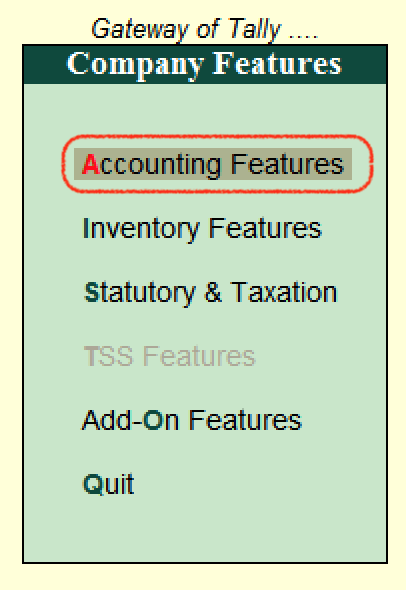
The Accounting Features screen is available under F11: Company Features. Because these settings apply to the company currently open in Tally, select the correct company before changing them.
Sections Available Under F1: Accounting Features
The options displayed on the Accounting Features screen are grouped by purpose. Depending on the company configuration and Tally.ERP 9 release, the screen can include the following sections:
- General accounting settings
- Outstanding management
- Cost and profit centre management
- Invoicing
- Budgets and scenarios management
- Banking
- Other accounting features
An option set to Yes is enabled for the selected company. Some dependent options appear only after their parent feature is enabled.
How to Open Accounting Features in Tally.ERP 9
Use the following steps to open the Accounting Features screen:
- Open the required company in Tally.ERP 9.
- Go to Gateway of Tally.
- Press F11, or select F11: Features from the button bar.
- Select F1: Accounting Features.
The navigation path is:
Gateway of Tally > F11: Features > F1: Accounting Features
General Accounting Settings in Tally.ERP 9
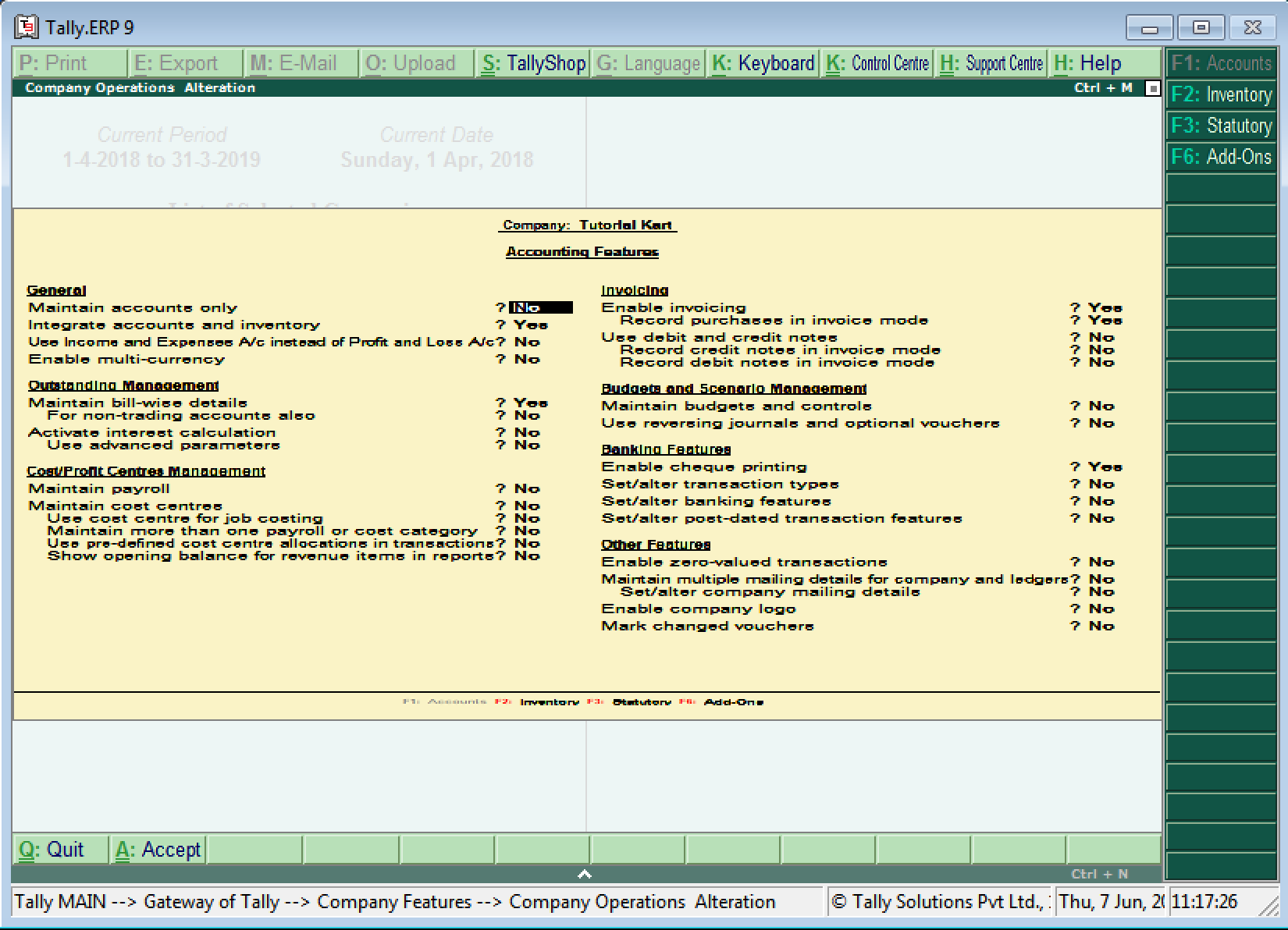
The General section determines whether the company maintains only financial accounts or also maintains inventory. Review these settings before entering opening balances or regular vouchers.
- Maintain accounts only: Set this option to Yes when the company does not need stock items, stock groups, units or inventory vouchers. Set it to No when inventory records are required.
- Integrate accounts and inventory: Set this option to Yes when inventory values should affect the financial books. The closing stock value is then derived from inventory records. This option is relevant when the company maintains inventory.
- Use income and expense A/c instead of profit and loss A/c: Enable this option for organisations that prepare an Income and Expenditure Account rather than a conventional Profit and Loss Account.
- Enable multi-currency: Enable this setting when transactions must be entered in currencies other than the company’s base currency. Currency masters and exchange rates must then be configured correctly.
Outstanding Management and Bill-Wise Tracking
Outstanding Management helps track individual receivables and payables instead of showing only a single ledger balance.
- Maintain bill-wise details: Enables reference-based tracking for customer and supplier bills. While entering a voucher, an amount can be classified as a new reference, adjusted against an existing reference, recorded as an advance or entered without a bill reference.
- For non-trading accounts also: Extends bill-wise tracking to suitable ledgers outside normal sales and purchase transactions.
- Activate interest calculation: Allows Tally to calculate interest according to the rules defined in the relevant ledger or group.
- Use advanced parameters: Provides additional conditions for interest calculation when the standard configuration is insufficient.
Enabling bill-wise details does not automatically produce accurate outstanding reports. Customer and supplier ledgers must also be configured for bill-wise tracking, and voucher entries must use the correct references.
Cost Centre, Profit Centre and Payroll Features
Cost centres provide an additional reporting dimension for analysing income and expenses by department, project, branch, employee or another responsibility unit.
- Maintain cost centres: Enables cost centre masters and cost allocation during voucher entry.
- Use cost centre for job costing: Supports job- or project-based allocation where costs and revenues must be reviewed for a particular job.
- More than one payroll or cost category: Allows parallel categories when one allocation structure is not sufficient.
- Use predefined cost centre allocations in transactions: Allows reusable allocation patterns to be applied during voucher entry.
- Show opening balances for revenue items in reports: Controls whether opening balances assigned to revenue items are included in applicable cost centre reports.
- Maintain payroll: Enables payroll-related masters, vouchers and reports when payroll is managed in Tally.
After enabling cost centres, configure the relevant expense and income ledgers to accept cost centre allocation. Otherwise, Tally will not request an allocation while those ledgers are used in vouchers.
Sales, Purchase, Debit Note and Credit Note Invoicing
The Invoicing section controls whether transactions can be recorded through invoice-style entry screens.
- Enable invoicing: Enables invoice mode for sales transactions.
- Record purchases in invoice mode: Allows purchase vouchers to be entered using an invoice format.
- Use debit and credit notes: Enables Debit Note and Credit Note voucher types.
- Record credit notes in invoice mode: Allows sales returns and similar adjustments to be entered in invoice format.
- Record debit notes in invoice mode: Allows purchase returns and applicable adjustments to be entered in invoice format.
The available fields in an invoice can also depend on inventory settings, statutory configuration, voucher-type settings and F12 configuration. Enable only the modes required by the company’s transaction process.
Budgets, Scenarios and Optional Voucher Control
- Maintain budgets and controls: Enables budgets for ledgers, groups or cost centres so actual amounts can be compared with planned amounts in reports.
- Use reversing journals and optional vouchers: Enables provisional entries that can be reviewed without immediately affecting regular books in the same way as confirmed vouchers. Reversing journals can also be configured to reverse on a specified date.
Budgets do not create accounting entries. They provide reference values for comparison and control. Optional and reversing vouchers should be reviewed before final reports are prepared.
Banking and Cheque Printing Features
The Banking section contains options used to configure cheque printing and supported banking processes.
- Enable cheque printing: Allows cheque printing for configured bank ledgers. The cheque dimensions and printing format must be set for the bank.
- Set or alter transaction types: Opens the configuration used for supported banking transaction classifications.
- Set or alter banking features: Provides banking-related setup options available in the installed Tally release.
- Set or alter post-dated transaction features: Controls the treatment of post-dated transactions where supported.
Other Accounting Features in Tally.ERP 9
- Enable zero-valued transactions: Permits applicable voucher or inventory entries with a zero value.
- Maintain multiple mailing details for company and ledgers: Allows more than one mailing address or contact configuration to be maintained where required.
- Enable company logo: Allows a configured logo to be used in supported printed documents and reports.
- Mark changed vouchers: Helps identify vouchers that were altered after entry, subject to the available security and audit configuration.
How to Save Accounting Features in Tally
After setting the required options, press Ctrl+A to accept and save the Accounting Features screen. You can also press Enter through the remaining fields and accept the confirmation prompt.
If a newly enabled option does not appear during voucher entry, check the related ledger, voucher type, inventory or statutory configuration. F11 enables company features, while F12 controls screen- and voucher-level configuration; the two menus serve different purposes.
Accounting Features Configuration Checklist
- Confirm that the required company is selected before opening F11.
- Set Maintain accounts only according to whether stock records are needed.
- Decide whether closing stock should be integrated with the financial accounts.
- Enable bill-wise details before creating customer and supplier ledgers that require invoice-level tracking.
- Verify that interest rules are defined in the appropriate ledgers after enabling interest calculation.
- Configure income and expense ledgers for cost centre allocation after enabling cost centres.
- Enable debit notes, credit notes and invoice modes only when they match the company’s voucher workflow.
- Review optional and reversing vouchers before relying on final financial reports.
- Configure bank ledgers and cheque formats before printing cheques.
- Save the screen with Ctrl+A and test the configuration using a sample voucher and the related report.
Frequently Asked Questions About Tally Accounting Features
What accounting features are available in Tally.ERP 9?
Tally.ERP 9 includes company-level options for accounts-only operation, inventory integration, multi-currency, bill-wise outstanding tracking, interest calculation, cost centres, payroll, invoicing, debit and credit notes, budgets, scenarios, banking and other accounting controls.
What is the difference between F11 and F12 in Tally?
F11: Features enables or disables functional capabilities for a company, such as bill-wise tracking or cost centres. F12: Configure changes the behaviour or display of the current screen, voucher or report. F12 options vary according to the screen from which the key is pressed.
Should Maintain accounts only be set to Yes or No?
Set it to Yes when the company maintains financial accounts without stock records. Set it to No when stock items, inventory vouchers, stock quantities or inventory reports are required.
Why are bill references not appearing in a Tally voucher?
Check that Maintain bill-wise details is enabled in Accounting Features and that bill-wise tracking is enabled for the party ledger. The voucher must also use a suitable customer, supplier or other bill-wise ledger.
Can Accounting Features be changed after vouchers have been entered?
Many features can be changed later, but doing so can affect voucher entry, ledger behaviour and report presentation. Back up the company data and review existing transactions before changing major settings such as inventory integration, bill-wise tracking or cost centre allocation.