 TutorialKart.com
What are groups in Tally?
A group in Tally is a collection of ledgers that have a similar accounting nature. Groups organize the chart of accounts and determine where ledger balances appear in the Balance Sheet, Profit and Loss Account, and other financial reports.
Tally provides 28 predefined groups: 15 primary groups and 13 subgroups. A primary group is at the top level of the accounting hierarchy, while a subgroup is placed beneath a primary group. Businesses can also create additional groups when the predefined structure does not provide the required reporting detail.
- Primary groups
- Subgroups
- User-created groups
How groups organize ledgers in Tally
Each ledger is assigned to a group. For example, customer ledgers are normally placed under Sundry Debtors, supplier ledgers under Sundry Creditors, and bank ledgers under Bank Accounts. Tally uses this hierarchy to total related balances and present them under the appropriate financial statement heading.
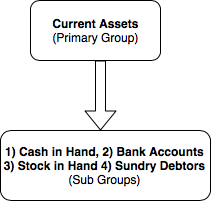
Example of Group
15 primary groups in Tally
Primary groups form the highest level of Tally’s predefined accounting structure. Nine primary groups are generally associated with the Balance Sheet, and six are associated with the Profit and Loss Account.
| Primary group | Financial statement | Typical use |
|---|---|---|
| Branch/Divisions | Balance Sheet | Accounts maintained for branches or divisions |
| Capital Account | Balance Sheet | Owner’s or partners’ capital |
| Current Assets | Balance Sheet | Short-term assets and related subgroups |
| Current Liabilities | Balance Sheet | Short-term obligations and related subgroups |
| Fixed Assets | Balance Sheet | Land, buildings, machinery, furniture, and equipment |
| Investments | Balance Sheet | Shares, bonds, and other investments |
| Loans (Liability) | Balance Sheet | Borrowings and loan-related subgroups |
| Misc. Expenses (ASSET) | Balance Sheet | Expenses carried forward when applicable |
| Suspense A/c | Balance Sheet | Amounts awaiting final classification |
| Direct Expenses | Profit and Loss Account | Expenses directly connected with production or purchases |
| Direct Incomes | Profit and Loss Account | Income directly connected with the principal activity |
| Indirect Expenses | Profit and Loss Account | Administrative, selling, and other operating expenses |
| Indirect Incomes | Profit and Loss Account | Income such as interest or commission received |
| Purchase Accounts | Profit and Loss Account | Purchase ledgers used for goods or materials |
| Sales Accounts | Profit and Loss Account | Sales ledgers used for goods or services |
13 predefined subgroups in Tally
The 13 predefined subgroups sit beneath four primary groups: Capital Account, Current Assets, Current Liabilities, and Loans (Liability). The following table shows their default parent groups and common ledger examples.
| Predefined subgroup | Parent primary group | Example ledger |
|---|---|---|
| Reserves & Surplus | Capital Account | General Reserve |
| Bank Accounts | Current Assets | Current Account with a bank |
| Cash-in-Hand | Current Assets | Petty Cash |
| Deposits (Asset) | Current Assets | Security Deposit |
| Loans & Advances (Asset) | Current Assets | Employee Advance |
| Stock-in-Hand | Current Assets | Opening Stock |
| Sundry Debtors | Current Assets | Customer account |
| Duties & Taxes | Current Liabilities | GST or other statutory tax ledger |
| Provisions | Current Liabilities | Provision for Expenses |
| Sundry Creditors | Current Liabilities | Supplier account |
| Bank OD A/c | Loans (Liability) | Bank overdraft account |
| Secured Loans | Loans (Liability) | Loan secured against an asset |
| Unsecured Loans | Loans (Liability) | Loan without pledged security |
Common ledger group examples in Tally
| Ledger or account | Common Tally group | Reason |
|---|---|---|
| Customer account | Sundry Debtors | Tracks amounts receivable from customers |
| Supplier account | Sundry Creditors | Tracks amounts payable to suppliers |
| Office rent | Indirect Expenses | Usually an administrative operating expense |
| Wages used in production | Direct Expenses | Directly related to manufacturing or production |
| Cash account | Cash-in-Hand | Represents cash held by the business |
| Bank current account | Bank Accounts | Represents money deposited with a bank |
| Plant and machinery | Fixed Assets | Represents a long-term business asset |
| GST ledger | Duties & Taxes | Records a statutory tax balance |
| Interest received | Indirect Incomes | Usually income outside the principal trading activity |
| Owner’s capital | Capital Account | Represents the owner’s investment in the business |
The correct group can depend on the nature of the transaction and the accounting policy followed by the business. For example, an expense may be direct for one type of business but indirect for another. Classification should reflect how the amount contributes to the business’s operations.
How to create a group in TallyPrime and Tally.ERP 9
Create a group in TallyPrime
- Open the required company in TallyPrime.
- From Gateway of Tally, choose Create. You can also use Alt+G to open Go To and select Create Master.
- Select Group.
- Enter a clear name for the new group.
- In the Under field, select the appropriate primary group or existing subgroup.
- Complete the remaining group options required for the business.
- Press Ctrl+A to save.
Create a group in Tally.ERP 9
- Go to Gateway of Tally > Accounts Info. > Groups.
- Select Create under Single Group.
- Enter the group name.
- Select the parent group in the Under field.
- Configure the applicable group options and accept the screen to save.
A user-created group does not increase or replace the predefined group count. It adds another level to the hierarchy. For example, a business could create Online Customers under Sundry Debtors to report those customer ledgers separately.
How group selection affects Tally reports
Tally follows a ledger-based accounting structure. Transactions are recorded through ledgers, and each ledger inherits its reporting position from the group under which it is created. Incorrect grouping can therefore place a balance in the wrong section of a financial statement.
- A customer ledger placed under Sundry Creditors may appear as a payable instead of a receivable.
- A machinery ledger placed under Indirect Expenses may charge the complete amount to the Profit and Loss Account instead of presenting it as a fixed asset.
- A bank overdraft placed under Bank Accounts may not be presented with borrowings as intended.
- A sales ledger placed under Direct Incomes instead of Sales Accounts may reduce the usefulness of sales reports.
Checklist for assigning ledgers to Tally groups
- Confirm whether the ledger represents an asset, liability, capital, income, or expense.
- For an income or expense, determine whether it is direct or indirect for this business.
- Use Sundry Debtors for customer receivables and Sundry Creditors for supplier payables.
- Distinguish a positive bank account from a bank overdraft facility.
- Place tax ledgers under Duties & Taxes and configure the applicable statutory details.
- Review the Balance Sheet and Profit and Loss Account after creating or altering a group.
- Avoid creating duplicate custom groups when an appropriate predefined group already exists.
Groups in Tally FAQs
What are the 28 groups in Tally?
Tally includes 28 predefined groups. These consist of 15 primary groups and 13 subgroups. The primary groups cover the main Balance Sheet and Profit and Loss classifications, while the subgroups provide standard classifications for items such as bank accounts, cash, debtors, creditors, taxes, and loans.
What is the difference between a primary group and a subgroup in Tally?
A primary group is a top-level classification in Tally’s chart of accounts. A subgroup is placed beneath a primary group and provides a more specific classification. For example, Current Assets is a primary group, while Bank Accounts and Sundry Debtors are its predefined subgroups.
Can predefined groups be deleted from Tally?
The predefined groups form part of Tally’s standard accounting structure and are not intended to be deleted. User-created groups can be altered or deleted when they are no longer required, subject to dependencies such as ledgers or other groups created beneath them.
Which group should customer and supplier ledgers use?
Customer ledgers with amounts receivable are normally created under Sundry Debtors. Supplier ledgers with amounts payable are normally created under Sundry Creditors.
Related group management tasks in Tally
- How to create a group
- How to create a single group
- How to select a primary group
- How to alter or delete a user-created group
- How to create multiple groups