 TutorialKart.com
What Is Tally Accounting Software?
Tally is business management software used to record financial transactions, maintain accounts, manage inventory and generate business reports. Depending on the product, release, licence and enabled features, it can also support taxation, payroll, banking and connected business processes.
TallyPrime is the current product line from Tally Solutions and succeeds Tally.ERP 9. Both products use familiar accounting concepts such as companies, groups, ledgers, voucher types and financial statements, but their interfaces and some workflows differ. This guide explains those shared concepts and helps readers distinguish TallyPrime from Tally.ERP 9.
For a release-specific walkthrough, see this guide to TallyPrime 5.0.

How Tally Records Business Transactions
Tally organises the records of a business inside a company data set. The user first creates accounting masters such as groups and ledgers, then selects an appropriate voucher type to record each transaction. Reports are generated from the saved vouchers, so an incorrect ledger group, date or voucher selection can affect several reports.
Tally follows the double entry accounting system. Every valid accounting transaction affects at least two accounts, with total debits equal to total credits. The software processes the entry, but the user remains responsible for choosing the correct accounts and accounting treatment.
| Business event | Typical voucher | Accounting records affected |
|---|---|---|
| Cash deposited into a bank | Contra | Cash and bank ledgers |
| Office rent paid | Payment | Rent expense and cash or bank |
| Money received from a customer | Receipt | Customer and cash or bank |
| Goods purchased from a supplier | Purchase | Purchase or inventory and supplier |
| Goods sold to a customer | Sales | Sales and customer or cash |
| Depreciation recorded | Journal | Depreciation expense and accumulated depreciation or asset |
Tally Accounting, Inventory and Business Features
The features available in Tally depend on the installed product, release, country configuration and licence. A company should enable only the functions that match its accounting and operational requirements.
Accounting and voucher management in Tally
- Create groups and ledgers for assets, liabilities, income and expenses.
- Record receipts, payments, contra entries, journals, purchases, sales, debit notes and credit notes.
- Maintain bill-wise details for customer and supplier balances where configured.
- Reconcile eligible bank transactions and review outstanding amounts.
Inventory management in Tally
- Create stock groups, stock categories, units of measure and stock items.
- Record inventory movement through purchase, sales and inventory vouchers.
- Maintain locations or godowns when stock is stored at more than one place.
- Review stock summaries, movement and valuation based on the configured method.
GST, TDS and statutory functions in Tally
Country-specific releases can provide statutory functions such as GST and TDS. These features assist with calculation, classification, reconciliation and return-related work, but they do not replace verification by the person responsible for compliance. Tax registrations, rates, ledger classifications and release updates must be configured correctly.
Payroll and cost-centre accounting in Tally
Where supported and enabled, payroll can maintain employee-related masters, attendance or production information, pay heads and salary vouchers. Cost centres can allocate income and expenses to departments, projects, branches or other internal units without changing the primary ledger structure.
Tally financial and management reports
- Day Book for reviewing vouchers by date.
- Ledger reports for account-level transactions and balances.
- Trial Balance for reviewing ledger and group balances.
- Profit and Loss Account for income and expense results.
- Balance Sheet for assets, liabilities and capital.
- Stock Summary and other inventory reports when inventory is enabled.
TallyPrime vs Tally.ERP 9
TallyPrime is not merely a different name displayed on the Tally.ERP 9 screen. It is the successor product with redesigned navigation and updated workflows. The underlying accounting principles remain similar, which helps experienced Tally.ERP 9 users adapt, but menu instructions should be checked against the product actually installed.
| Area | Tally.ERP 9 | TallyPrime |
|---|---|---|
| Product generation | Earlier Tally ERP product | Successor to Tally.ERP 9 |
| Navigation | Gateway of Tally menus and function-key-driven workflows | Redesigned navigation with broader search and contextual access |
| Accounting concepts | Companies, groups, ledgers and vouchers | Retains the main company, ledger and voucher concepts |
| Reports | Accounting, inventory and statutory reports based on enabled features | Updated report presentation and navigation, depending on release |
| Ongoing use | May remain in use with existing installations and company data | Appropriate for supported current deployments and newer features |
| Procedure compatibility | Instructions must match Tally.ERP 9 menus | Instructions must match the installed TallyPrime release |
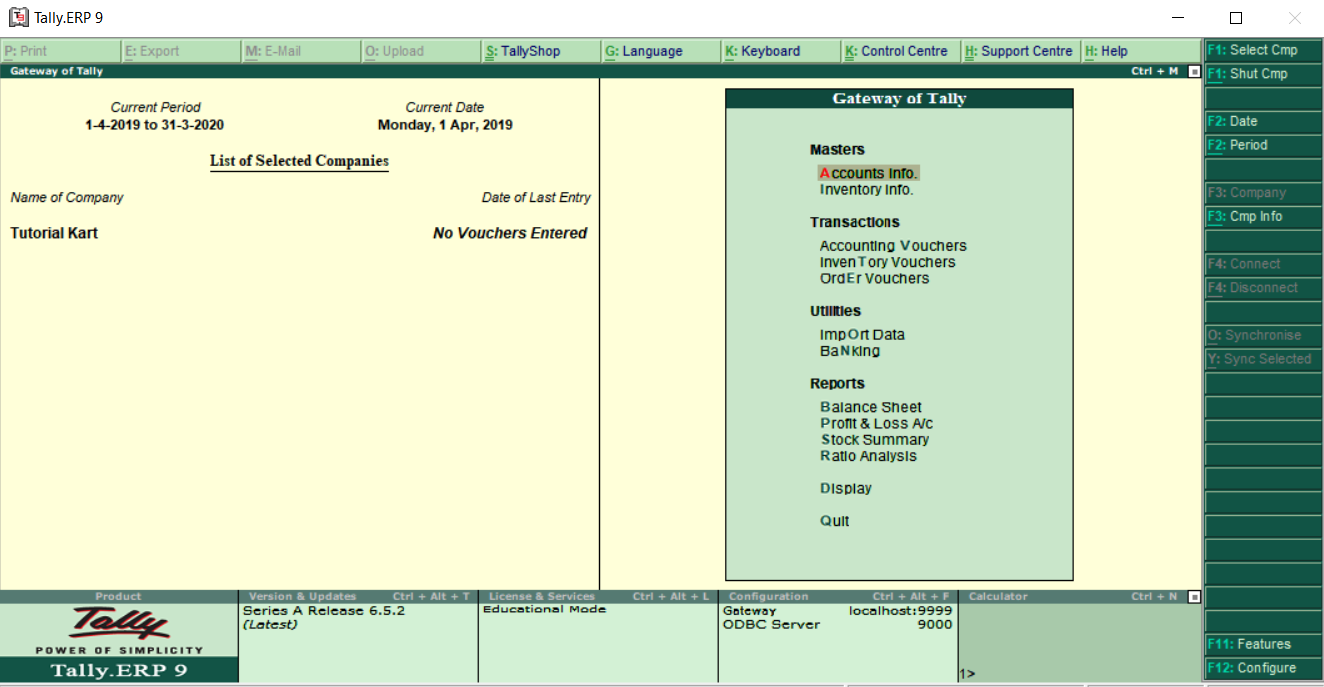
The image above reflects the Tally.ERP 9 product era. TallyPrime now succeeds Tally.ERP 9, so references to Tally.ERP 9 as the latest version should be understood as historical.
How Tally Developed from Accounting Software to TallyPrime
Tally began as accounting software and expanded over successive product generations to cover inventory, taxation, payroll, reporting, data exchange and multi-user requirements. Tally.ERP 9 became a widely used generation of the product, and TallyPrime later introduced a redesigned interface and continuing release-based enhancements.
| Product generation | Main development represented |
|---|---|
| Early Tally products | Computerised bookkeeping and basic financial accounts |
| Windows-era Tally releases | Graphical operation and broader accounting and inventory functions |
| Tally 7, 8 and 9 generations | Expansion of statutory, multilingual, payroll and data-management capabilities across releases |
| Tally.ERP 9 | Integrated accounting, inventory, taxation, payroll and business reporting in an ERP-oriented product |
| TallyPrime | Successor product with redesigned navigation and features delivered through continuing releases |
Where Tally Fits in an ERP System
An ERP system connects data from multiple business functions. Tally can bring accounting, sales, purchasing, inventory, banking, payroll and statutory records into a common company data set when the relevant functions are enabled.
However, the term ERP does not mean that every specialised process is available automatically. A business should compare its requirements for manufacturing, customer relationship management, approvals, e-commerce, logistics, analytics and integrations with the features of the chosen Tally product and release.
When Tally Is Suitable for a Business
Tally may be suitable when a business needs transaction entry, ledger accounting, inventory records and standard financial or statutory reports in one system. Suitability depends on business processes rather than company size alone.
- Transaction volume: Estimate daily vouchers, concurrent users and reporting requirements.
- Inventory complexity: Check requirements for locations, batches, units, valuation and manufacturing records.
- Compliance scope: Confirm that the installed release supports the applicable country and statutory requirements.
- Access model: Evaluate on-premises, connected and remote-access requirements along with licence conditions.
- Controls: Define user permissions, voucher approval procedures, audit review and backup responsibilities.
- Integration: Verify any required exchange with banks, spreadsheets, applications or external systems.
How to Start Using TallyPrime
- Confirm system and business requirements: Identify the number of users, company locations, accounting period, inventory needs and applicable taxes.
- Obtain the appropriate product: Use Tally Solutions or an authorised provider and verify the licence terms for the intended country and user count.
- Install and create a practice company: Learn the workflow with fictional data before configuring the live company.
- Configure the financial period: Check the financial-year date, books-beginning date, base currency and company details.
- Enable required features: Configure accounting, inventory, taxation, cost centres or payroll only as needed.
- Create or import masters carefully: Review ledger groups, opening balances, stock units and tax classifications before transaction entry.
- Record and verify sample vouchers: Compare entries with the Day Book, ledgers, Trial Balance, Profit and Loss Account and Balance Sheet.
- Establish controls: Set user access, define backup procedures and document who may alter or delete data.
Tally Licence Selection and Purchase Checks
Product names, licence plans, prices and purchase screens can change. Review the current options on the official site instead of relying on an older screenshot or price list.
- Determine the country in which the licence will be used.
- Confirm whether the business needs single-user or multi-user operation.
- Check whether the requirement is for a new licence, renewal, upgrade or rental plan.
- Review included services, statutory updates, remote capabilities and renewal terms.
- Confirm billing details, taxes and the authorised seller before payment.
- Retain the serial number, account details, invoice and recovery information securely.

The purchase image above shows an earlier Tally ERP 9 page and may not match the current store interface. For current product and licence information, visit tallysolutions.
For an installation walkthrough, see how to download Tally ERP 9. If you are installing TallyPrime, use instructions that match your TallyPrime release rather than assuming every Tally ERP 9 screen is unchanged.
Tally Company Setup and Data-Safety Checklist
- Verify the installed product name, release and licence before documenting menu paths.
- Confirm the company name, financial year, books-beginning date and base currency.
- Check that ledgers are assigned to the correct accounting groups.
- Validate GST, TDS or other statutory settings against current professional guidance.
- Reconcile opening balances with the approved source records.
- Test voucher entry and reports in a practice or backup copy before live use.
- Set user permissions according to job responsibilities.
- Create a backup, test restoration and document the storage location.
- Review the Day Book, Trial Balance and exception reports after migration or bulk import.
Frequently Asked Questions About Tally and TallyPrime
What is the difference between Tally, Tally.ERP 9 and TallyPrime?
Tally is the broader software family and is also commonly used as a general name for the product. Tally.ERP 9 is an earlier product generation. TallyPrime is its successor, with redesigned navigation and features that continue to evolve through product releases.
Should a business use Tally.ERP 9 or TallyPrime?
For a new deployment, evaluate the currently supported TallyPrime product and the licence appropriate to the business. An organisation still using Tally.ERP 9 should review compatibility, backup, customisation, statutory and migration requirements before changing products or releases.
Can TallyPrime manage accounting and inventory together?
Yes. Accounting and inventory can be maintained in the same company data set when inventory features are enabled and configured. The business must still define stock masters, units, locations, valuation settings and the appropriate voucher workflow.
Does TallyPrime calculate GST and TDS automatically?
TallyPrime can calculate and report applicable taxes based on the configured statutory features, transaction details and tax classifications. The results should be reviewed because an incorrect registration, rate, ledger setup, place of supply or transaction classification can produce an incorrect tax treatment.
Can TallyPrime be accessed remotely?
Remote and connected access options may be available depending on the licence, configuration, user permissions, connectivity and services supported by the installed release. Confirm current requirements with Tally Solutions and apply appropriate account and data-security controls.