 TutorialKart.com
In SAP Sales and Distribution (SAP SD), assigning schedule line categories means telling the system which schedule line category it should propose for a sales document item. The assignment is maintained with Transaction Code VOV5 and is mainly based on the combination of item category and MRP type.
This tutorial explains how to assign schedule line categories in SAP SD, how the automatic determination works, which fields you maintain in VOV5, and what to check before saving the configuration. The steps are useful when you create or adjust custom item categories and want the correct delivery, requirements, and planning behavior in sales documents.
What Schedule Line Category Assignment Means in SAP SD
A schedule line category controls how schedule lines behave for a sales document item. Schedule lines carry confirmed quantities and delivery dates, so the schedule line category affects whether the item is relevant for delivery, whether requirements are transferred to planning, and whether availability-related checks are considered.
The assignment in VOV5 does not define the schedule line category itself. It only determines which schedule line category should be proposed for a particular item category and MRP type combination. The detailed controls of a schedule line category are configured separately, commonly in the schedule line category configuration activity.
- Item category identifies the sales document item behavior, such as standard item, third-party item, text item, free-of-charge item, or a custom item category.
- MRP type comes from the material master and helps the system decide whether planning-related behavior is relevant.
- Proposed schedule line category is the schedule line category the system suggests automatically during sales document processing.
- Manual schedule line category allows a permitted alternative schedule line category to be entered manually when business processing requires it.
The system automatically determines the schedule line category for each item in a sales document based on the item category and MRP type specified in the Material Master. If the assignment is missing or incorrect, the sales order item may not behave as expected for delivery, requirements transfer, or planning.
How SAP SD Determines the Schedule Line Category
In standard SAP SD processing, schedule line category determination follows a simple rule: the system checks the item category of the sales document item and the MRP type from the material master, then looks for a matching assignment in VOV5.
| Determination Input | Where It Usually Comes From | Why It Matters |
|---|---|---|
| Item Category | Sales document item category determination | Identifies the business behavior of the line item. |
| MRP Type | Material master, usually the MRP view | Indicates planning relevance for the material. |
| Schedule Line Category | VOV5 assignment | Controls the schedule line behavior proposed in the sales document. |
For example, if a custom standard item category is used for a material with an MRP type that does not require planning, you can assign a suitable schedule line category that fits that process. If the same item category is used with a planning-relevant MRP type, a different schedule line category may be required.
SAP IMG Path and T-Code VOV5 for Assigning Schedule Line Categories
To assign schedule line categories, follow the SAP IMG path or directly use the T-code below:
| Component | Details |
|---|---|
| SAP Role | Assign Schedule Line Categories |
| Transaction Code | VOV5 |
| SAP IMG Path | SPRO > SAP Reference IMG > Sales and Distribution > Sales Documents > Schedule Lines > Assign Schedule Line Categories |
For background learning, SAP also explains schedule line category configuration in its official learning material for sales customizing. You can use the SAP documentation together with this VOV5 assignment tutorial when you need to understand both the assignment logic and the detailed controls behind each schedule line category.
Step-by-Step Process to Assign Schedule Line Categories in SAP SD
Step 1: Open Transaction Code VOV5 in SAP
- Log in to the SAP system with a user that has authorization for SD customizing.
- In the Command Field, enter the transaction code VOV5 and press Enter. Image Description:
- This image shows the SAP command field with the T-code
VOV5entered, highlighting where users need to start.
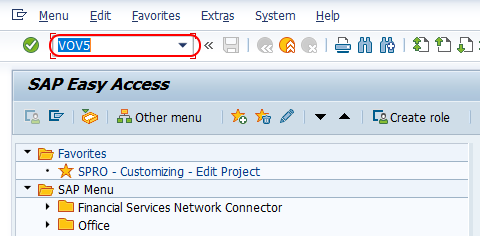
- This image shows the SAP command field with the T-code
You can also reach the same activity through the IMG path shown above. Directly using VOV5 is faster when you already know that you need to maintain schedule line category assignment.
Step 2: Review Existing Item Category and Schedule Line Category Assignments
- On the Change View “Assign Schedule Line Categories” overview screen:
- The system displays a list of existing entries, showing item categories and their assigned schedule line categories.
- Check whether an assignment already exists for your item category and MRP type combination. This avoids duplicate or conflicting customizing entries.
- Click on the New Entries button to assign a new schedule line category.
- The image highlights the “New Entries” button on the overview screen, enabling users to add new assignments.

Before creating a new entry, compare your custom item category with the closest standard item category. This helps you select a schedule line category that matches the intended process instead of assigning one only because it appears in another configuration line.
Step 3: Enter Item Category, MRP Type, Proposed Schedule Line Category, and Manual Category
On the New Entries: Assign Schedule Line Categories screen, update the following fields:
- Item Category: Enter the item category key you want to assign a schedule line category to, such as a custom item category like ZSTD.
- MRP Type: Enter the material requirement planning type, such as ND for no material requirements planning or another MRP type used in your material master.
- Proposed Schedule Line Category: Specify the default schedule line category that should be proposed automatically for this item category and MRP type combination.
- Manual Schedule Line Category: Optionally enter a schedule line category that users may manually select as an alternative. Leave it blank if manual replacement should not be allowed for the process.
- This image shows the “New Entries” screen where item categories, MRP types, and schedule line categories are configured.
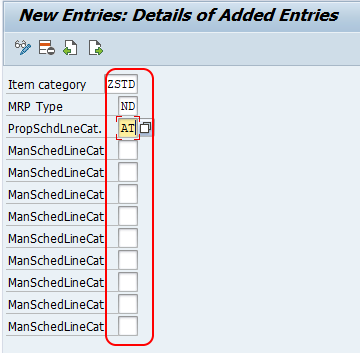
If you use a blank MRP type entry as a fallback in your configuration, document the reason clearly in your project notes. A blank or generic assignment can affect more materials than expected if it is used without proper review.
Step 4: Save the VOV5 Schedule Line Category Assignment
- After entering all the required details, click on the Save button.
- The system will prompt you for a Customizing Request. Enter the appropriate request details and save the assignment. What to Expect:
- The newly assigned schedule line categories will now appear in the overview screen.
- The assignment can be transported to the next system according to your organization’s transport process.
After saving, create or change a test sales order with the same item category and material MRP type. Check the schedule line tab to confirm that the expected schedule line category is proposed.
Example VOV5 Assignment for a Custom SAP SD Item Category
Consider the following example for a custom standard item category. The actual schedule line category must be selected according to your business process and the configuration maintained in your SAP system.
| Field | Example Value | Meaning |
|---|---|---|
| Item Category | ZSTD | Custom standard item category |
| MRP Type | ND | No Material Requirements Planning |
| Proposed Schedule Line Cat. | AT | Default schedule line category proposed by the system for this assignment |
| Manual Schedule Line Cat. | Blank | No manual replacement is maintained in this example |
This example is only a configuration pattern. In a real project, confirm the correct schedule line category by checking how the sales item should behave for delivery relevance, requirements transfer, availability checking, and inventory movement.
Difference Between Item Category and Schedule Line Category in SAP SD
The item category and schedule line category are closely connected, but they control different parts of sales document processing.
| Area | Item Category | Schedule Line Category |
|---|---|---|
| Main Purpose | Controls the behavior of the sales document item. | Controls the behavior of schedule lines for quantities and dates. |
| Typical Level | Item level | Schedule line level |
| Common Impact | Billing relevance, pricing relevance, completion rule, item processing behavior. | Delivery relevance, requirements transfer, availability-related processing, movement type where applicable. |
| Determination Link | Determined from sales document type, item category group, usage, and higher-level item category. | Determined from item category and MRP type using VOV5. |
In simple terms, the item category tells SAP how the line item should behave, while the schedule line category tells SAP how the confirmed quantities and delivery dates for that item should behave.
Controls to Check Before Assigning a Schedule Line Category
Before you assign a schedule line category in VOV5, review the configuration behind the schedule line category itself. The following controls commonly influence whether the assignment is suitable for your sales process:
- Delivery relevance: Check whether the schedule line should create delivery-related processing.
- Transfer of requirements: Confirm whether requirements should be passed to planning.
- Availability check relevance: Review whether confirmed quantities should be influenced by availability-related logic.
- Movement type: For goods movement scenarios, verify that the correct movement type is assigned where applicable.
- Purchasing or third-party relevance: For third-party or procurement-related sales items, confirm whether the schedule line category supports the required purchase processing.
Do not assign a schedule line category only by copying another entry. A schedule line category that works for a standard order item may not be correct for a third-party, returns, free-of-charge, or non-stock process.
Common Issues After Schedule Line Category Assignment in VOV5
| Issue in Sales Document | Likely Configuration Area to Check |
|---|---|
| Expected schedule line category is not proposed. | Check the item category, material MRP type, and matching VOV5 entry. |
| Item is not relevant for delivery. | Check the schedule line category controls for delivery relevance. |
| Requirements are not transferred to planning. | Check the requirements transfer setting and MRP-related configuration. |
| Manual schedule line category cannot be entered. | Check whether the manual schedule line category is maintained in VOV5. |
| Wrong behavior occurs for a custom item category. | Compare the custom item category and schedule line category with the closest standard configuration. |
Testing should include at least one sales document with a material that has the exact MRP type used in the assignment. If the material master uses a different MRP type, the expected VOV5 line may not be selected.
QA Checklist for SAP SD Schedule Line Category Assignment
- Confirm that the item category in the sales document is the same item category maintained in VOV5.
- Check the material master MRP type used by the test material.
- Verify that the proposed schedule line category has the correct delivery and requirements behavior.
- Maintain a manual schedule line category only when users should be allowed to replace the proposed category.
- Create a test sales order and confirm the schedule line category in the schedule line details.
- Save the configuration in the correct customizing request and transport it according to project rules.
FAQs on Assigning Schedule Line Categories in SAP SD
How is the schedule line category determined in SAP SD?
The schedule line category is determined mainly from the item category and the MRP type. The assignment is maintained in VOV5. When a sales document item is created, SAP reads this combination and proposes the matching schedule line category.
Which transaction code is used to assign schedule line categories?
The transaction code used to assign schedule line categories is VOV5. You can also access it through SPRO > SAP Reference IMG > Sales and Distribution > Sales Documents > Schedule Lines > Assign Schedule Line Categories.
What is the difference between assigning and defining a schedule line category?
Assigning a schedule line category in VOV5 tells SAP which category to propose for an item category and MRP type. Defining or configuring a schedule line category controls the behavior of that category, such as delivery relevance, requirements transfer, movement type, and availability-related settings.
Can a manual schedule line category be allowed in SAP SD?
Yes. In VOV5, you can maintain a manual schedule line category as an allowed alternative. This lets users replace the proposed schedule line category in specific cases, provided the manual entry is valid for the business process.
Why is the expected schedule line category not appearing in a sales order?
Common reasons include a different item category being determined in the sales order, a different MRP type in the material master, a missing VOV5 assignment, or an unsuitable fallback entry. Check the sales item category and the material master MRP type first.
Conclusion: Using VOV5 Correctly for Schedule Line Category Assignment
Assigning schedule line categories in SAP SD using T-code VOV5 helps SAP propose the correct schedule line behavior for each sales document item. The key is to maintain the right combination of item category, MRP type, proposed schedule line category, and optional manual schedule line category.
Before saving a new assignment, confirm the controls behind the selected schedule line category and test the result in a sales order. This ensures that delivery relevance, requirements transfer, planning behavior, and manual replacement options match the intended SAP SD process.