 TutorialKart.com
Profiles in Salesforce | Salesforce profiles
Profiles in salesforce are collections of settings and permissions that define the baseline access for Salesforce users. Using a profile, an administrator can control access to apps, tabs, record types, page layouts, login hours, login IP ranges, object permissions, and Field Level Security for Objects.
A Salesforce user must have one profile assigned. The profile gives the user a starting security configuration, while permission sets and permission set groups can add extra permissions without creating a separate profile for every job variation.
What Does a Salesforce Profile Control?
Profiles in Salesforce control several important parts of a user’s experience and access. The exact options visible on a profile can vary based on the Salesforce edition, license type, enabled features, and whether the org is using the enhanced profile user interface.
- Page layouts :- Profiles help decide which page layout a user sees for an object and record type combination.
- Field Level Security :- Using field level security, we can control whether users can see or edit specific fields.
- Custom apps :- Profiles can define which standard and custom apps are visible to the user.
- Tabs :- Profiles can control whether tabs are visible, hidden, or default on for users.
- Record types :- Profiles decide which record types are available to a user and which record type is selected by default.
- Login :- Login IP ranges and Salesforce login hours restrictions can be configured for users through profiles.
- Object and user permissions :- Profiles can include object permissions and system permissions, although current Salesforce administration practice is to move most additional permissions to permission sets where possible.
Salesforce Profiles, Permission Sets, and Roles Compared
Profiles are often confused with roles and permission sets. These three features work together, but they solve different access problems in Salesforce.
| Salesforce access feature | Main purpose | Simple example |
|---|---|---|
| Profile | Defines the user’s baseline permissions, app settings, tab settings, login controls, and default access configuration | A Sales User profile gives sales users a common starting setup |
| Permission Set | Adds extra permissions to selected users without changing their profile | A discount approval permission set gives selected users extra access |
| Permission Set Group | Bundles multiple permission sets so they can be assigned together | A Sales Manager permission set group combines report, dashboard, and approval permissions |
| Role | Controls record visibility through the role hierarchy and sharing model | A Sales Manager role can see records owned by users below it, depending on sharing settings |
The simplest way to remember the difference is this: profiles and permission sets control what a user can do, while roles help control which records a user can see.
Different Profiles in Salesforce
There are two main types of Profiles in Salesforce. They are
- Standard Profiles.
- Custom Profiles.
Standard Profiles :- Standard Profiles in Salesforce are provided by Salesforce. They cannot be deleted, and their behavior can depend on the user license and Salesforce features enabled in the org.
Standard profiles which are commonly seen in SFDC are listed below. The exact permissions available for each profile can vary by org and license.
- System Administrator :- System Administrator is the highest administrative profile and can customize and manage most settings in an organization.
- Standard User :- Standard User is used for regular internal users who need access to standard Salesforce features based on the org security model.
- Read Only :- Read Only users can generally view records but have restricted create, edit, and delete access.
- Solution Manager :- Solution Manager is related to solution management features in orgs where those features are available.
- Marketing User :- Marketing User can be used for users who work with campaigns, leads, and marketing-related features, depending on org configuration.
- Contract Manager :- Contract Manager is used for users who work with contracts and related access, depending on enabled features.
Custom Profiles :- Custom Profiles in Salesforce are created by administrators, usually by cloning an existing profile and adjusting the required settings. Custom profiles can be edited and deleted if they are not assigned to users or restricted by the org configuration.
Navigating to Profiles in Salesforce Setup
Profiles in Salesforce can be accessed from Administer | Manage users | Profiles.
In Salesforce Lightning Experience, open Setup, enter Profiles in the Quick Find box, and select Profiles. From the Profiles page, you can view standard and custom profiles, clone a profile, edit profile settings, and open the list of users assigned to a profile.
Relationship Between User and a Profile in Salesforce
What is the relationship between user and a profile? Whether it is one to many or many to many relationships. It is one to many relationship between profile and a user. A profile can have many users but a user must have only one profile assigned.
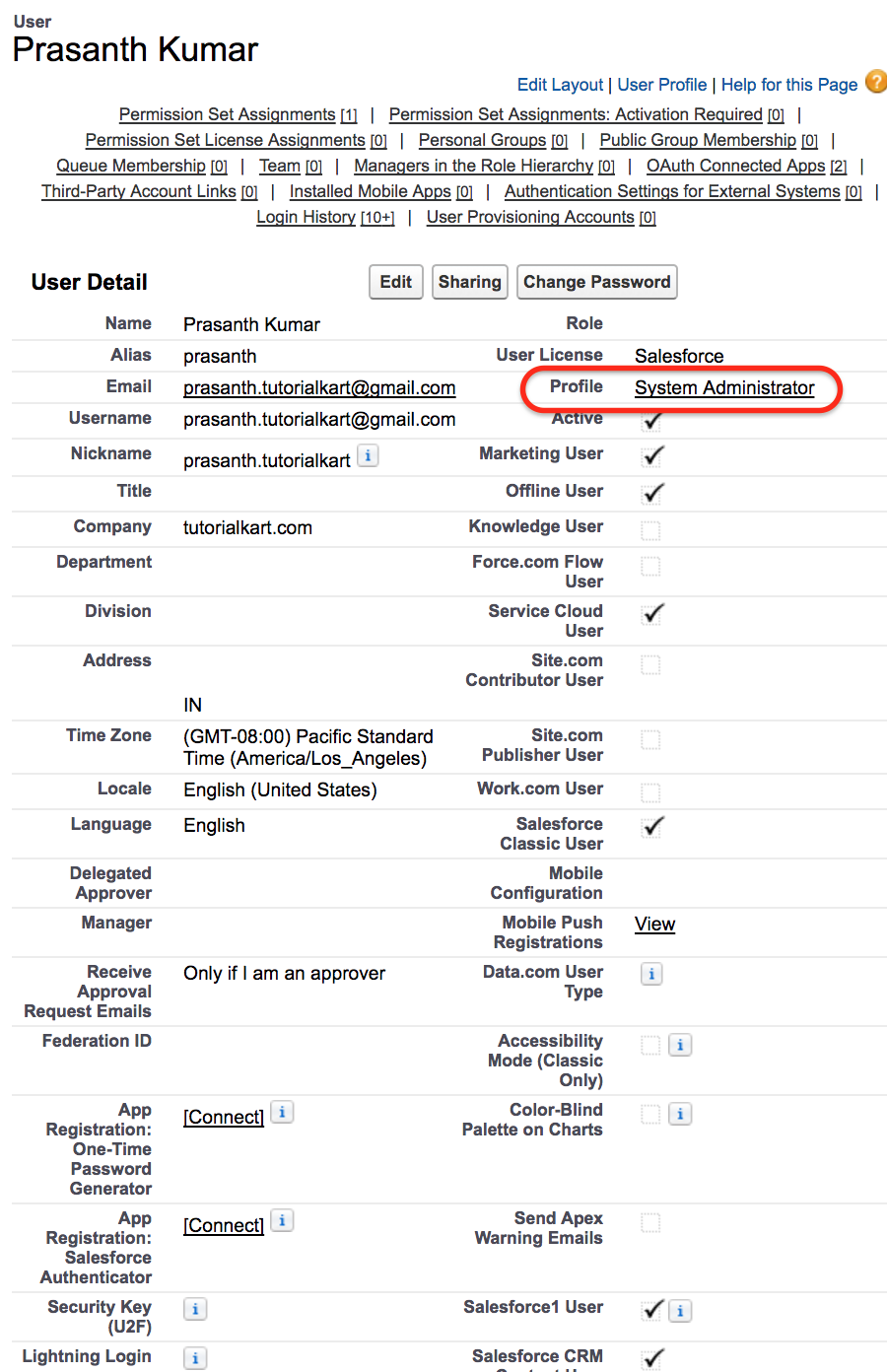
There is only one profile assigned to a user. To check the list of users assigned to a profile, open the profile detail page and use the user list option available on that page.
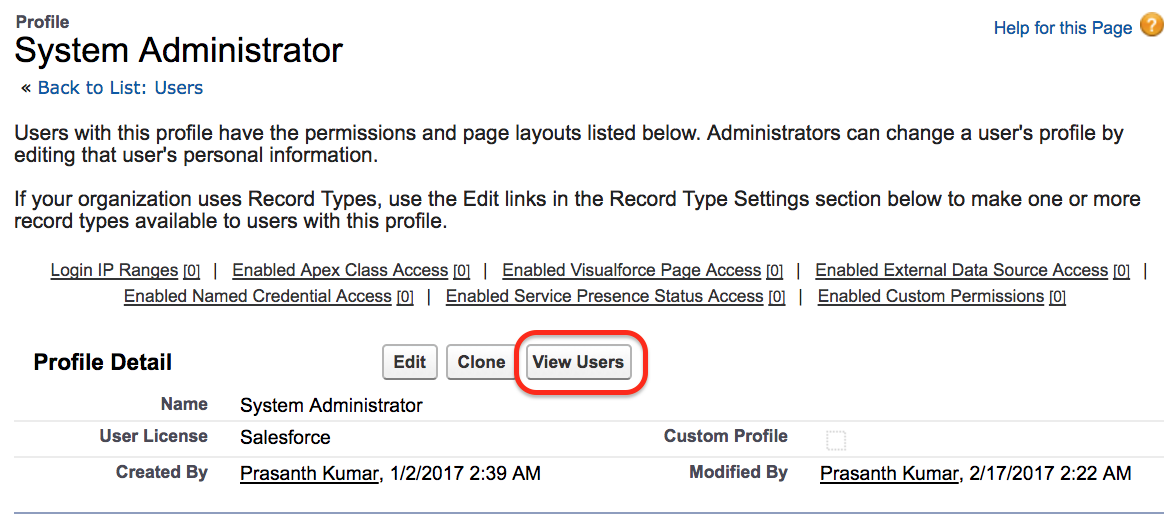
Click on view users to check the list of users attached to a profile.
How to Review and Edit a Salesforce Profile Safely
Profile changes can affect many users at the same time. Before editing a Salesforce profile, check how many users are assigned to it and identify which business process depends on the setting you want to change.
- Open Setup and search for Profiles.
- Open the required profile, such as Standard User or a custom sales profile.
- Review the users assigned to the profile before changing permissions.
- Check object permissions, field permissions, app visibility, tab settings, record type settings, login hours, and login IP ranges.
- When possible, add new access through permission sets instead of editing a broad profile used by many users.
- Test profile and permission changes in a sandbox before applying them in production.
Salesforce Profile Permissions and the Move to Permission Sets
Salesforce has been guiding administrators toward a permission set-led security model. Earlier communications discussed retirement of permissions on profiles starting in Spring ’26, but Salesforce later postponed enforcement. Profiles still exist and still support permissions for now, but new access designs should avoid creating many profiles only to handle small permission differences.
A practical approach is to keep profiles focused on baseline access, login controls, page layout and record type defaults, and app or tab settings. Then use permission sets and permission set groups to grant additional object, field, app, and system permissions to users who need them.
| Access requirement | Recommended Salesforce tool |
|---|---|
| Every user with a license needs the same base setup | Profile |
| Only a few users need extra access temporarily or permanently | Permission Set |
| A job function needs several permission sets together | Permission Set Group |
| Users need visibility to records owned by users below them | Role hierarchy and sharing settings |
| Users must log in only from approved times or IP ranges | Profile login hours and login IP ranges |
Best Practices for Profiles in Salesforce Administration
- Use the fewest practical number of profiles and avoid creating a new profile for every small access difference.
- Use permission sets for add-on permissions that apply to selected users.
- Use clear custom profile names, such as Sales Base User or Support Base User, instead of vague names such as Profile 1.
- Review profiles regularly to remove outdated object permissions, field permissions, and login settings.
- Do not assign System Administrator profile to users only because one permission is missing. Create a controlled permission set instead.
- Document why each custom profile exists and which teams should use it.
Common Salesforce Profile Mistakes to Avoid
- Confusing profiles with roles: Profiles control permissions and user settings. Roles support record visibility through hierarchy and sharing.
- Creating too many custom profiles: Too many profiles make access management harder to audit and maintain.
- Changing a profile without checking assigned users: One profile update can affect many users immediately.
- Using profiles for every exception: Permission sets are usually better for add-on access.
- Ignoring field-level security: Object access alone is not enough. Field visibility and editability must also be reviewed.
Official Salesforce Profile and Permission References
For current product details, refer to Salesforce documentation and administrator guidance: Salesforce Help for User Profiles, Salesforce Developer Profile object reference, and Salesforce Admin guide to profiles and permissions.
Profiles in Salesforce FAQ
Is Salesforce phasing out profiles?
Salesforce is not removing profiles. Profiles still exist and remain required because every user must have one profile. Salesforce has encouraged admins to move toward permission sets and permission set groups for most permission assignments, while keeping profiles for baseline access and user settings.
What should remain on profiles in Salesforce?
Profiles are commonly used for baseline settings such as assigned apps, tab settings, record type defaults, page layout assignments, login hours, and login IP ranges. Many additional object, field, app, and system permissions can be managed through permission sets and permission set groups.
Can one Salesforce user have multiple profiles?
No. A Salesforce user can have only one profile. If the user needs additional access beyond the assigned profile, the administrator can assign permission sets or permission set groups.
What is the difference between a profile and a role in Salesforce?
A profile controls what a user can do in Salesforce, such as object permissions, app access, tab settings, and login restrictions. A role helps control record visibility through the role hierarchy and sharing settings.
What are standard and custom profiles in Salesforce?
Standard profiles are provided by Salesforce and are available based on the user’s license and org features. Custom profiles are created by administrators, usually by cloning an existing profile and changing settings for a specific business need.
Editorial QA Checklist for This Salesforce Profiles Tutorial
- Confirms that every Salesforce user has exactly one profile.
- Explains the difference between profiles, permission sets, permission set groups, and roles.
- Corrects field-level security wording so it refers to field visibility and edit access, not deleting fields.
- Mentions the current permission set-led model without saying profiles have been removed.
- Preserves the existing tutorial screenshots and explains how to navigate to Profiles in Salesforce Setup.
Conclusion.
Profiles in Salesforce define the baseline settings and permissions for users. A profile can be assigned to many users, but each user can have only one profile. For modern Salesforce administration, profiles should be used carefully along with permission sets, permission set groups, roles, sharing settings, and field level security in Salesforce. In our next Salesforce tutorial we are going to learn more about Salesforce security configuration.