 TutorialKart.com
Salesforce Custom domain and Salesforce My Domain are related, but they are not exactly the same feature. My Domain gives your Salesforce org a unique login and app URL such as https://yourDomain.my.salesforce.com. A Salesforce custom domain is used when you want an external-facing Salesforce site, such as an Experience Cloud site, to run on a domain that you own. In this Salesforce tutorial, we learn how to enable My Domain in Salesforce, what settings to review, and when you need a separate custom domain setup.
Salesforce Custom domain is also a security and identity configuration. It helps Salesforce separate your org from the standard shared login URL, supports branded login pages, and is required or expected for several modern Salesforce features such as Lightning Experience, authentication providers, single sign-on, and Experience Cloud URLs. The My Domain URL format is usually:
https://yourDomain.my.salesforce.comFor this tutorial, we use the sample Salesforce My Domain name tutorialkart-dev-ed, which creates a URL like https://tutorialkart-dev-ed.my.salesforce.com. In your own org, choose a short, recognizable name that users and administrators can identify easily.
Salesforce My Domain vs Salesforce custom domain for Experience Cloud
Before configuring domain settings, understand the difference between these two commonly confused terms.
| Domain type | Typical URL | Main use | DNS needed? |
|---|---|---|---|
| Salesforce My Domain | yourDomain.my.salesforce.com | Org login, Lightning pages, app URLs, SSO, authentication providers, branded login | No. Salesforce provisions the subdomain. |
| Salesforce custom domain | www.example.com | Experience Cloud sites, Salesforce Sites, public-facing branded URLs | Yes. You usually configure DNS, HTTPS, and custom URL mapping. |
If your goal is to use Lightning, configure SSO, or brand the Salesforce login page, start with My Domain. If your goal is to publish an Experience Cloud site under your company-owned URL, you also need Domains and Custom URLs under Salesforce domain management.
Before enabling Salesforce My Domain in an org
- Use a user account that has permission to view and manage Setup.
- Choose the My Domain name carefully because users, bookmarks, SSO settings, connected apps, and integrations can depend on Salesforce URLs.
- Do the setup first in a sandbox when you are working on a production org with existing integrations.
- Inform users before deployment if the login URL is changing.
- Review authentication settings, login policies, and redirect behavior after the domain is ready.
Enabling Salesforce Custom domain – Salesforce My Domain
To enable Salesforce My Domain, open Setup, enter My Domain in the Quick Find box, and select My Domain. In older Salesforce Setup navigation, this page was commonly described as Administer | Domain Management | My Domain.
- Click on My Domain.
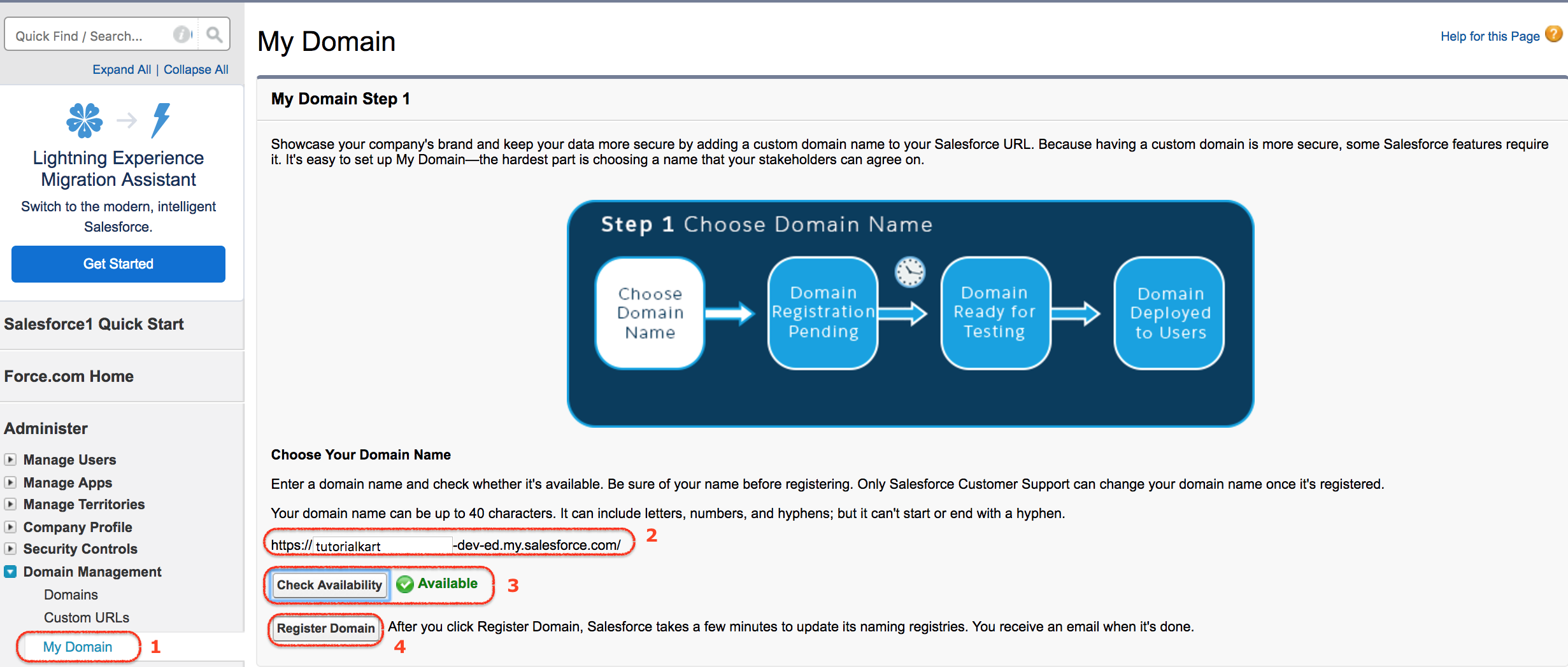
- Enter your custom name in the URL field and check whether the name is available.
- If the name is available, click the register domain button.
- Salesforce provisions the My Domain. This often takes a few minutes, and Salesforce sends an email when the domain is ready to test.
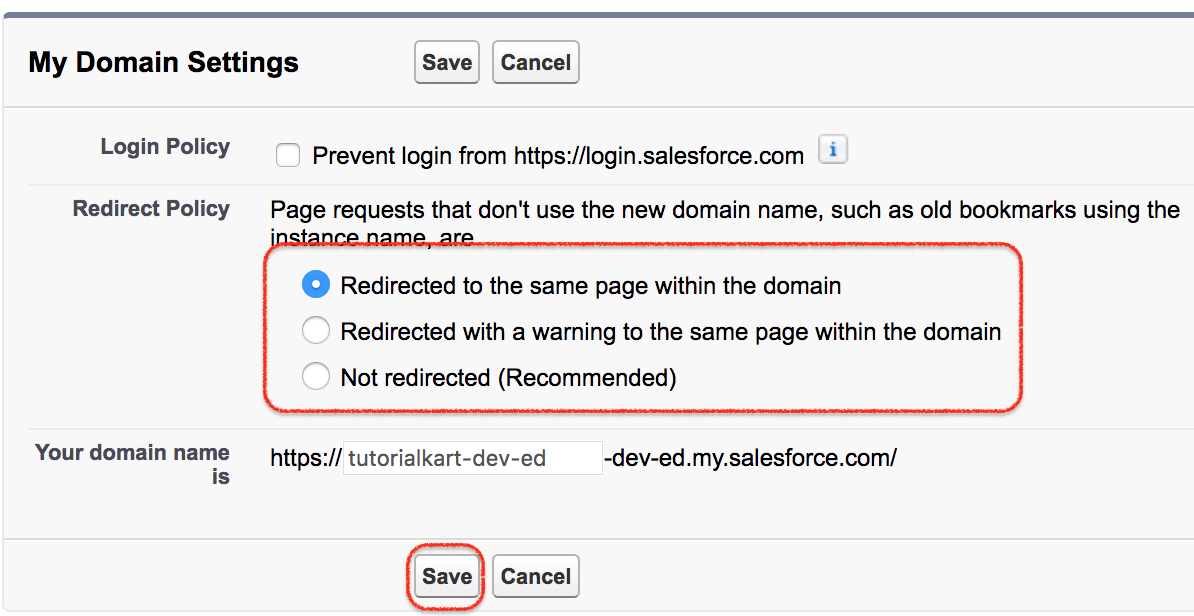
- Open the test link, log in with your Salesforce username and password, and verify that the org loads correctly under the new My Domain URL.
- Review routing, login policy, authentication, and redirect settings, then save your My Domain settings.
When things get completed, you will get an email notification that your developer edition domain is ready to test. Click on the link in the email and enter your username and password.
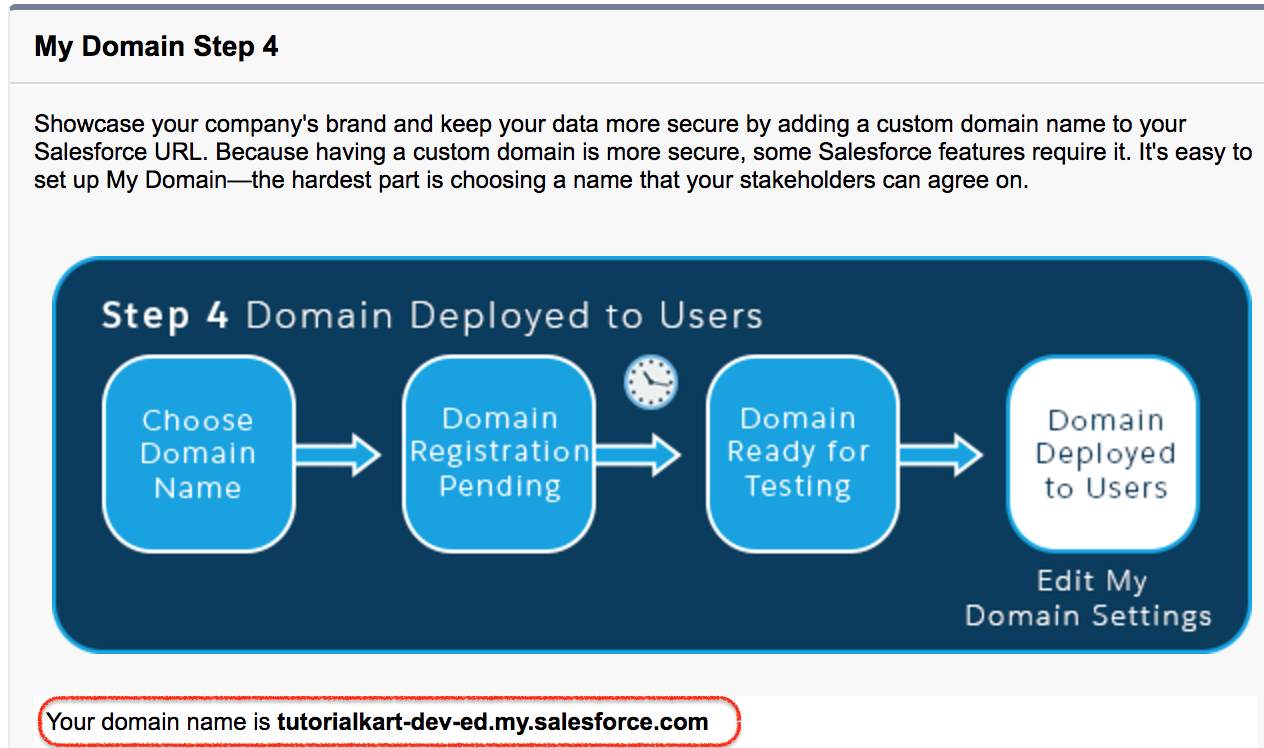
As shown above, we have created custom domain called https://tutorialkart-dev-ed.my.salesforce.com successfully.

Deploying Salesforce My Domain after testing the new URL
Testing the My Domain URL is not the final step. After Salesforce provisions the domain and you verify that the new URL works, deploy the My Domain so that users can use it. Review the deployment page carefully because this can affect login bookmarks, Salesforce URLs, SSO configuration, connected apps, and integrations that depend on older instance-based URLs.
- Test login with a normal user profile, not only with a system administrator.
- Check Lightning apps, Visualforce pages, Experience Cloud links, and embedded content if your org uses them.
- Verify SSO, authentication providers, and login flows.
- Confirm whether users should be redirected from the old login URL to the My Domain URL.
- Deploy My Domain only after testing the important login and navigation paths.
Salesforce My Domain settings to review after registration
The My Domain page contains settings that control how users reach the org and how the login experience appears. Exact options can vary by Salesforce edition and release, but these are the settings administrators commonly review.
| My Domain setting area | What to check |
|---|---|
| Login policy | Decide whether users can log in from the standard Salesforce login page or must use the My Domain login URL. |
| Redirect policy | Choose how Salesforce handles requests to old URLs after My Domain is deployed. |
| Authentication configuration | Assign the correct authentication services, such as SSO or social sign-in, when used by your org. |
| Login page branding | Add approved branding, background color, logo, and right-side login content if your org uses a branded login page. |
| Enhanced domains | Confirm that your org uses the current enhanced domain format for Salesforce-hosted URLs. |
Benefits of setting up a Salesforce My Domain
- Users can log in with an org-specific URL instead of a generic Salesforce instance URL.
- Administrators can brand the Salesforce login page with approved company content.
- Salesforce can support login policies, redirect behavior, and authentication settings tied to the org domain.
- My Domain supports features such as Lightning Experience, authentication providers, SSO, and working across multiple Salesforce orgs in the same browser.
- Enhanced domains make Salesforce-hosted URLs more consistent across the org, including sites, Visualforce pages, and content files.
Salesforce My Domain naming rules and practical tips
- Use a short and recognizable domain name, usually based on the company or project name.
- Do not use spaces or special characters that Salesforce does not allow in the My Domain name.
- Salesforce blocks some reserved words and unavailable names, so try a variation if the first name is not available.
- Avoid names that are too specific to a temporary project, department, or sandbox unless the org is only for that purpose.
- For a sandbox, use a name that clearly identifies the environment so users do not confuse it with production.
Creating a Salesforce custom domain for an Experience Cloud site
A company-owned external URL such as https://www.example.com is configured differently from My Domain. For Experience Cloud and Salesforce Sites, you usually add the domain in Salesforce, configure HTTPS, update DNS with your domain provider, and then map the domain to the site through a custom URL.
- In Setup, search for Domains and add the fully qualified domain name you own.
- Choose the HTTPS option required for your implementation, such as Salesforce CDN or your own HTTPS certificate.
- Update DNS at your domain provider. Salesforce provides the target value you must use for the CNAME record.
- Activate the domain after Salesforce verifies the configuration.
- Add a custom URL that maps the domain and path to the correct Experience Cloud site or Salesforce Site.
A simplified DNS example looks like this. Do not copy this value directly; use the exact canonical name that Salesforce gives for your org and domain.
www.example.com CNAME salesforce-provided-canonical-name.exampleFor detailed current steps, refer to Salesforce documentation on custom domains in Salesforce, pointing a custom domain to your Salesforce org, and My Domain.
Common Salesforce My Domain setup issues
| Issue | Likely reason | What to do |
|---|---|---|
| My Domain name is not available | Another org uses it or Salesforce blocks the word. | Choose a different variation that still identifies your org. |
| Users still use the old login URL | Redirect or communication settings were not reviewed. | Update login instructions and review redirect policy. |
| SSO stops working after deployment | The identity provider still points to old URLs. | Update SSO metadata, callback URLs, and connected app settings as needed. |
| Experience Cloud site does not open on the external domain | DNS, HTTPS, activation, or custom URL mapping is incomplete. | Verify CNAME, certificate/CDN option, domain activation, and site mapping. |
| Bookmarks show old instance-based URLs | Users saved links before My Domain deployment. | Ask users to update bookmarks after the My Domain URL is deployed. |
Salesforce My Domain setup checklist before deployment
- The chosen My Domain name matches the org or environment.
- Administrator and standard user logins were tested with the new My Domain URL.
- SSO, authentication providers, and login flows were checked.
- Redirect policy and login policy were reviewed.
- Important Lightning apps, Visualforce pages, Experience Cloud pages, and integrations were tested.
- Users know which login URL to use after deployment.
Salesforce Custom domain and My Domain FAQs
What is My Domain in Salesforce?
My Domain is the unique subdomain assigned to your Salesforce org, such as yourCompany.my.salesforce.com. It is used for login, Salesforce app URLs, branded authentication, and many modern Salesforce features.
How do I create a custom domain in Salesforce?
For My Domain, go to Setup, search for My Domain, enter a unique name, register it, test the new URL, review settings, and deploy it. For an external Experience Cloud custom domain, use Setup > Domains, configure HTTPS and DNS, activate the domain, and add a custom URL for the site.
Do I need DNS changes for Salesforce My Domain?
No. A My Domain URL under my.salesforce.com is provisioned by Salesforce. DNS changes are required when you map a domain that you own, such as www.example.com, to an Experience Cloud site or Salesforce Site.
Can I change my existing Salesforce My Domain name?
Salesforce allows My Domain changes in supported orgs, but the change must be planned carefully because URLs, SSO, connected apps, bookmarks, and integrations can be affected. Test the change in a sandbox when possible and review Salesforce guidance before deploying it.
Why is Salesforce My Domain required for Lightning and authentication features?
My Domain gives Salesforce a stable, org-specific URL that can be used for secure login, Lightning pages, authentication providers, single sign-on, and branded access. Without it, several identity and Lightning-related features cannot be configured correctly.
Conclusion: Salesforce Custom domain and My Domain setup
Salesforce My Domain should be the first domain setting you configure when preparing an org for Lightning, branded login, SSO, and modern Salesforce URLs. A Salesforce custom domain for Experience Cloud is a separate setup that uses your own external domain, DNS, HTTPS, and custom URL mapping. After registering My Domain, always test the new URL, review login and redirect policies, and deploy the change only after important user and integration paths are verified.