 TutorialKart.com
What is bucket field in Salesforce Reports?
A bucket field in Salesforce Reports is a report-only field that groups existing field values into readable categories without creating a custom field, formula field, workflow, or automation on the object. For example, you can group several Account Type values into buckets such as Customer, Partner, and Other directly inside a report.
Bucket field in Salesforce Reports is used to quickly categorize values for a field in a report without the need to have a custom formula field at the object level. When you create a bucket field in Salesforce, you define multiple categories into groups depending on the record values, this bucket field will not affect other Salesforce reports. Bucket fields in Salesforce are available in Tabular reports, Summary Reports and Matrix reports. Joined Reports does not support Bucket fields.
Salesforce Reports are used to generated data and display the data in the form of Rows and Columns with rule criteria. Every reports in Salesforce is stored in Folders. We can set folder to hidden, Shared, read-only or read/write. If we need to categorize multiple number of values of a field into one category, then we go for Bucket fields in Salesforce.
In this Salesforce tutorial, we are going to learn about Bucket fields in Salesforce reports, why Salesforce bucket fields are used and how can we create Bucket fields in Salesforce. Let us learn how to create Bucket fields in Salesforce Reports.
When to use a Salesforce report bucket field
Use a bucket field when the grouping is needed only for reporting. It is useful when business users want to analyze data in broader groups but do not need to save those groups back to each record.
- Grouping picklist values: Combine several Account Type, Industry, Lead Source, or Case Reason values into fewer report categories.
- Creating numeric ranges: Group revenue, amount, age, score, or quantity values into ranges such as Small, Medium, and Large.
- Cleaning report presentation: Replace long lists of raw field values with simpler labels for managers and reviewers.
- Avoiding unnecessary custom fields: Keep the object model clean when the categorization is needed only in one report.
Bucket field in Salesforce Reports compared with custom fields
| Comparison point | Bucket field in a report | Custom field on an object |
|---|---|---|
| Where it exists | Only inside the report | On the Salesforce object |
| Data storage | Does not store values on records | Stores values on records |
| Best use case | Report grouping and display | Business data that must be reused across Salesforce |
| Setup effort | Created in the report builder | Created from Object Manager setup |
| Effect on other reports | Does not affect other reports unless recreated there | Can be used in reports, layouts, automation, validation, and integrations |
If the category must be available for automation, validation rules, page layouts, integrations, or multiple reports, create a custom field instead. If the category is only for one report, a bucket field is usually the lighter option.
Creating Bucket field in Salesforce reports
The following example creates a bucket field on an Accounts report. The goal is to group Account Type values into a report column named Type (Core).
- To create Bucket field in Salesforce reports, navigate to Reports tabs and click on the New Reports button.

- Select the Accounts report type and click on the plus sign under the Accounts & Contacts category.
- Click on the Create button to continue.
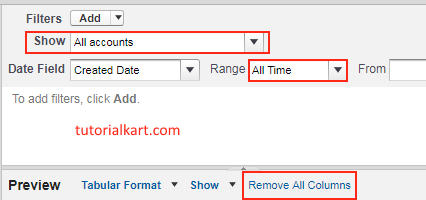
- Change Show to All Accounts.Change the Date Field Range to All Time.
- Click on Remove All Columns to clear the report without any columns.
- Add Account Name and Account Owner by double-clicking on the field from the left-hand side panel.
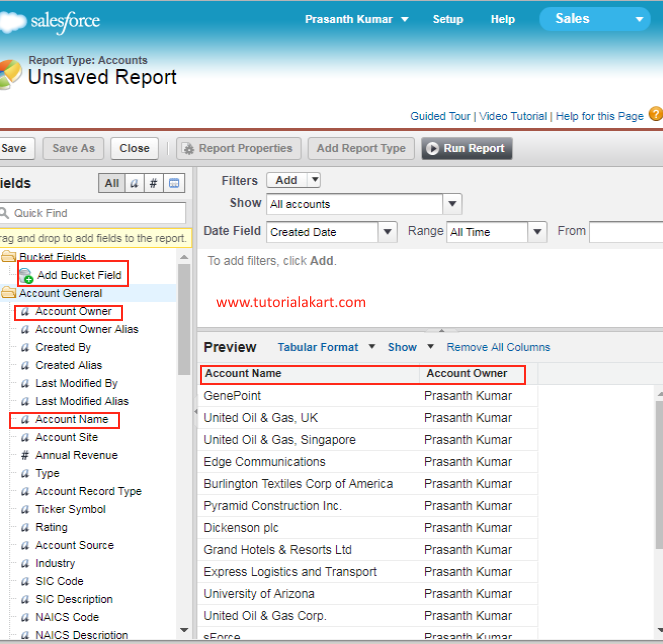
- Double-click on Add Bucket Field (or drag it to the report area) in the top-left panel under Bucket Fields.
- Set Source Column to Type.
- In Bucket Field Name, enter Type (Core).
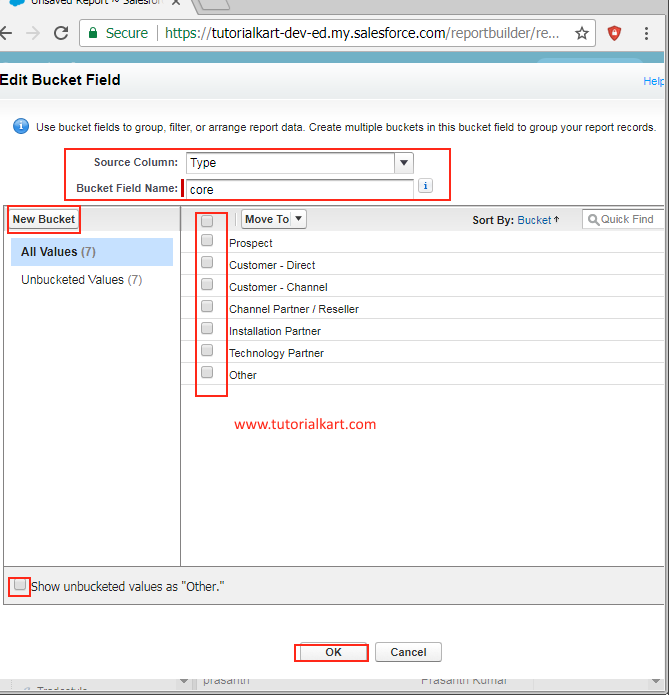
- Click on the New Bucket button and type in Customer.
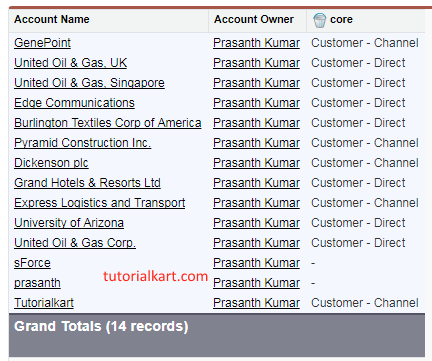
Finally click on Run Report to generate Salesforce report as shown above.
How to organize values inside a Salesforce bucket column
After adding the bucket field, review all available values from the source column and move them into the correct buckets. For an Account Type bucket, one possible setup is shown below.
| Bucket name | Example source values | Report meaning |
|---|---|---|
| Customer | Customer – Direct, Customer – Channel | Accounts that already buy from the company |
| Partner | Channel Partner, Technology Partner | Accounts that support sales or delivery |
| Prospect | Prospect, Target Account | Accounts still being evaluated or developed |
| Other | Blank or uncategorized values | Records that need review or do not fit the main groups |
Keep bucket names short because they become visible report values. Also review blank values carefully. A blank source value can be placed in a separate bucket if users need to track incomplete data.
Salesforce bucket field limits and practical restrictions
A bucket field is designed for report-level categorization, not permanent data modeling. Before relying on it, remember these practical restrictions.
- A bucket field applies to the report where it is created.
- It does not update the original field value on the record.
- It is not a replacement for a field that must be used in automation or integrations.
- Joined reports do not support bucket fields.
- Report users may need suitable report builder access to edit or create bucket fields.
Salesforce also provides official help for bucket field overview and adding bucket columns in reports. Use those references when checking behavior in your Salesforce edition or report builder experience.
Common mistakes when creating bucket fields in Salesforce reports
- Using a bucket field for permanent business logic: If other processes need the category, use a custom field instead.
- Leaving important values uncategorized: Review all source values before saving the report.
- Creating unclear bucket names: Use names that report viewers can understand without asking the report owner.
- Forgetting blank values: Decide whether blank values should appear in their own bucket or remain separate.
- Expecting the bucket field in other reports: A bucket field is report-specific, so it must be recreated or rebuilt where needed.
QA checklist for a Salesforce bucket field report
- Does the bucket field name clearly describe the grouped report value?
- Are all important source column values assigned to the correct bucket?
- Have blank or unexpected values been reviewed before running the report?
- Is a bucket field appropriate, or should this category be a custom field on the object?
- Does the report type support bucket fields, instead of using a joined report layout?
FAQs about bucket fields in Salesforce Reports
What is a bucket field in Salesforce?
A bucket field in Salesforce is a report-level field that groups existing field values into categories. It helps report users organize values without creating a new custom field on the object.
How do I add a bucket column in Salesforce Reports?
Open the report in the report builder, choose the field to bucket, add a bucket column, create bucket names, move values into the correct buckets, and run or save the report.
Can a Salesforce bucket field be used in other reports?
A bucket field is created inside a specific report. It does not become a reusable object field. If the same grouping is needed in many reports, consider a custom field or a consistent reporting design.
Do bucket fields change Salesforce record data?
No. Bucket fields do not update the original record data. They only change how values are grouped and displayed inside the report.
Are bucket fields supported in joined reports?
No. Bucket fields are supported in tabular, summary, and matrix reports. Joined reports do not support bucket fields.
Conclusion: bucket field in Salesforce Reports
A bucket field in Salesforce Reports is useful when you need report-only grouping for field values. It helps organize report data without changing the object schema or storing new values on records. Use bucket fields for simple report categorization, and use custom fields when the grouped value must be reused across automation, layouts, integrations, or several reports.