 TutorialKart.com
What is Workbench Salesforce ?
Workbench Salesforce is a powerful, web-based suite of tools designed for Salesforce administrators and developers to interact with Salesforce.com organization via Force.com APIs. Using Salesforce Workbench, administrators and developers can quick view their organization’s data, Data Loading, can perform SOQL Query, SOSL search, session settings, test, deploy and troubleshoot their own application.
Workbench is useful when you need a browser-based way to inspect objects, run SOQL or SOSL, test REST API calls, execute small Apex snippets, and perform data operations. It connects directly to the Salesforce org that you choose at login, so it must be used carefully, especially in a production org.
Salesforce has also published guidance recommending integrated developer tools such as Salesforce CLI, Visual Studio Code extensions, Code Builder, Data Loader, and API clients for many tasks that users previously performed in Workbench. Therefore, treat Workbench as a practical utility for selected admin and developer tasks, not as the only or primary Salesforce development tool.
Workbench Salesforce Uses for Admins and Developers
Workbench Salesforce is commonly used for these tasks:
- View metadata and object descriptions for standard and custom objects.
- Run SOQL queries to inspect Salesforce records.
- Run SOSL searches across searchable Salesforce fields.
- Insert, update, upsert, delete, undelete, and purge records when permissions allow it.
- Test REST Explorer requests against Salesforce APIs.
- Execute Apex code snippets for controlled admin or developer tasks.
- Retrieve and deploy metadata packages.
- View session information and understand the current login context.
- Reset or set user passwords when the logged-in user has the required permission.
How to login Workbench Salesforce?
There are different ways that we can login Salesforce Workbench. Workbench supports standard username / password login, we can login with a session id and using OAuth 2.0 remote access login. Salesforce users can also use firefox browser extension to use Salesforce Workbench.
- Workbench Salesforce login URL : https://workbench.developerforce.com/login.php.
- Login to Workbench Salesforce using Salesforce.com account credentials.
- Select your Environment as Production or Sandbox.
- Select I agree to the terms and conditions.
- Now click on Login with Salesforce.
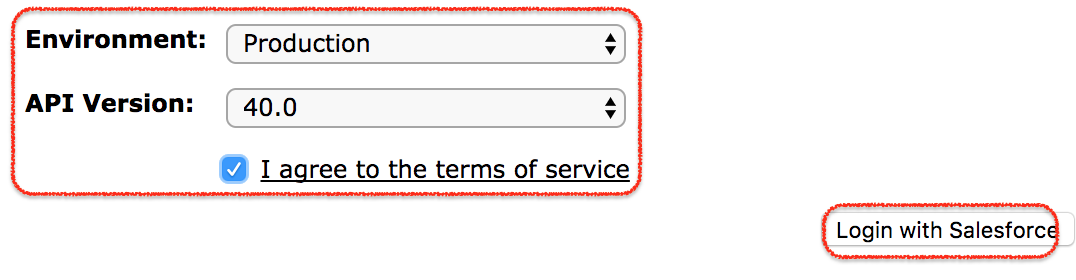
Choose the environment carefully. If you select Production, every data operation is performed against live Salesforce data. If you are learning, testing a query, validating an Apex snippet, or checking a destructive action, use a sandbox whenever possible.
- After login to Workbench Salesforce successfully, the pages allows Salesforce user to jump to different options like Standard and Custom objects, Metadata Type and components, SOQL query, SOSL search, Insert, Update, Upsert, Delete, Insert, Undelete, Purge, deploy, retrieve and many more.
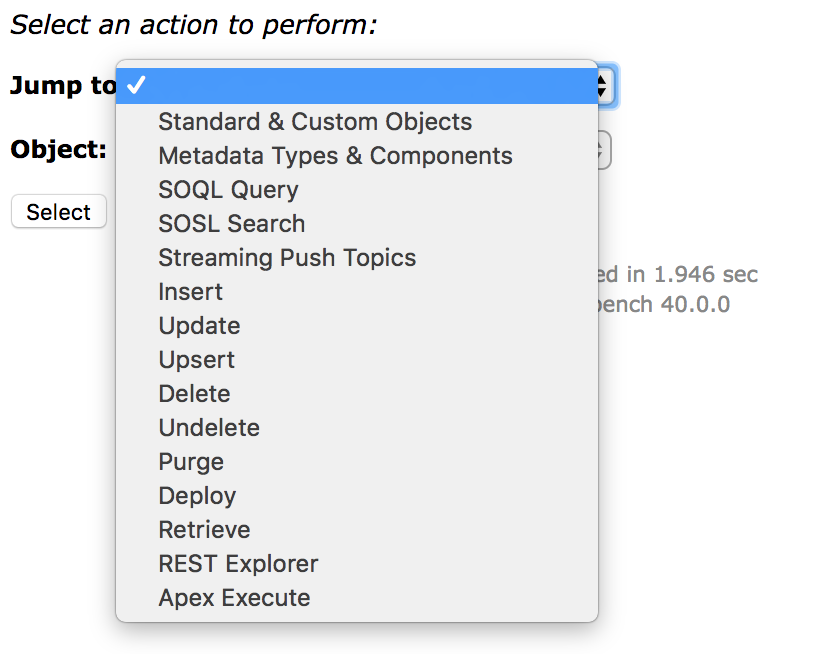
- Select any one from the options and select object from the list. Here we will select Standard & Custom objects.
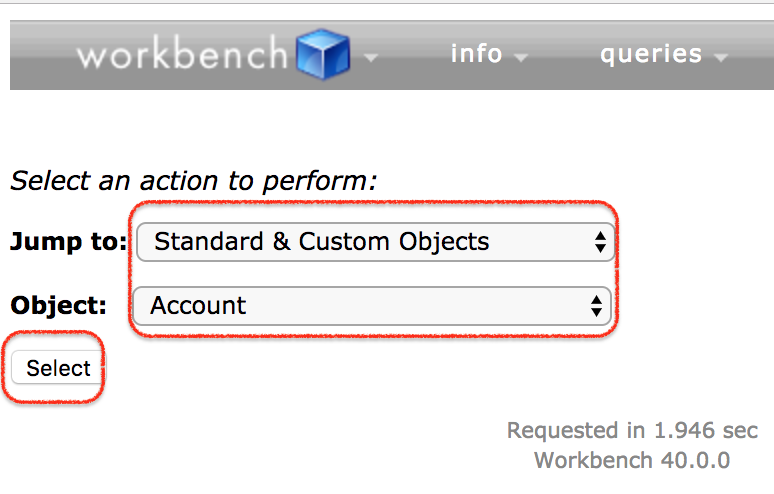
In this Salesforce tutorial, we will learn how to get session information, how to build SOQL query in Workbench Salesforce, How to create, update, delete records using Apex execute and how to reset password using Workbench Salesforce.
Workbench Salesforce Safety Checklist Before Using Production
Workbench is safe only when the user understands the selected environment, permissions, and operation. The tool does not prevent every risky action. If your profile or permission set allows updates, deletes, metadata deployment, or Apex execution, Workbench can perform those actions against the connected org.
- Use a sandbox first for queries, Apex execution, data load tests, and metadata deployment tests.
- Confirm whether you are connected to Production or Sandbox before clicking a data-changing button.
- Export affected records before update, delete, purge, or mass data changes.
- Use
LIMITin SOQL while testing a query. - Do not paste unknown Apex code from the internet into Execute Anonymous.
- Do not share session IDs, OAuth tokens, screenshots containing sensitive data, or exported CSV files.
- Prefer Salesforce CLI, Data Loader, VS Code extensions, Code Builder, or an approved API client when your team has a standard tool policy.
Session Information.
System administrators can cancel user sessions in Salesforce. Session Information in Workbench displays details about current user session like Connection, Accessibility mode, profileId, Session seconds valid,user Email, user FullName, UserLocale, UserType and many more.
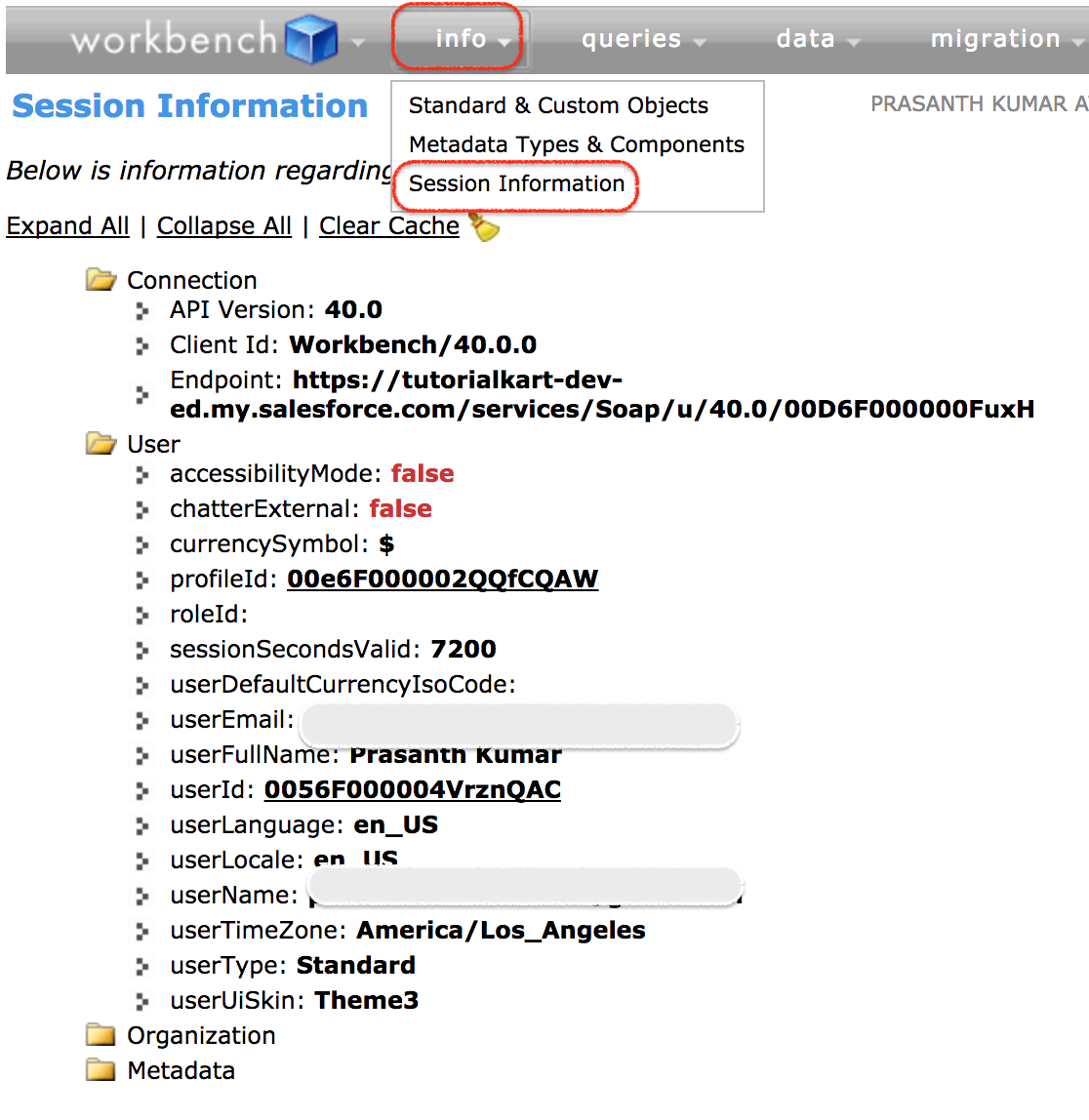
Session Information is helpful when you need to check the connected user, org context, API version, current session details, or whether the login is using the correct Salesforce environment. It is also a useful first screen to verify before doing any change operation.
How to Run SOQL Query in Workbench Salesforce
SOQL means Salesforce Object Query Language. It is used to read records from one object or related objects. In Workbench, open Queries | SOQL Query, select the object, choose fields, add filter conditions if needed, and run the query.
SELECT Id, Name, Industry
FROM Account
WHERE Industry != null
ORDER BY Name
LIMIT 10
For production use, start with a small LIMIT, verify the returned fields, and then expand the query only if needed. SOQL in Workbench is commonly used for checking records before a data update or troubleshooting a field value issue.
How to perform SOSL search in Workbench Salesforce?
SOSL stands for Salesforce Object Search language. Using SOSL search we can search text based search queries against the search index. So how to perform SOSL search in Workbench Salesforce? Follow the steps given below.
- Navigate to Queries | SOSL Search.
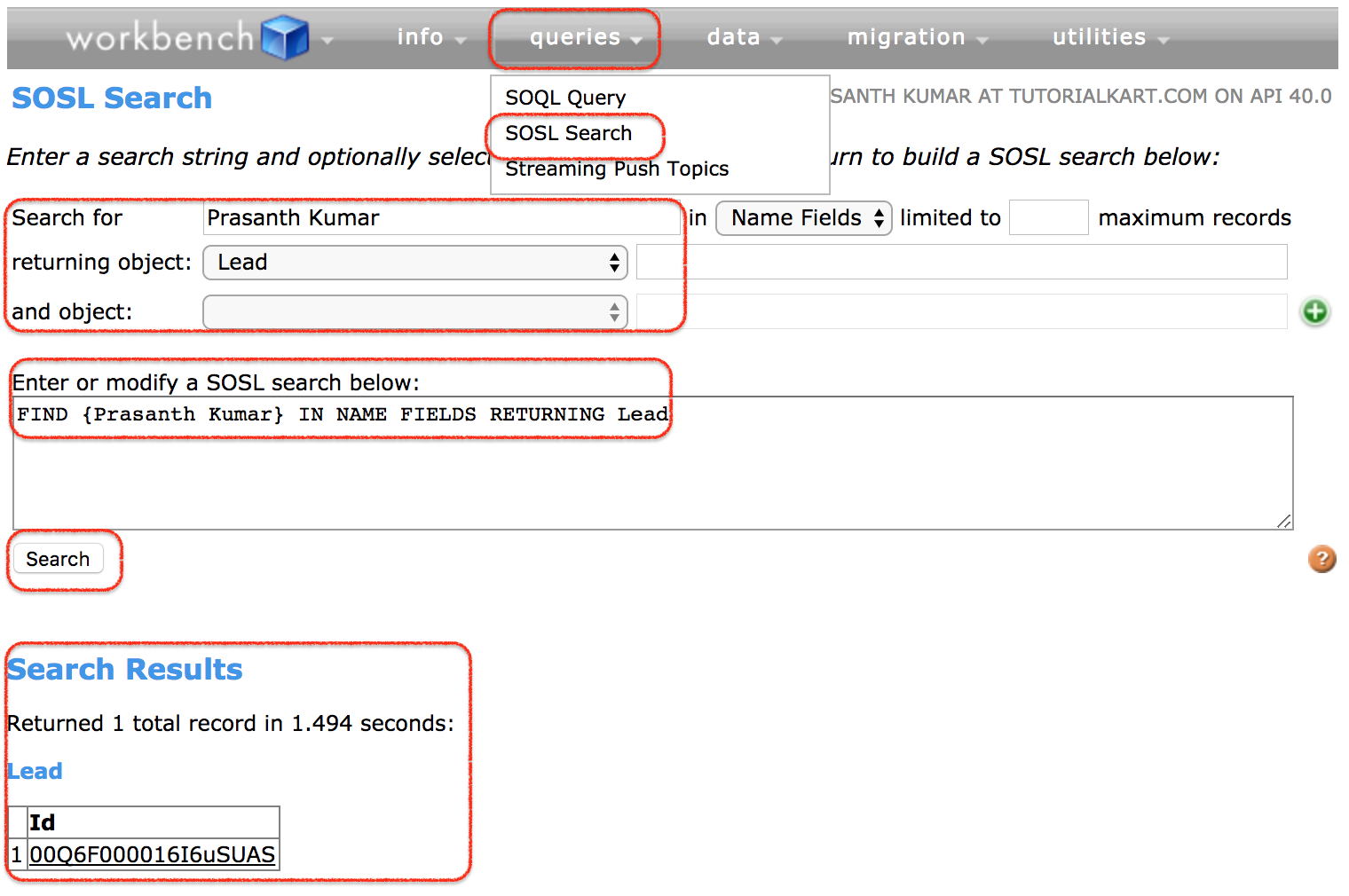
As shown in above SOSL search, we searched for Prasanth in the Lead Object in the Name field. When we click on Search. List of all results will be returned as shown above.
SOSL is useful when you know the text to search for, but you do not know exactly which record or object contains it. A simple SOSL search can look like this:
FIND 'Prasanth'
IN ALL FIELDS
RETURNING Lead(Id, Name, Company), Contact(Id, Name, Email)
Use SOQL when you need structured filtering on known objects and fields. Use SOSL when you need text search across one or more searchable objects.
SOQL and SOSL Difference in Workbench Salesforce
| Area | SOQL in Workbench | SOSL in Workbench |
|---|---|---|
| Primary use | Query records from known objects and fields | Search text across searchable fields and objects |
| Best when | You know the object, fields, and filter condition | You know the search term but not the exact record location |
| Example object usage | FROM Account | RETURNING Account(...), Contact(...) |
| Typical Workbench menu | Queries | SOQL Query | Queries | SOSL Search |
Workbench Salesforce Data Operations: Insert, Update, Upsert, Delete, and Undelete
Workbench can perform data operations from the Data menu. These operations are useful for controlled admin tasks, but they can change real records. Always confirm the object, file, field mapping, and environment before clicking the final action.
| Workbench data option | What it does in Salesforce | Production caution |
|---|---|---|
| Insert | Creates new records | Check required fields and validation rules first |
| Update | Changes existing records by record ID | Back up records before updating |
| Upsert | Updates existing records or creates new records using an ID or external ID | Verify the external ID field and duplicate behavior |
| Delete | Moves records to the Recycle Bin when supported | Confirm record IDs before deleting |
| Undelete | Restores deleted records when still recoverable | Check lookup relationships and restored field values |
| Purge | Permanently removes records where allowed | Use only after formal approval because recovery may not be possible |
How to execute Apex code in Salesforce Workbench?
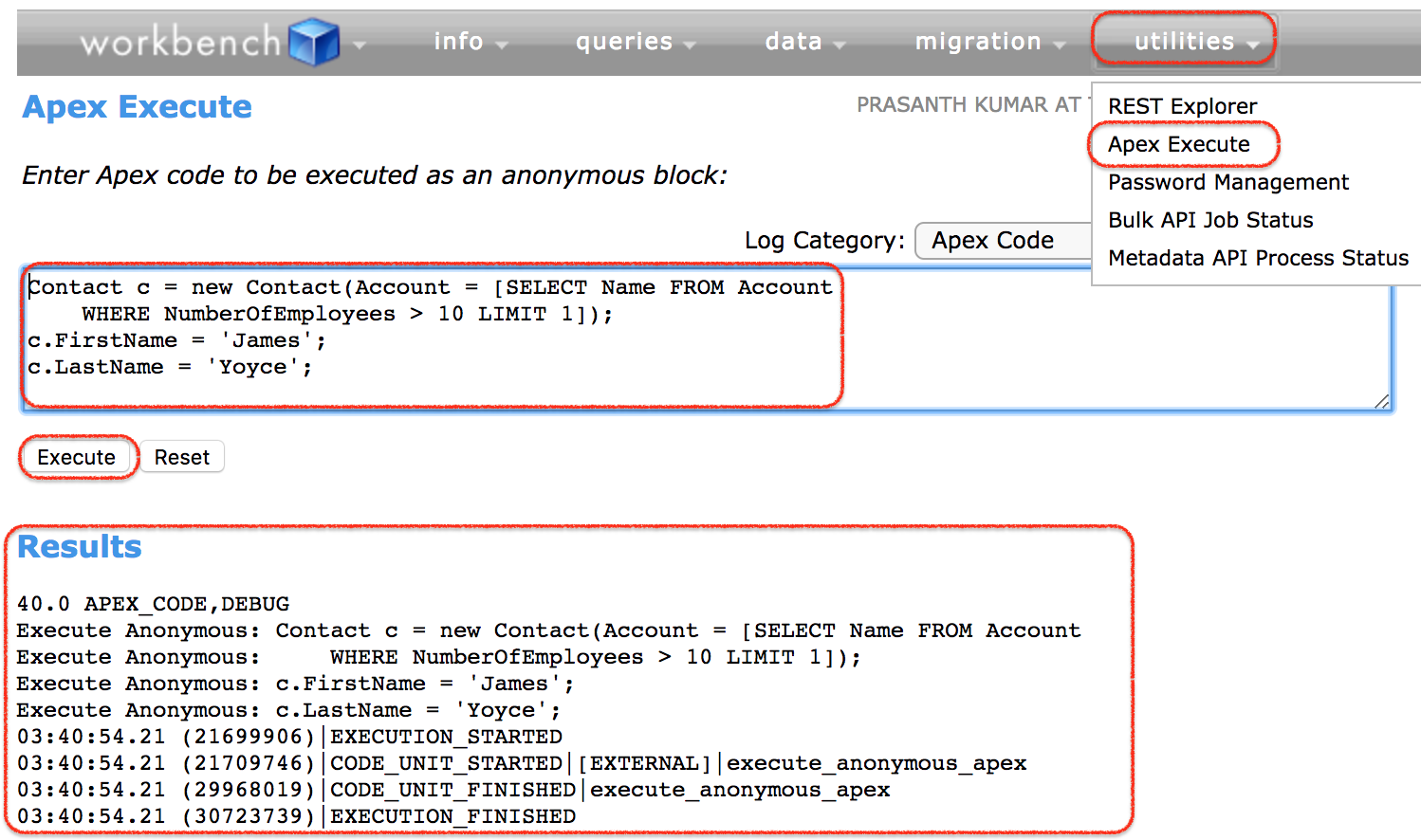
You can also create new objects from SOQL queries on existing ones. The following example creates a new contact for the first account with the number of employees greater than 10. Note that the newly created object contains null values for its fields, which will need to be set.
To execute Apex in Workbench, open Utilities | Apex Execute, paste the Apex code, and click Execute. This runs as Execute Anonymous Apex in the connected org and uses the permissions available to the logged-in user.
List<Account> accounts = [
    SELECT Id, Name
    FROM Account
    WHERE NumberOfEmployees > 10
    LIMIT 1
];

if (!accounts.isEmpty()) {
    Contact con = new Contact();
    con.LastName = 'Sample Contact';
    con.AccountId = accounts[0].Id;
    insert con;
}
Run Apex snippets first in a sandbox. Avoid large data changes inside Execute Anonymous unless the logic has been reviewed and the affected records are backed up.
Workbench Salesforce REST Explorer for API Testing
REST Explorer lets you send API requests from the browser after logging in to Salesforce. This is helpful for checking endpoint responses, testing record reads, and understanding API output before using the same request in an integration tool.
/services/data/v60.0/sobjects/Account/describeA describe request returns metadata about the object, including fields and properties that can help with integration mapping. Use the API version available in your org and adjust the endpoint based on the task.
Workbench Salesforce Metadata Retrieve and Deploy
Workbench includes migration options for retrieving and deploying metadata. These features can be useful for small package-based tasks, but production deployment should normally follow your team release process. For regular development, Salesforce CLI and source-driven tools are usually easier to review, automate, and version-control.
- Use Migration | Retrieve to retrieve selected metadata components.
- Use Migration | Deploy to deploy a prepared metadata package.
- Run validation before deployment when the option is available for your deployment path.
- Confirm test execution requirements before deploying Apex-related metadata.
- Keep a copy of the package and deployment result for review.
How to reset password in Workbench Salesforce?
Salesforce login password can be set and can be reset using Workbench in Salesforce. Follow the steps given below.
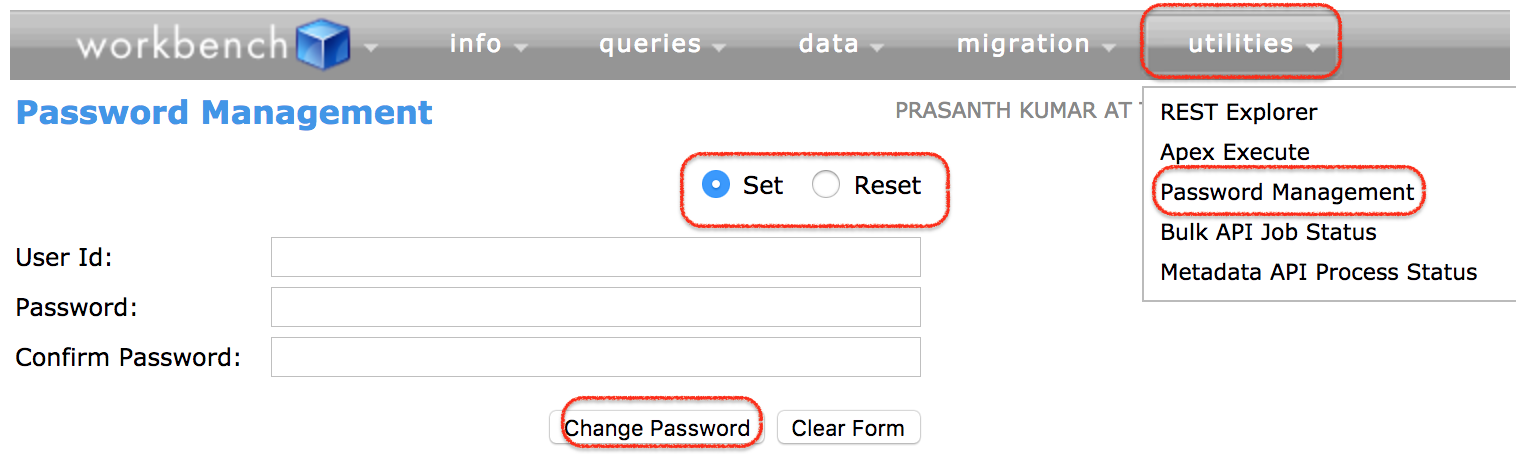
- Click on Utilities and select password management link.
- Now select Set or Rest.
- Click on Change Password button.
The option should be used only by administrators or delegated users who have the required permission. If your org uses single sign-on, identity provider rules, or a formal access management process, follow that process instead of resetting passwords directly from Workbench.
Workbench Salesforce Alternatives Recommended for Common Tasks
Workbench remains familiar to many Salesforce users, but it is not the only tool for the tasks shown in this tutorial. The better tool depends on whether you are querying data, loading records, writing Apex, deploying metadata, or testing APIs.
| Task | Workbench option | Common alternative |
|---|---|---|
| Run SOQL or SOSL | Queries menu | Developer Console, Salesforce CLI, VS Code extensions, Code Builder |
| Load records | Data menu | Data Loader, Salesforce CLI, approved ETL tools |
| Execute Apex | Utilities | Apex Execute | Developer Console, VS Code extensions, Salesforce CLI |
| Test REST API | REST Explorer | Postman or another approved API client |
| Retrieve and deploy metadata | Migration menu | Salesforce CLI, VS Code extensions, Code Builder, DevOps Center or team CI/CD |
Workbench Salesforce FAQ
Is Salesforce Workbench safe to use?
Salesforce Workbench can be safe for trained users, but it connects directly to the selected Salesforce org. If you log in to production and run update, delete, purge, deploy, or Apex operations, those actions can affect live data and metadata. Use sandbox first, verify the environment, and back up affected records before making changes.
What is Workbench for Salesforce used for?
Workbench for Salesforce is used to inspect objects, run SOQL queries, run SOSL searches, test REST API requests, perform data operations, execute Apex snippets, view session information, and retrieve or deploy metadata.
Should I use Salesforce Workbench in production?
You can use Workbench in production when you have permission and a clear reason, but it should be used with caution. Read-only tasks such as checking object metadata or running limited SOQL queries are lower risk. Data changes, purge actions, Apex execution, and metadata deployments should be tested and approved first.
Can Workbench Salesforce run SOQL and SOSL?
Yes. Workbench has query tools for SOQL and SOSL. Use SOQL when you know the object and fields to query. Use SOSL when you need to search for text across searchable fields and possibly across multiple objects.
What tools can replace Salesforce Workbench?
Depending on the task, common replacements include Salesforce CLI, Visual Studio Code extensions, Code Builder, Developer Console, Data Loader, Postman, DevOps Center, and approved integration or deployment tools used by the Salesforce team.
Editorial QA Checklist for This Workbench Salesforce Tutorial
- Verify that every production-related Workbench step clearly warns the reader to confirm the connected environment.
- Check that SOQL and SOSL examples are labeled correctly and not described as the same query language.
- Confirm that Apex Execute guidance does not encourage unreviewed code execution in a live org.
- Review data operation explanations for high-risk actions such as delete, purge, upsert, metadata deploy, and password reset.
- Ensure the tutorial mentions practical Workbench alternatives such as Salesforce CLI, VS Code extensions, Code Builder, Data Loader, and API testing tools.