 TutorialKart.com
In this SAP FICO tutorial, you will learn how to configure the Automatic Payment Program in SAP using transaction code FBZP and how the configuration is used later in a payment run to clear due open items.
The Automatic Payment Program, commonly called APP, is used in SAP FI to select due invoices, create a payment proposal, post payment documents, and generate payment media such as checks, bank transfer files, or payment advice forms. In most SAP implementations it is used for outgoing vendor payments, but it can also be configured for customer-related payment scenarios depending on the business process.
Automatic Payment Program in SAP FICO: FBZP Customizing and Payment Run Flow
Automatic Payment Program configuration connects the payment company code, country-specific payment method, company-code payment method, house bank, account ID, available amount, and bank subaccount. Once these settings are complete, the payment run is executed through the payment program to process due open items.
In SAP, Automatic Payment Program configuration normally involves the following FBZP objects.
- Set up all company codes for payment transactions.
- Set up all paying company codes for payment transactions.
- Set up payment methods per country for payment transactions.
- Set up payment methods per company code for payment transactions.
- Set up bank determination for payment transactions.
- Set up house banks and account IDs.
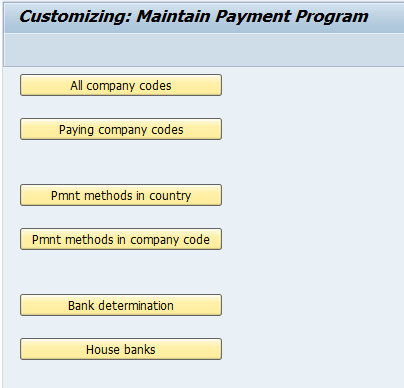
FBZP Navigation Path for Automatic Payment Program Configuration
Navigation path
| SAP R/3 Role Menu | Automatic Payment Program Run |
| Transaction code | FBZP |
| IMG menu path | SPRO > IMG > Financial Accounting (New) > Accounts receivable (A/R) & Accounts payable (A/P)> Business transactions > Outgoing payments > Automatic outgoing payments > Payment methods/bank selection > setup payment program |
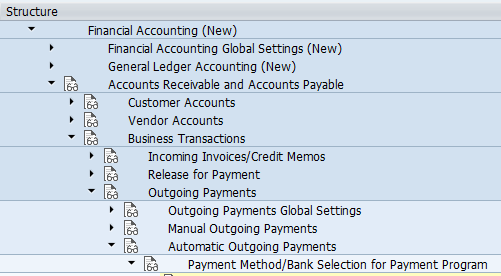
Enter SAP T-code FBZP in the command field and execute.
Prerequisites Before Configuring SAP Automatic Payment Program
Before starting FBZP configuration, confirm that the basic finance objects are already available. This avoids common errors during proposal creation and payment posting.
- The company code is created and assigned correctly.
- Vendor or customer master data contains the payment method, payment terms, bank details, reconciliation account, and required payment blocks.
- Open items are posted and due according to the baseline date and payment terms.
- House bank, account ID, bank G/L, and payment medium details are available.
- Document types, number ranges, posting keys, and bank clearing accounts are configured for payment posting.

Step 1 – Configure All Company Codes for Automatic Payments in FBZP
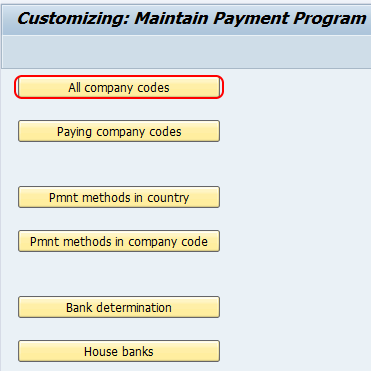
On the Customizing: Maintain Payment Program screen, click All company codes to set up company-code-level payment transaction settings.
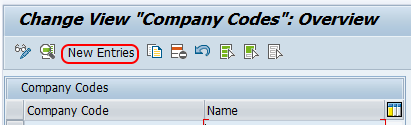
On the Change View Company Codes: Overview screen, click New Entries to set up the company code for automatic payment transactions.
On the new entries screen, update the following details.
- Company Code: Update the company code, for example TK01.
- Sending company code: Update the sending company code if it is different. This is the company code displayed to the vendor as the sender of payment information.
- Paying company code: Update the paying company code, for example TK01. This is the company code responsible for making the payment.
- Separate payment per business area: Choose this option only if payments must be separated by business area.
- Tolerance days for payables: Maintain the number of days used while determining whether an item is due for payment.
- Maximum cash discount: Select this only if the company wants the payment program to use the maximum cash discount regardless of the normal discount date.
- Special G/L transactions: Maintain special G/L indicators if down payments, advances, or other special G/L items must be considered by the payment program.
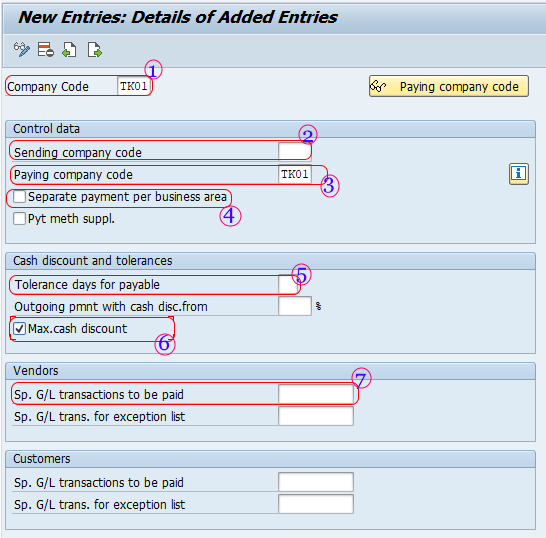
Click Save and save the configured company code payment transaction details.
Step 2 – Configure Paying Company Codes for APP Payments
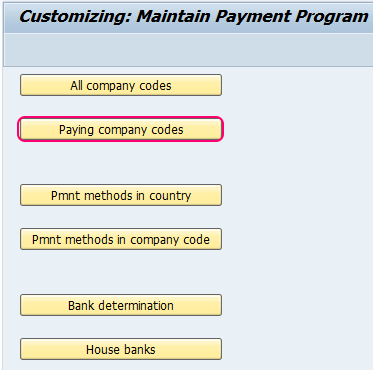
Go back to the main Automatic Payment Program configuration screen, Customizing: Maintain Payment Program, and click Paying company codes.
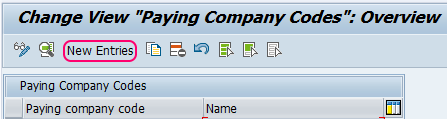
On the Change View Paying Company Codes: Overview screen, click New Entries.
On the new entries screen, update the following details.
- Paying co. code: Update the paying company code, for example TK01.
- Minimum amount for incoming payment: Enter the minimum accepted incoming payment amount, for example 1000.
- Minimum amount for outgoing payment: Enter the minimum outgoing payment amount, for example 1000.
- No exchange rate difference: Select this if exchange rate difference posting should not be considered for this payment scenario.
- Separate payment for each reference: Select this if invoices must be paid separately based on reference.
- Bill/exch paymt: Select this if the payment is made through bills of exchange.
- Form for the payment advice: Choose the payment advice form from the list by pressing F4.
- Sender details: Maintain the sender details printed on the form, such as text ID, letter header, and footer.
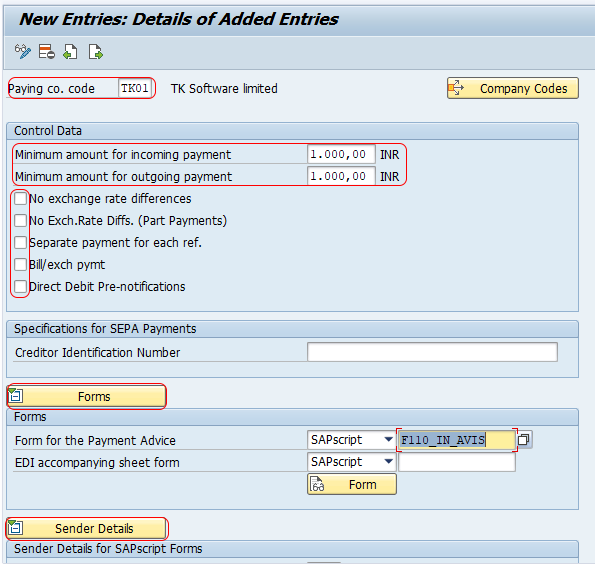
Click Save and save the configured paying company code details.
Step 3 – Configure Payment Methods in Country for SAP APP
Go back to the main Automatic Payment Program screen and click Payment methods in country. This setting defines the payment method at country level before it can be used by a company code.
On the Change View Payment Methods: Overview screen, click Position, update the country key such as IN, and press Enter. The defined payment methods for that country are displayed at the top of the screen. To define a new payment method for the country, click New Entries.
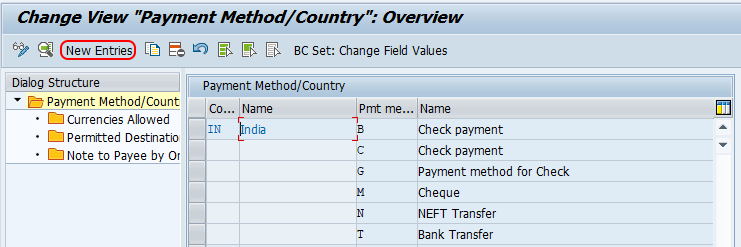
On the new entries screen, update the following details.
- Country: Update the country key for which the payment method is configured.
- Pymt method: Enter the key that identifies the payment method in SAP.
- Description: Enter a clear description of the payment method.
- Payment method: Choose whether the method is for outgoing payments, incoming payments, or both where applicable.
- Payment method classification: Choose the classification, such as bank transfer or check.
- Allowed for personal payments: Select this only if the company allows this payment method for personal payments.
- Posting details: Specify the document type for payment and clearing, as required by your accounting design.
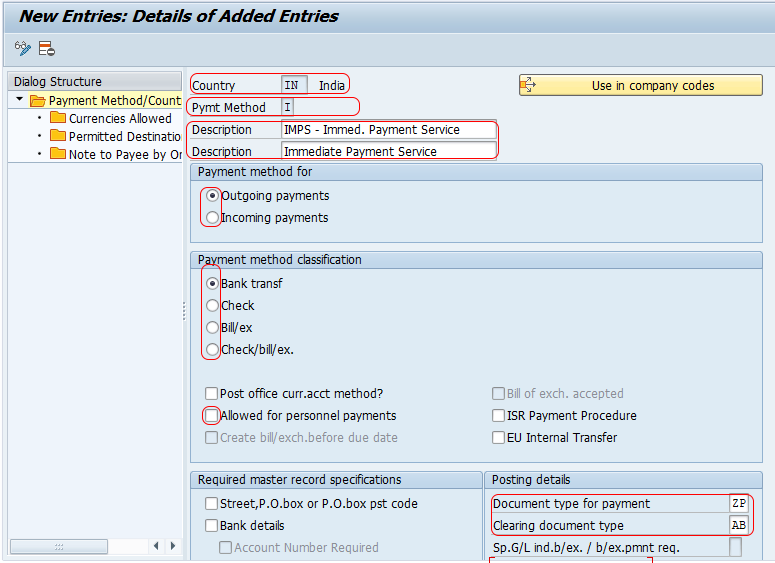
Update the details according to the project requirement and click Save to save the configured payment method in country.
Step 4 – Configure Payment Methods in Company Code for SAP APP
On the Customizing: Maintain Payment Program screen, click Payment methods in company code. This step narrows the country-level payment method to the specific paying company code and defines amount limits and foreign payment options.
On the Change View Maintenance of Company Code Data for a Payment Method: Overview screen, click New Entries to maintain the payment method for company codes.

On the new entries payment method for company code screen, update the following details.
- Paying co. code: Update the paying company code, for example TK01.
- Pymt Method: Update the payment method, for example I for IMPS in this tutorial example.
- Amount Limits: Maintain the minimum and maximum payment amount allowed for this method.
- Payment per due day: Select this option if payments should be grouped by due date.
- Foreign payment / foreign currency payment: Select the required options only if the organization allows foreign payments, foreign banks, or foreign currency payments for this company code.
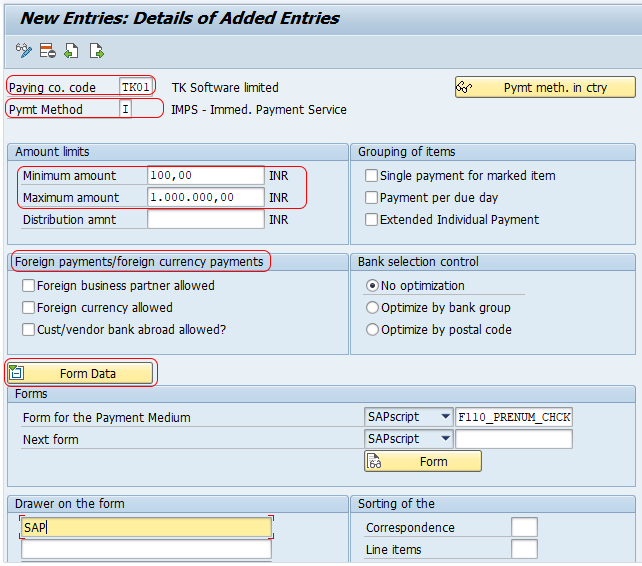
After maintaining the required details of payment methods for company code, click Save.
Step 5 – Configure Bank Determination for Automatic Payment Program
From the main Automatic Payment Program configuration screen, click Bank determination. Bank determination tells the payment program which bank account should be used for a payment method, currency, amount, and company code combination.
Bank determination involves the following configuration areas.
- Ranking Order
- Bank Accounts
- Available Amounts
- Value Date
- Expenses/Charges
Ranking Order in SAP Bank Determination
On the Display View Bank Selection screen, choose Position and update your company code. The paying company code is displayed at the top of the screen.
Now choose paying company code TK01 and double click Ranking Order.
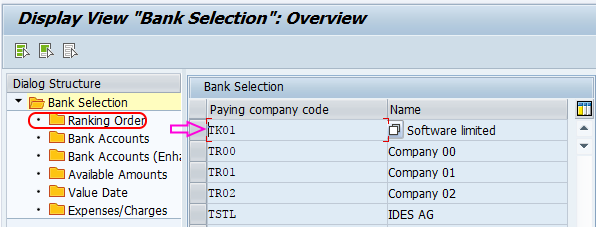
On the Change View Ranking Order: Overview screen, click New Entries.
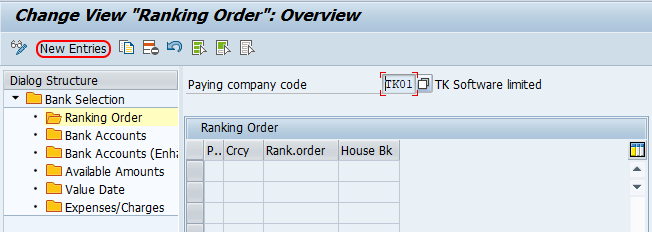
On the new entries rank order screen, update the following details.
- PM: Update the payment method, for example I.
- Currency: Update the currency, for example INR.
- Rank Order: Update the priority order for bank selection, for example 1.
- House bank: Update the house bank key, for example AXISB.
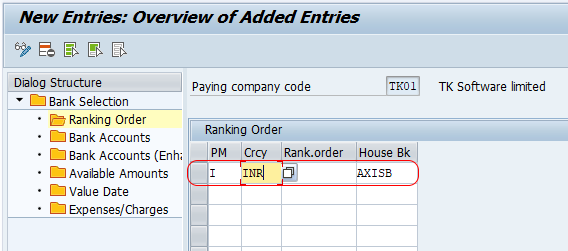
Click Save and save the bank ranking order details.
Bank Accounts in SAP Automatic Payment Program
Double click Bank Accounts and click New Entries.
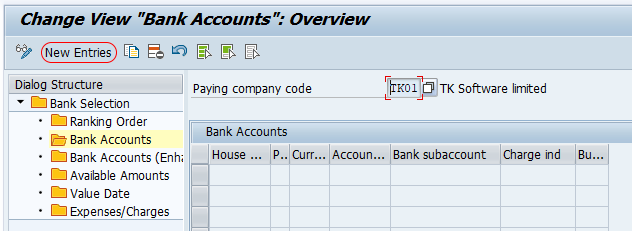
On the new entries bank accounts screen, update the following details.
- House bank: Enter the house bank key, for example AXISB.
- Pay.Method: Update the payment method, for example I.
- Currency: Update the currency key, for example INR.
- Account ID: Update the account ID, for example AXIS.
- Bank subaccount: Update the bank clearing G/L account, for example 200108 for Axis Bank current account in this tutorial example.
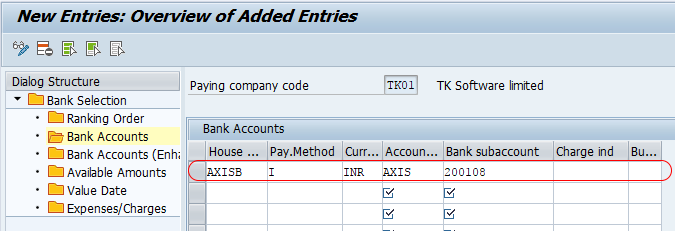
After maintaining the required details, click Save to save the configured bank accounts in SAP.
Available Amounts for House Bank Selection in APP
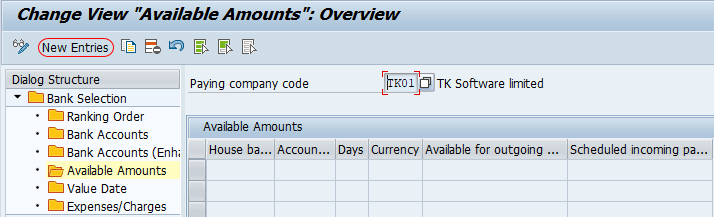
Double click Available Amounts and click New Entries to maintain amount availability for the house bank account.
On the new entries available amounts screen, update the following details.
- House bank: Update the house bank, for example AXISB.
- Account ID: Update the account ID, for example AXIS.
- Days: Maintain this field only if the available amount must be evaluated for a specific number of days.
- Available for outgoing payment: Enter the available amount for outgoing payments. This helps the payment program evaluate bank selection, but the business should still reconcile actual bank balance separately.
- Scheduled incoming payments: Maintain this only when expected incoming payments should be considered in the availability evaluation.
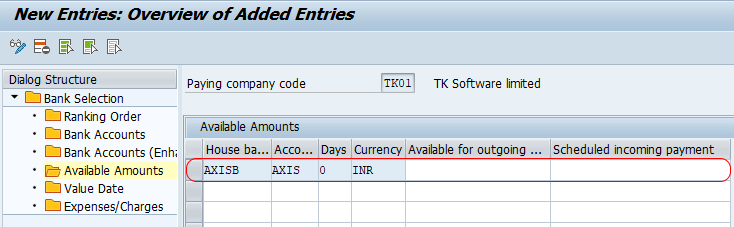
Click Save and save the configured details.
Value Date and Bank Charges in Automatic Payment Program
The Value Date setting is used when the bank needs a calculated value date for a payment method, currency, and house bank combination. The Expenses/Charges setting is used when bank charges must be considered for payment processing. These settings depend on the bank agreement and country-specific payment process, so maintain them only when the project requires them.
Step 6 – Create or Assign House Banks for SAP APP
House banks store the company code bank details used for incoming and outgoing payments. In SAP, create house banks as per project requirements and assign the relevant account IDs. Click New Entries and create house banks as per client requirements. Refer to how to create house banks in SAP.
How FBZP Configuration Is Used in the SAP Payment Run
After FBZP customizing is complete, the payment program can process open items through a payment run. The payment run checks due dates, payment method, payment block, vendor or customer master data, bank determination, and available amount before creating payment documents.
- Enter the payment run date and identification.
- Maintain parameters such as company code, payment method, next payment date, vendor or customer range, and posting date.
- Run the proposal so SAP can select due open items.
- Review the proposal log and exception list. Correct blocked items, missing payment methods, bank details, or amount limit issues.
- Schedule the payment run after the proposal is correct.
- Generate the payment medium or print checks/payment advice based on the configured payment method.
The proposal step is important because it shows why an invoice was selected or excluded. Do not run the final payment until the proposal has been reviewed, especially in a new configuration or testing client.
FBZP, F110, and F-53 Difference in SAP Payments
| Transaction | Purpose in SAP payments | Typical use |
|---|---|---|
| FBZP | Customizes the Automatic Payment Program settings. | Used by consultants to configure company codes, payment methods, and bank determination. |
| F110 | Runs the automatic payment program. | Used to create proposal, post payment documents, and generate payment media. |
| F-53 | Posts manual outgoing payment. | Used when a single vendor payment is posted manually instead of through APP. |
Automatic Payment Program Configuration Checklist Before F110 Testing
- Confirm that the paying company code in FBZP matches the company code used in the payment run.
- Check that the payment method exists both at country level and company-code level.
- Check amount limits so the invoice amount is not outside the allowed minimum or maximum payment amount.
- Confirm that the vendor master has a valid payment method and bank details where required.
- Confirm that the invoice is due and not blocked for payment.
- Check bank determination ranking order, house bank, account ID, and bank subaccount.
- Review available amounts when the proposal excludes items because of insufficient amount settings.
- Check the payment advice form or payment medium format before testing output.
Common SAP APP Configuration Errors and Checks
If the payment proposal does not pick up expected open items, review these common causes before changing the configuration.
- Payment method missing: Maintain the payment method in the vendor master, invoice, or proposal parameters as required.
- Invoice not due: Check baseline date, payment terms, discount terms, and next payment date.
- Payment block active: Remove the payment block only after business approval.
- No bank selected: Check ranking order, bank accounts, house bank, account ID, and available amounts.
- Amount not allowed: Compare the invoice amount with the minimum and maximum amount limits in payment method per company code.
- Payment medium issue: Check form, payment medium format, and bank file settings used by the payment method.
What You Define in Customizing for the SAP Payment Program
In payment program customizing, you define the rules that allow SAP to decide what can be paid, from which company code, through which payment method, and from which bank account. The core objects are company code settings, paying company code settings, payment methods in country, payment methods in company code, bank determination, house bank, and payment medium settings.
We have now configured the main Automatic Payment Program settings in SAP. To run the automatic payment program successfully, open items must exist in the vendor account or customer account, the items must be due, and the payment run must pass the payment method and bank determination checks.
Automatic Payment Program in SAP FAQs
How do you configure Automatic Payment Program in SAP?
Configure Automatic Payment Program in SAP through FBZP. Maintain all company codes, paying company codes, payment methods in country, payment methods in company code, bank determination, and house banks. After that, test the payment run with due open items.
What objects do you configure when customizing automatic payments?
The main objects are company code settings, paying company code settings, country-level payment methods, company-code payment methods, ranking order, bank accounts, available amounts, value date, charges, house banks, and account IDs.
What is the use of FBZP in SAP FICO?
FBZP is used to customize the Automatic Payment Program. It does not itself post vendor payments; it stores the rules that the payment run uses for selecting items, choosing payment methods, and determining house banks.
What is the difference between F110 and F-53 in SAP?
F110 is used for automatic payment runs where SAP selects due items and processes payments in batches. F-53 is used to post a manual outgoing payment for a vendor.
Why is a vendor invoice not selected in the SAP payment proposal?
A vendor invoice may be skipped because it is not due, has a payment block, has no valid payment method, exceeds amount limits, has missing bank details, or fails bank determination. Check the proposal log for the exact reason.